Note added to posted article: Reference citations have not been provided and figures
related only to the original experimental purpose have not been included. Only sections 1
and 2 which introduce the subject and develop the theory have been reproduced. For
experimental information and references, see the original article:
Reprinted from Journal of Applied Physics, Vol. 36, No. 12; 3770-4778,
December 1965
Copyright 1963 by the American Institute of Physics
Printed In U .S. A.
General Relationship for the Thermal Oxidation of Silicon
B. E. Deal and A. S. Grove
Fairchild Semiconductor, A Division of Fairchild Camera and Instrument
Corporation,
Palo Alto, California
(Received 10 May 1965; in final form 9 September 1965)
The thermal-oxidation kinetics of silicon are examined in detail. Based on a simple model
of oxidation which takes into account the reactions occurring at the two boundaries of the
oxide layer as well as the diffusion process, the general relationship xo2+Ax0=B(t+
t ) is derived. This relationship is
shown to be in excellent agreement with oxidation data obtained over a wide range of
temperature (700° --1300° C), partial pressure (0.1-1.0 atm) and
oxide thickness (300-20,000A )
for both oxygen and water oxidants. The parameters A, B, and t are shown to be related to the physico-chemical constants
of the oxidation reaction in the predicted manner. Such detailed analysis also leads to
further information regarding the nature of the transported species as well as
space-charge effects on the initial phase of oxidation.
1. INTRODUCTION
Owing to its great importance in planar silicon-device technology, the
formation of silicon dioxide layers by thermal oxidation of single-crystal silicon has
been studied very extensively in the past several years1-15 Now, with the
availability of large amounts of experimental data, it appears that there is much
contradiction and many peculiarities in the store of knowledge of silicon oxidation. For
instance, reported activation energies of rate constants vary between 27 and 100 kcal/mole for oxidation in dry oxygen; pressure dependence of rate constants has
been reported as linear as well as logarithmic. While most of the data on silicon
oxidation have been evaluated using the parabolic rate law, certain authors have taken
recourse to using empirical power-law dependence,14 xon
= kt, where both n and k were complex functions of temperature,
pressure, and oxide thickness.
The problems associated with the latter approach
can be illustrated by considering Figs 1 and 2 (not provided in this copy).
These figures contain a summary of data obtained in these laboratories which are in good
general agreement with the corresponding data of Fuller and Stricter1’ and
of Evitts, Cooper, and Flaschen.13 (The experimental methods are dealt with in
detail later.) The plots are logarithm of oxide thickness vs the logarithm of oxidation
time for dry and wet oxygen (950C H2O) at various temperatures. The
slope of the lines corresponds to the exponent it in the above power law. These values are
indicated at the limiting position of some of the curves. In the case of wet oxygen (Fig.
1), n ranges from 2 for thicker oxides at l2000C to 1 for the thinner
oxide region of the 9200C data. However, for dry oxygen (Fig. 2), the value of
n at 12000 approaches 2 as the oxide thickness increases above 1.0 um but at lower temperatures and oxide thicknesses the value of n decreases
only to about 1.5 and then appears to increase again. Obviously the data cannot be
represented by a simple power law.
Most of the previous theoretical treatments of the kinetics of the
oxidation of metals emphasize only two limiting types of oxidation mechanisms.16
In one, the oxide thickness is small in comparison to the extent of possible space-charge
regions within the oxide, and the oxidation kinetics is strongly influenced by the space
charge or by a voltage drop across the oxide film due to contact potential differences. In
the other, the rate of diffusion of either the oxidizing species or the metal across the
oxide film determines the oxidation kinetics. This latter condition leads to a parabolic
relationship, xoµ t1/2. These two
approaches have been emphasized to such an extent that deviations from parabolic oxidation
have been attributed incorrectly to space-charge effects.
In this paper the oxidation kinetics are examined in greater detail. It
is shown that when the reactions occurring at the two boundaries of the oxide layer are
taken into account, a general relationship can be obtained with parameters which are
explicitly related to the physico-chemical constants of the oxidation system. This general
relationship is shown to be in excellent agreement with data obtained by various groups of
investigators over a wide range of conditions. It is shown that the parameters of this
relationship follow the predictions of the model. In addition, further information is
obtained regarding the mechanism of oxidation: the nature of the transported species, and
the role of space-charge effects.
2. GENERAL OXIDATION EQUATION
Consider silicon covered by an oxide layer of thickness xo,
as indicated in Fig. 3. In accordance with the experimental evidence for silicon, it is
assumed that oxidation proceeds by the inward movement of a species of oxidant rather than
by the outward movement of silicon.2,3,8,17 The transported species must go
through the following stages:
(1) It is transported from the bulk of the oxidizing gas to the outer
surface where it reacts or is adsorbed.
(2) It is transported across the oxide film towards the silicon.
(3) It reacts at the silicon surface to form a new layer of SiO2.
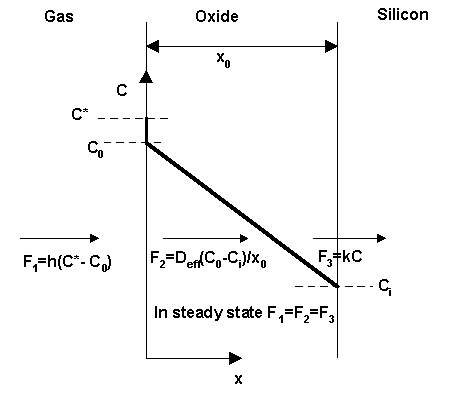 Fig. 3. Model for the oxidation of silicon.
It is assumed in this paper that the oxidation process is beyond an
initial transient period with the consequence that the fluxes of oxidant in each of the
above three steps are, at all times, identical. (The flux of oxidant is the number of
oxidant molecules crossing a unit surface area in a unit time.) The validity of this
steady-state assumption is shown in the Appendix. The steady-state fluxes are approximated
as follows.
The flux of the oxidant from the gas to the vicinity of the outer
surface is taken to be
F1=h(C* - Co)
where h is a gas-phase transport coefficient, Co is the
concentration of the oxidant at the outer surface of the oxide at any given time, and C*
is the equilibrium concentration of the oxidant in the oxide. (This linearized
approximation to the transport rate is analogous to Newton’s law of cooling.) Note
that when C0 = C*, F1 = 0. The equilibrium
concentration of the oxidant is assumed to be related to the partial pressure of the
oxidant in the gas by Henry’s law,
C*= Kp.
Henry’s law only holds in the absence of dissociation or
association of the oxidant at the outer surface. Thus, the oxidant is assumed to be
molecular O2, and H2O in the cases of dry- and wet-oxygen oxidation,
respectively. The experimental evidence will be seen to justify this assumption.
The flux of the oxidant across the oxide layer is assumed to be given by Fick’s
law,
F2 = —Deff (dC/dx), (3)
at any point x within the oxide layer, where Deff is the
effective diffusion coefficient and dC/dx is the concentration gradient of the
oxidizing species in the oxide.
It follows from the assumption of steady-state oxidation that F2,
must be the same at any point x within the oxide film, or that dF2/dX
= 0. Consequently, the concentration of the oxidant within the oxide layer is linear as
indicated in Fig. 3, and the flux F2 is given by
where Ci is the concentration of the oxidant near the oxide-silicon interface.
If the transported species are ionic, they set up a space charge within
the oxide film. The effective diffusion coefficient Deff incorporates the
effect of such space charges in enhancing the rate of transport. It was shown by Cabrera
and Mott,16 as well as by Bardeen, Brattain, and Shockley,18 that if
the oxide thickness is large enough in comparison to the thickness of the space-charge
regions, Deff is approximately twice the actual diffusion coefficient. The
extent of the space-charge region in SiO2 films is shown later to be of the
order of 200 A, or less, so that this condition is met in most practical cases.
Finally, the flux corresponding to the oxidation reaction is expressed
by the first-order relation
Noting that F1=F2, and F2=F3
due to the steady-state condition, and solving for Ci and Co between
these two equations, one obtains
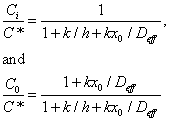 (6) and (7)
Note that in the limit where the diffusivity becomes very small
relative to the rate constants associated with surfaces, k and h (i.e., Deff/kxo
—> 0), Ci —> 0 and Co —> C*.
This condition is commonly referred to as "diffusion controlled."
With Ci and Co eliminated, the flux is given by
 (8)
If N1 is the number of oxidant molecules incorporated
into a unit volume of the oxide layer, the rate of growth of the oxide layer is described
by the differential equation
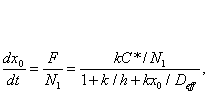 (9)
To arrive at a general initial condition to this equation, the total
oxide thickness x0 is taken to consist of two parts: an initial layer of
oxide xi that might have been present on the silicon prior to the
oxidation step under consideration, and the additional thickness grown during the step
under consideration. Thus the initial condition for this step is:
xo= xi at t=0, (10)
where C4 is the concentration of the oxidant near the
oxide—silicon interface.
Such division of the oxide layer is not only important because it
permits consideration of multiple oxidations, but also because xi can be regarded as the
thickness of the layer grown before the approximations of the above treatment become
valid. Thus, an initial oxide layer may be formed by mechanisms involving fields and space
charges within the oxide layer.16
The solution of the differential equation, Eq. (9), subject to the
initial condition, Eq. (10), obtained by a straightforward integration, is
 (11)
which can be rewritten in the form
 (12a)
where
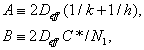 (12b)
and
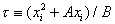 (12c)
The quantity tau corresponds to a shift in the time coordinate which corrects for the
presence of the initial oxide layer xi. The form of this mixed parabolic
relationship was first proposed by Evans.19,20
Solving the quadratic equation (12) yields the form
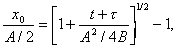 (13)
which gives the oxide thickness as a function of time.
It is interesting to examine two limiting forms of Eq. (13). At
relatively large times, i.e., t³ >A2/4B,
and also t>>t ,
or
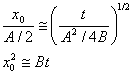 (13)
Thus, the general relation, Eq. (13), reduces to the well-known parabolic oxidation law
for relatively long times. The coefficient B, as given by Eq. (12b), is identical
with that derived by Cabrera and Mott.16 It is referred to as the parabolic
rate constant.
At the other extreme, for relatively small oxidation times, i.e.,  ,
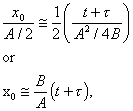 (15)
Thus, the general relationship reduces to a linear law. The coefficient
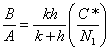
is referred to as the linear rate constant. The general
relationship and its two limiting forms are shown in Fig. 12, together with experimental
points which are discussed later. It should be noted at this point, however, that for most
of the range the parabolic limit does not provide a good approximation. For this reason,
simply dividing x02 by t does not necessarily yield
the true parabolic rate constant B, but rather it gives some quantity which may or
may not approximate B depending on the oxidation conditions and the time. Thus, it
appears that many of the contradictions referred to in the Introduction may well have been
due to forcing the parabolic law in regions where it could not provide a meaningful fit.