
Transitivity of correlations – a bane of the Life Sciences
This is a favorite fallacy because it’s very easy to fall for, and I have seen it do real damage. Psychology and the Life Sciences are to a large extent empirical disciplines; a lot of studies are still devoted to establishing positive facts from which models for better mechanistic understanding can be formulated. Correlation of two variables is often a first step in this chain of knowledge gain. The ”transitivity of correlation” fallacy now proceeds as follows: “variable A correlates with variable B, variable B correlates C; thus, variable A obviously correlates with C too.” This sounds plausible at first glance, but is utterly wrong. You can hear this fallacy reverberating in a lot of reasoning in seminars and paper reviews. I have a friend and colleague who received harsh criticism in a grant review where the reviewer committed this fallacy. He dismissed her grant proposal in which she proposed to study whether A affects C via the mediating mechanism of B. In the reviewer’s mind, this was completely unnecessary since independent research had already established without a shadow of a doubt that A correlates with B, and B correlates with C – case closed.
The mathematical demonstration of this fallacy is very simple. Imagine you generate two random samples, A and C, which are sampled from a normal distribution. The distribution does not really matter, just the fact that they are independently sampled. The expectation value for the correlation between A and C is zero. Now just form B according to B=A+C. A and B will now have some residual correlation, B and C too, but A and C are uncorrelated by design.
An appreciation of this fallacy will also make your eye for the use of biomarkers a lot sharper. If no mechanistic certainty pre-exists and any reasoning is based on empirical correlations alone, you should be skeptical when drugs are advocated merely because they lower a biomarker for a particular disease. That’s not good enough, and is akin to reasoning that because A(=drug) correlates with B (= biomarker) which in turn correlates with C (=disease), thus A correlates with C. You can look at a numerical example of this fallacy below. I literally constructed this according to the recipe above. A and C both are sampled independently from a normal distribution and B=C-A. A is the drug, B the biomarker and C the disease risk. Higher values for B signal increased disease risk, while drug A lowers levels of the biomarker B. The figure below shows that A and C are unrelated and their x-y scatter plot looks like birdshot, contrary to the –superficially reasonable- assumption that A would lower disease risk.
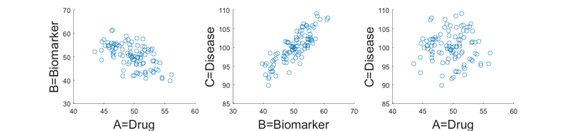
Keep in mind that I constructed this fallacy explicitly from mock data and forced A and C to be uncorrelated. This is meant to caution against reasoning purely on the grounds of empirical correlation. There might be scenarios where there is additional understanding how the biomarker B is causally implicated in the disease process, and that reducing it might indeed correspondingly lower the disease risk. Even in that case, the correlation between A and C should clearly be negative. Correlation does not imply causation, but causation necessarily implies correlation – otherwise no cigar!