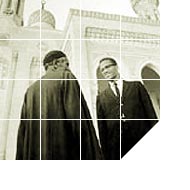
When Malcolm was assassinated at the Audubon Ballroom in
Manhattan, at the age of thirty-nine on February 21, 1965,
he had been a prominent public figure for less than a decade.
He had formerly been the national spokesperson of the Nation
of Islam, a conservative Muslim sect that had little impact
on mainstream American life. His new protest group based
in Harlem, the Organization of Afro-American Unity, existed
barely a year and had only several hundred members and supporters
at the time of his death. For these reasons, many prominent
black leaders felt that Malcolm X’s influence would
quickly and quietly disappear. Only days after the assassination,
Bayard Rustin, the architect of the 1963 March on Washington,
D.C., wrote: "Now that he is dead, we must resist the
temptation to idealize Malcolm X, to elevate charisma to
greatness. Malcolm X is not a hero of the movement, he is
a tragic victim of the ghetto…. White America, not the
Negro people, will determine Malcolm’s role in history." Political
journalist Henry Lee Moon, editor of the NAACP’s publication The
Crisis, declared in April 1965, that "Malcolm was
an anachronism… vivid and articulate but, nevertheless,
divorced from the mainstream of Negro American thought."
A generation after his assassination, Malcolm X’s image and historical
reputation have been profoundly transformed. Most historians of the black experience
now rank Malcolm X among the half dozen most influential personalities in African-American
history, an elite group that includes Frederick Douglass, Booker T. Washington,
Dr. W.E.B. DuBois, Marcus Garvey, and Dr. Martin Luther King, Jr. But unlike
these other historical personalities, Malcolm X alone has become a genuine
cultural icon to millions of young African Americans since the early 1990s.
In a 1992 opinion poll conducted by the Gallup Organization and published in Newsweek,
57 percent of all African Americans polled agreed with the statement that Malcolm
X should be considered "a hero for black Americans today." Another
82 percent responded that Malcolm X symbolized a "strong black male." Dozens
of prominent performance artists within contemporary urban, "hip hop culture",
began to draw upon the words and image of Malcolm X in their work. Spike Lee’s
powerful film depicting the life of Malcolm X brought this charismatic historical
figure to an international audience. By the late 1990s, almost three million
copies of The Autobiography of Malcolm X had been sold worldwide. In
1999, Time magazine selected The Autobiography as one of the
top ten nonfiction works of the twentieth century, placing it with classics
such as The Diary of Anne Frank.
One can "construct" a wide variety of "Malcolm’s":
the frightened young Negro boy named Malcolm Little who was
separated from his family and placed in foster homes in Michigan;
the streetwise, zoot-suited hustler nicknamed "Detroit
Red"; the angry incarcerated convict called "Satan" by
fellow prisoners and prisons guards alike; the conservative,
racial separatist Malcolm X, national spokesperson for the
Nation of Islam; the Sunni Muslim named El Hajj Malik El-Shabazz;
the revolutionary internationalist Malcolm X, speaking before
the Organization of African Unity in 1964; and the loving
husband and father figure. There is also the "life after
death" of Malcolm X: the Malcolm of the Black Power
movement and the Black Panther Party; the Malcolm represented
by black playwrights, poets and novelists; Spike Lee’s
Malcolm-as-Denzel Washington; and the hip hop culture’s
expropriation of Malcolm. Part of the present difficulty
in refocusing the actual political legacy and relevancy of
Malcolm X to contemporary struggles is the confusion generated
by much of the literature written about him since 1965.
Under the direction of Dr. Manning Marable and with the guidance of members
of the Shabazz family, the Institute has launched the Malcolm X Project which
principally includes the development of a multimedia version of The Autobiography
of Malcolm X, providing interactive electronic visual presentations of
Malcolm X’s writings, historical documents and speeches, media & film
clippings of Malcolm X, and interviews with historians of the period; a Malcolm
X – Dr. Betty Shabazz Oral History Project, which would record interviews
with their surviving siblings and close relatives, prominent civil rights,
labor, business and community leaders from Harlem and throughout black America;
the Malcolm X Papers Project that would compile and organize the full range
of Malcolm X’s correspondence, speeches, interviews, unpublished writings,
and related materials, which would be published in several edited volumes,
and a comprehensive biography of the subject; and an annual symposium at Columbia
University on the thought and legacy of Malcolm X, bringing international scholars,
writers and artists to celebrate and examine his life and contemporary legacy.
|