SITE CONDITIONS
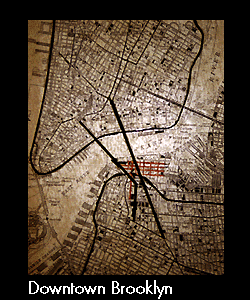
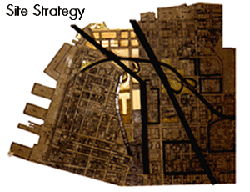
The site I have choosen to investigate incorporates many of these barriers and is located between Tillary St. and the water's edge. It is bounded by Adams St. and Cadman Plaza West focussing on the movement along Washington St. towards the water. Crossing this site are the Brooklyn Bridge and the Brooklyn Queens expressway. There is a steep elevation change, from 80 to 20 feet above sea level, as one moves north towards the water. The many 12 story industrial buildings between Front and Plymouth Sts. are now mostly vacant or used as office space. Some of the loft spaces are being rented by artists. At the end of the site is a hidden park offering a view of downtown Manhattan from an angle quite unlike the more conventional one from the Brooklyn Heights' Promenade. It is also here that the pier of the Brooklyn Bridge stands hidden from sight.
PROGRAM
~To establish a relationship between highways, bridges and street that involves human interaction.
~To link the area to the rest of downtown Brooklyn by activating Washington St. through the addition of trees, steet lamps, seating and commercial activity.
~To provide parking, seating, and walking zones and encourage commercial activity under the bridge.
~To overcome visual barriers by taking advantage of the topography.
~To reveal the Brooklyn Bridge and its pier so it can be seen and experienced at many levels.
~To encourage middle income housing, work and exhibit space for artists in the existing industrial buildings.
~To incorporate different modes of transportation that could bring people to the area: the Fulton Ferry, the BQE exits onto Front St., the stairs from the pedestrian walkway on the Brooklyn Bridge and the High St. subway entrance.
~To revitalize the area between the bridges providing places for people in downtown Brooklyn to discover and use at the scale of Brooklyn.
PROBES
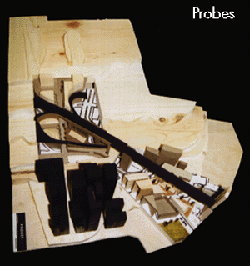
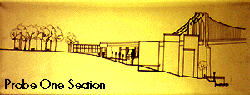
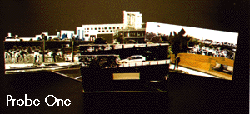
1. An existing street: along Washington St. between the Brooklyn Bridge and the highway where topography and infrastructure create physical and visual barriers.
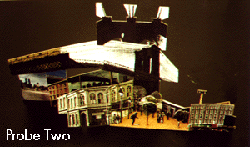
2. A new street: under the Brooklyn Bridge between Front Street and the water. Visual and physical barriers are caused by buildings resulting in little activity and movement towards water.