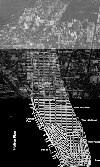
The Urban Waterfront
MANHATTAN WEST SIDE (42ND STREET TO BATTERY PARK), MANHATTAN, NY
The far west side of Manhattan is characterized by many building types, activities and uses. Some have international and national while others operate at the scale of the city region. Recently, the New York Governor pledged funds to reactivate a long dormant design project to improve and add recreational uses to West Street, the high speed roadway along the river The West Side study area provides an excellent way to explore urban issues related to design of the urban waterfront. The challenge is to assess the various kinds of development envisioned the contemporary waterfronts (among these, recreational, touristic, infrastructual and residential) and to project futures for the city's edge.
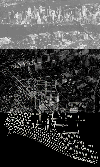
The Satellite Center
DOWNTOWN BROOKLYN, BROOKLYN, NY(42ND STREET TO BATTERY PARK), MANHATTAN, NY
Downtown Brooklyn, once an independent city, is strategically located
across the East River from downtown Manhattan. With many cultural and
educational facilities and a rich array of open spaces, the area still
lacks cohesiveness. Despite its assets, Brooklyn
The Brooklyn study area is an example of the new downtown or satellite
center. Situated between the urban core and the outer reaches of suburbia,
it
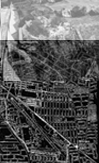
The Low - Density City:
INDUSTRIAL PARK, BETHPAGE, LONG ISLAND
A 600 acre lot in Bethpage, until recently
the site of Long Island's once largest
employer, Grumman Corporation. Among
its existing structures are huge sheds for
producing jet engines and planes, a
functioning power plant, and a 2 kilometer
landing strip. A major regional commuter
rail line to New York City runs adjacent to,
and at one point bisects, the lot. The
study area is surrounded by typical small
scale suburban residential and
commercial development. Also in the
vicinity is Levittown, originally built in
1947 as the first post-war, large-scale
federally subsidized moderate income
residential development.
This study raises crucial issues related to
late 20th century, outer periphery,
dispersed development patterns.
Because it provides opportunities to
investigate the future of the "low - density
city" the design challenge of this site is to
find and build upon the urban potentials of
apparently non-urban situations.