

Souvenir book of the fair in aid of the Educational Alliance and Hebrew Technical Institute.
(New York : De Leeuw & Oppenheimer, 1895.)
|
||

 Click here and hold to drag menu around
|





|
|
|
|

|
Page 33 | 
|
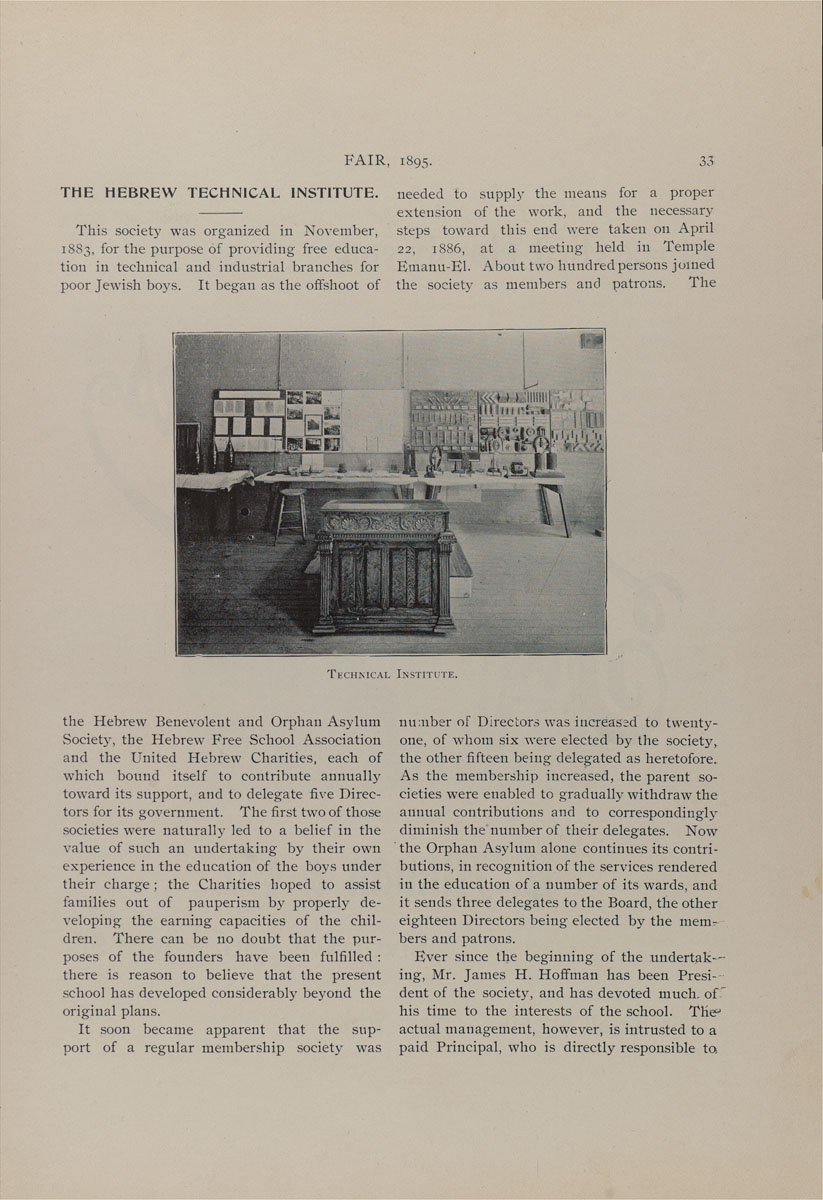
FAIR, 1895. 33 THE HEBREW TECHNICAL INSTITUTE. This society was organized in November, 1883, for the purpose of providing free educa¬ tion in technical and industrial branches for needed to suppl)^ the means for a proper extension of the work, and the necessary steps toward this end were taken on April 22, 1886, at a meeting held in Temple Emanu-Kl. About two hundred persons joined poor Jewish boys. It began as the offshoot of the society as members and patrons. The Technical Institute. the Hebrew Benevolent and Orphan Asylum Society, the Hebrew Free School Association and the United Hebrew Charities, each of which bound itself to contribute annually toward its support, and to delegate five Direc¬ tors for its government. The first two of those societies were naturally led to a belief in the value of such an undertaking by their own experience in the education of the boys under their charge; the Charities hoped to assist families out of pauperism by properly de¬ veloping the earning capacities of the chil¬ dren. There can be no doubt that the pur¬ poses of the founders have been fulfilled : there is reason to believe that the present school has developed considerably be3^ond the original plans. It soon became apparent that the sup¬ port of a regular membership society was number of Dh-ectors was increased to twenty- one, of whom six were elected by the society, the other fifteen being delegated as heretofore. As the membership increased, the parent so¬ cieties were enabled to gradually withdraw the annual contributions and to correspondingly diminish the number of their delegates. Now the Orphan Asylum alone continues its contri¬ butions, in recognition of the services rendered in the education of a number of its wards, and it sends three delegates to the Board, the other eighteen Directors being elected by the mem¬ bers and patrons. Ever since the beginning of the undertak-- ing, Mr. James H. Hoffman has been Presi¬ dent of the society, and has devoted much, of:" his time to the interests of the school. TKeP actual management, however, is intrusted to a paid Principal, who is directly responsible ta n ^ n 1 |
|
|
Page 33 |
|