

Souvenir book of the fair in aid of the Educational Alliance and Hebrew Technical Institute.
(New York : De Leeuw & Oppenheimer, 1895.)
|
||

 Click here and hold to drag menu around
|





|
|
|
|

|
Page 50 | 
|
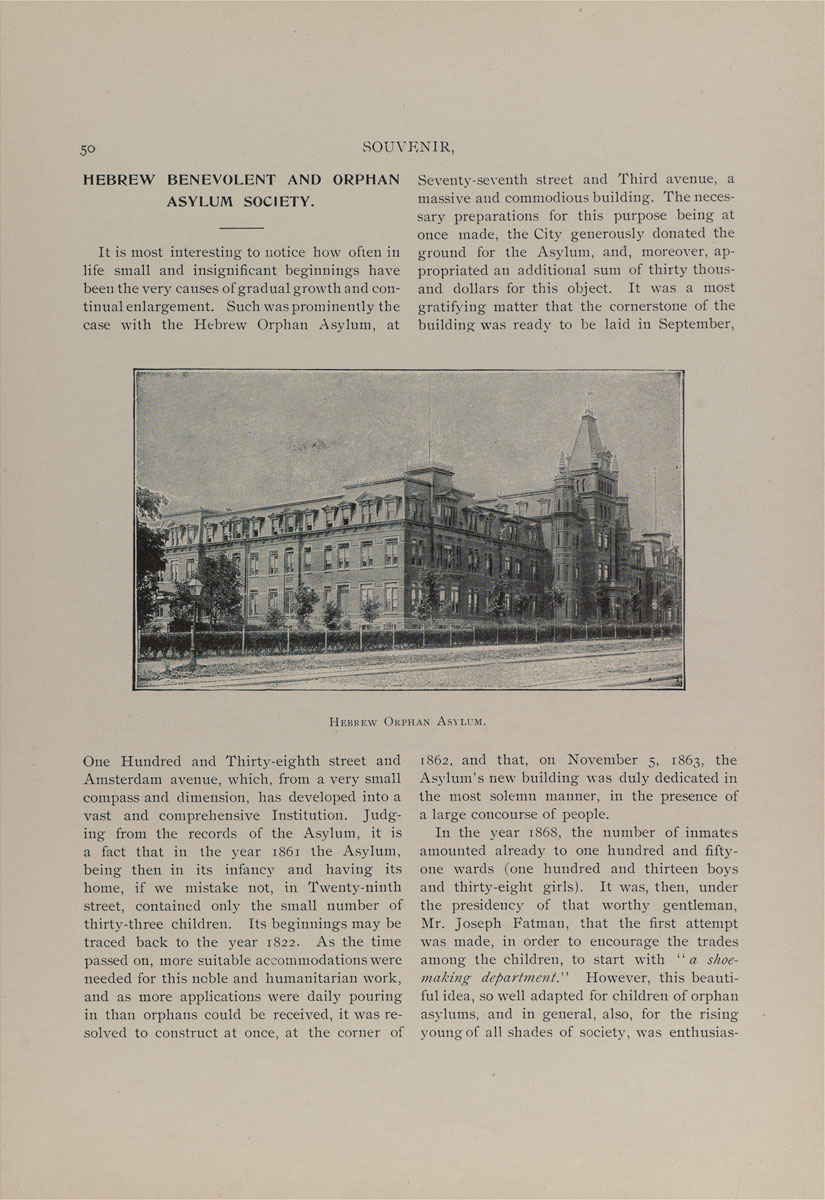
50 SOUVENIR, HEBREW BENEVOLENT AND ORPHAN ASYLUM SOCIETY. It is most interesting to notice how often in life small and insignificant beginnings have been the very causes of gradual growth and con¬ tinual enlargement. Such was prominently the case with the Hebrew Orphan xAsylum, at Seventy-seventh street and Third avenue, a massive and commodious building. The neces¬ sary preparations for this purpose being at once made, the City generously donated the ground for the Asylum, and, moreover, ap¬ propriated an additional sum of thirty thous¬ and dollars for this object. It was a most gratifying matter that the cornerstone of the building was ready to be laid in September, n Hebrew Orphan Asylum. One Hundred and Thirty-eighth street and Amsterdam avenue, w^hich, from a very small compass and dimension, has developed into a vast and comprehensive Institution. Judg¬ ing from the records of the Asylum, it is a fact that in the year 1861 the Asylum, being then in its infancy and having its home, if we mistake not, in Twenty-ninth street, contained only the small number of thirty-three children. Its beginnings may be traced back to the year 1822. As the time passed on, more suitable accommodations were needed for this noble and humanitarian work, and as more applications were daily pouring in than orphans could be received, it was re¬ solved to construct at once, at the corner of 1862, and that, on November 5, 1863, the Asylum's new building was duly dedicated in the most solemn manner, in the presence of a large concourse of people. In the year 1868, the number of inmates amounted already to one hundred and fifty- one wards (one hundred and thirteen boys and thirty-eight girls). It was, then, under the presidency of that worthy gentleman, Mr. Joseph Fatman, that the first attempt was made, in order to encourage the trades among the children, to start with "« skoe- maki'ng- department.'''' However, this beauti¬ ful idea, so well adapted for children of orphan asylums, and in general, also, for the rising young of all shades of society, was enthusias- a |
|
|
Page 50 |
|