

Wright, Thomas, On the influence of mediaeval upon Welsh literature
(London : T. Richards, 1863.)
|
||

 Click here and hold to drag menu around
|





|
|
|
|

|
Page 32 | 
|
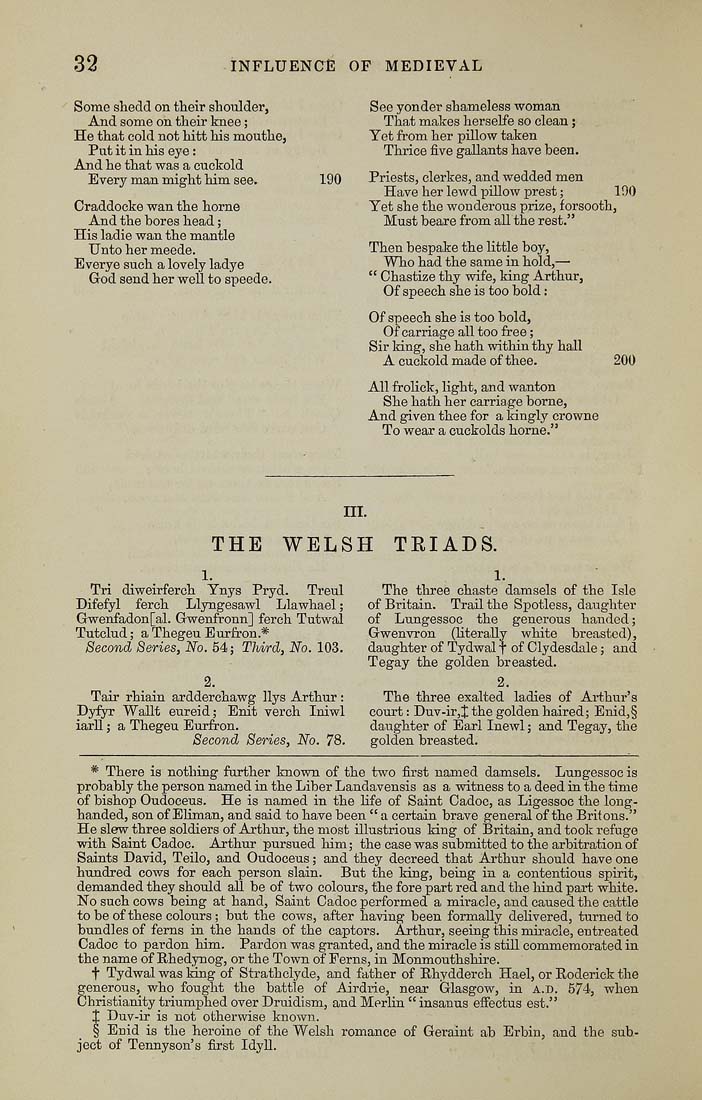
32                  INFLUENCE  OF  MEDIEVAL


Some shedd on their shoulder,

  And some on their knee;

He that cold not hitt his mouthe,

  Put it in his eye:

And he that was a cuckold

  Every man might him see.


Craddocke wan the home

  And the bores head;

His ladie wan the mantle

  Unto her meede.

Everye such a lovely ladye

  God send her well to speede.


       See yonder shameless woman

         That makes herselfe so clean;

       Yet from her pillow taken

         Thrice five gallants have been.


190    Priests, clerkes, and wedded men

         Have her lewd pillow prest;       190

       Yet she the wonderous prize, forsooth,

         Must beare from all the rest."


       Then bespake the little boy,

         Who had the same in hold,—

       " Chastize thy wife, king Arthur,

         Of speech she is too bold ;


       Of speech she is too bold,

         Of carriage all too free;

       Sir king, she hath within thy hall

         A cuckold made of thee.           200


       All frolick, light, and wanton

         She hath her carriage borne,

       And given thee for a kingly crowne

         To wear a cuckolds home."


                  ni.


THE   WELSH   TEIADS.


                 i.

  Tri diweirferch  Ynys Pryd.   Treul

Difefyl  ferch  Llyngesawl  Llawhael;

Gwenfadon[al. Gwenfronn] ferch Tutwal

Tutclud; aThegeuEurfron.*

 Second Series, No. 54;  Tlwrd, No. 103.


                 2.

  Tair rhiain ardderchawg llys Arthur :

Dyfyr Wallt  eureid;  Enit verch Iniwl

iarll; a Thegeu Eurfron.

                Second Series, No. 78.


                 1.

  The  three chaste damsels of the Isle

of Britain.  Trail the Spotless, daughter

of  Lungessoc  the  generous handed;

Gwenvron  (literally  white  breasted),

daughter of Tydwal f of Clydesdale; and

Tegay the golden breasted.

                  2.

  The three exalted ladies of Arthur's

court: Duv-ir,J the golden haired; Enid,§

daughter of Earl Inewl; and Tegay, the

golden breasted.


  * There is nothing further known of the two first named damsels.  Lungessoc is

probably the person named in the Liber Landavensis as a witness to a deed in the time

of bishop Oudoceus.   He is named in the life of Saint Cadoc, as  Ligessoc the long-

handed, son of Elirnan, and said to have been " a certain brave general of the Britons."

He slew three soldiers of Arthur, the most illustrious king of Britain, and took refuge

with Saint Cadoc.  Arthur  pursued him;  the case was submitted to the arbitration of

Saints David, Teilo, and Oudoceus;  and they decreed that Arthur should, have one

hundred cows for each person slain.   But the king, being in a  contentious spirit,

demanded they should all be of two colours, the fore part red and the hind part white.

No such cows being  at hand, Saint Cadoc performed a miracle, and caused the cattle

to be of these colours; but the cows,  after having been formally delivered, turned to

bundles of ferns in the hands of the captors.   Arthur, seeing this miracle, entreated

Cadoc to pardon him.  Pardon was granted, and the miracle is still commemorated in

the name of Rhedynog, or the Town of Ferns, in Monmouthshire.

  t Tydwal was king of Strathclyde, and father of Rhydderch Hael, or Roderick the

 generous, who  fought the  battle of Airdrie, near Glasgow, in a.d.  574, when

 hristianity triumphed over Druidism, and Merlin " insanus effectus est."

  X Duv-ir is  not otherwise known.

  § Enid is the heroine of the Welsh romance of Geraint ab Erbin, and the sub¬

ject of Tennyson's first Idyll.
|
|
|
Page 32 |
|