

Wright, Thomas, On the influence of mediaeval upon Welsh literature
(London : T. Richards, 1863.)
|
||

 Click here and hold to drag menu around
|





|
|
|
|

|
Page 33 | 
|
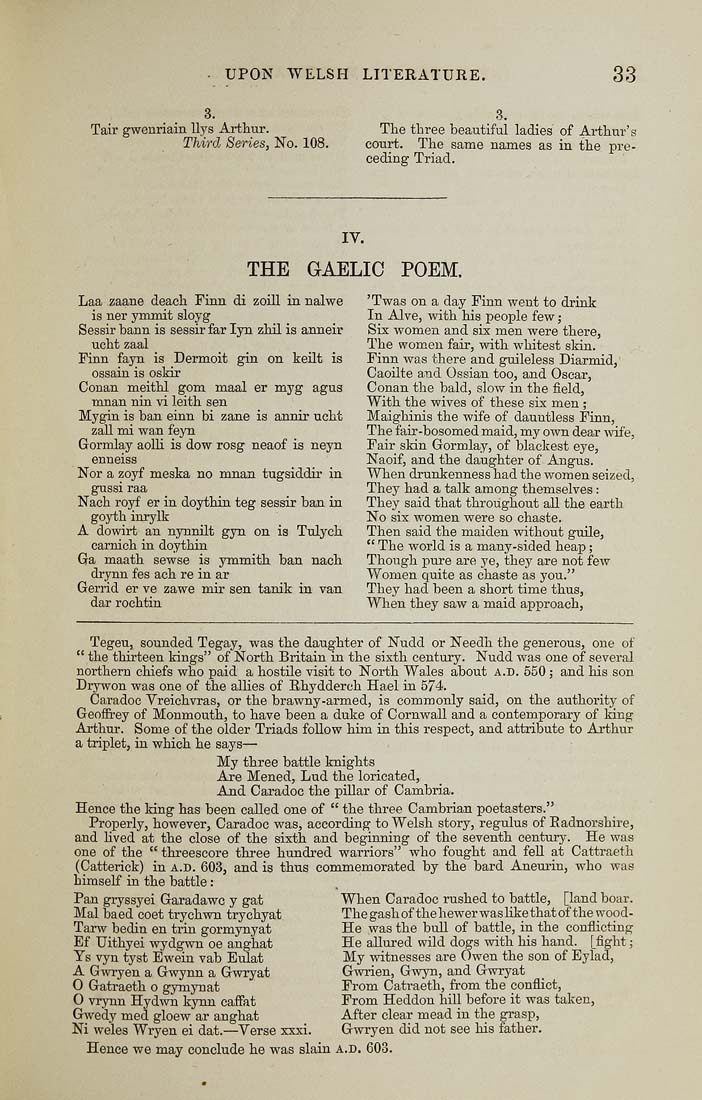
UPON  WELSH  LITERATURE.                  33


Tair gwenriain llys Arthur.

             Third Series, No. 108.


  The three beautiful ladies  of Arthur's

court.  The same names as  in the pre¬

ceding Triad.


THE  GAELIC   POEM.


Laa zaane deach Finn di zoill in nalwe

  is ner ymmit sloyg

Sessir bann is sessir far Iyn zhil is anneir

  ucht zaal

Finn fayn is Dermoit  gin on keilt  is

  ossain is oskir

Conan meithl gom  maa! er myg  agus

  mnan nin vi leith sen

Mygin is ban einn bi zane  is annir ucht

  zall mi wan feyn

Gormlay aolli is dow rosg neaof is  neyn

  enneiss

Nor a zoyf meska no  mnan tugsiddir in

  gussi raa

Nach royf  er in doythin teg sessir ban in

  goyth inrylk

A dowirt an nynnilt gyn on is Tulych

  carnich in doythin

Ga maath sewse is  ymmith  ban  nach

  drynn fes ach re in ar

Gerrid er ve  zawe mir sen tanik in van

  dar rochtin


'Twas on a day Finn went to drink

In Alve, with his people few ;

Six women and six men were there,

The women fair, with whitest skin.

Finn was there and guileless Diarmid,'

Caoilte and Ossian too, and Oscar,

Conan the bald, slow in the field,

With the wives of these six men ;

Maighinis the wife of dauntless Finn,

The fair-bosomed maid, my own dear wife,

Fair skin Gormlay, of blackest eye,

Naoif, and the daughter of Angus.

When drunkenness had the women seized,

They had a talk among themselves:

They said that throughout all the earth

No six women were so chaste.

Then said the maiden without guile,

" The world is  a many-sided heap;

Though pure are ye, they are not few

Women quite as chaste as you."

They had been a short time thus,

When they saw a maid approach.


  Tegeu, sounded Tegay, was the daughter of Nudd or Needh the generous, one of

" the thirteen kings" of North Britain in the sixth century.  Nudd was one of several

northern chiefs who paid  a hostile visit to North Wales about A.D. 550 ; and his son

Drywon was one of the allies of Rhydderch Hael in 574.

  Caradoc Vreichvras, or the brawny-armed,  is commonly said, on the authority of

Geoffrey of Monmouth, to have been a duke of Cornwall and a contemporary of king

Arthur. Some of the older Triads follow him in this respect, and attribute to Arthur

a triplet, in which he says—

                    My three battle knights

                    Are Mened, Lud the loricated,

                    And Caradoc the pillar of Cambria.

Hence the king has been called one of " the three Cambrian poetasters."

  Properly, however, Caradoc was, according to Welsh story, regulus of Radnorshire,

and lived at the  close of the sixth  and beginning  of the seventh century.   He was

one of the " threescore three hundred warriors" who  fought and fell at Cattraeth

(Catterick) in A.D. 603, and is thus  commemorated by the  bard  Aneurin, who was

himself in the battle:

                                     When Caradoc rushed to  battle,  [land boar.

                                     The gash of the hewer was like thatof the wood-

                                     He was the bull of battle, in the conflicting

                                     He allured wild dogs with his hand,   [fig-ht;

                                     My witnesses are Owen the son of Eylad,

                                     Gwrien, Gwyn, and Gwryat

                                     From Catraeth, from the  conflict,

                                     From Heddon hill before  it was taken,

                                     After clear mead in the grasp,

                                     Gwryen did not see his father.


Pan gryssyei Garadawc y gat

Mal baed coet trychwn trychyat

Tarw bedin en trin gormynyat

Ef Uithyei wydgwn oe anghat

Ys vyn tyst Ewein vab Eulat

A Gwryen a Gwynn a Gwryat

0 Gatraeth o gymynat

0 vrynn Hydwn kynn caffat

Gwedy med gloew ar anghat

Ni weles Wryen ei dat.—Verse xxxi.

  Hence we may conclude he was slain a.d. 60S,
|
|
|
Page 33 |
|