
ESC Carries AcIS Woes and Worries Into Fall Semester
by Joe Olivares

| |
ESC Carries AcIS Woes and Worries Into Fall Semester
by Joe Olivares
|
| The battle between Academic Information Services (AcIS) and the student government of SEAS has unofficially begun. The Engineering Student Council (ESC) has been at the forefront in the battle to upgrade and improve the overall quality of student computing services on the Columbia campus. "We are ten years behind the times," ESC President and former student services representative, Dan Finkelstein said in his presidential report at the ESC's first general meeting early this month, "There could be a catastrophic system failure at any time." These were his own words during his presidential report to the ESC at their first general meeting in early September. | |
 
|

|
|
These are not new warnings or accusations by Finkelstein, himself a former AcIS employee; he spent
much of last year trying to get answers to the complaints voiced by the undergraduate population. Last
semester, the ESC passed passed a motion formally condemning AcIS for inexcusable service and support.
This caught the attention of several AcIS management officials who came to an ESC meeting last
semester to hear student concerns about general AcIS services. "We thought it was a very cordial meeting
and even asked to be invited back," said Jeff Eldredge, the senior consultant in the AcIS student support
center in 102 Philosophy Hall. Several ESC members felt otherwise. Now that the ESC has formally met three times and continued its anti-AcIS rhetoric, rumors are floating around of an audit of academic computing. "As far as I know I'm not aware of any audit," Maurice Matiz, who manages AcIS consulting, replied when asked about a possible audit. In fact, AcIS was very open and cooperative to the questions and challenges posed to them by the ESC in a round table interview session conducted by The Moment. "Out of the 50-60 people who work for us we have about 3-4 people right out of college but other than that there are no people who lack experience with professional computing," Matiz said. "As far as being ten years behind the times I don't think so, maybe 5 years ago we were lagging, but now we are at the same level as many of our peer institutions. As far as I know we are one of the few schools who have real ethernet connections to all undergraduate housing." | |
|
|
|
|
Along with Matiz several other AcIS officials expressed concern about the ESC's complaints. "We
listened, we talked and we worked on the things they said to us," Eldredge commented when asked about
the complaints of support services such as telephone consulting. AcIS has made several improvements
over the summer, many directly addressing the ESC's complaints. For example, AcIS has now made it
possible for students to print from their dorm rooms, installed Macintoshes in Carman Hall, supplied
Schapiro Hall with a computer lab and printer, as well as opening several new facilities around campus.
Working with several other groups and organizations, AcIS used Columbia Capital Renewal money to
install more digital multimedia classrooms, expand the Digital Library, and rework the Network
Infrastructure of the whole University under the direction of 15 year networking veteran Bill Chen. "We
spent a lot of time this summer reworking the whole network so we could make sure that we can handle
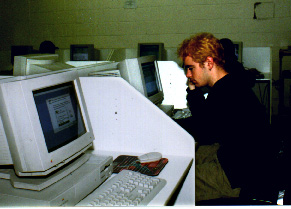
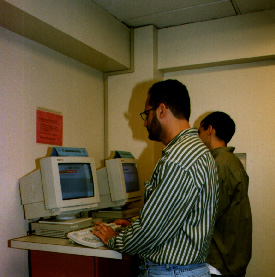
the increased volume of people," Chen said. One of the biggest summer changes AcIS made was the addition of more public access kiosks for web browsing and e-mail use. "It has been one of the biggest things we have received a great deal of attention about," Matiz said. "In fact, computing services from other institutions have come here just to see how we manage to keep them secure from outside hacking, and how we have set them up." Finkelstein, however, was not impressed. "They wasted money that they could have been used to by more HP's [Hewlett Packard computers] or PC's [personal computers] for the engineering school." ESC treasurer Dave Raymond added, "They did some of the things they said they would do but they really haven't done much." As of today there have been no formal talks with AcIS opened up by the ESC nor any attempt by either party to engage the other. Now both sides are left in the open to wonder on how to heal a salt filled wound.
|
|

|
The Moment - AcIS Adds 24 Hour Facilities Engineering Student Council Web Page Academic Information Systems Web Page AcIS Computing Facilities |
 |
 |
 |
 |
| Moment Home Page |
Current Article Index |
Search |
Back Issues |