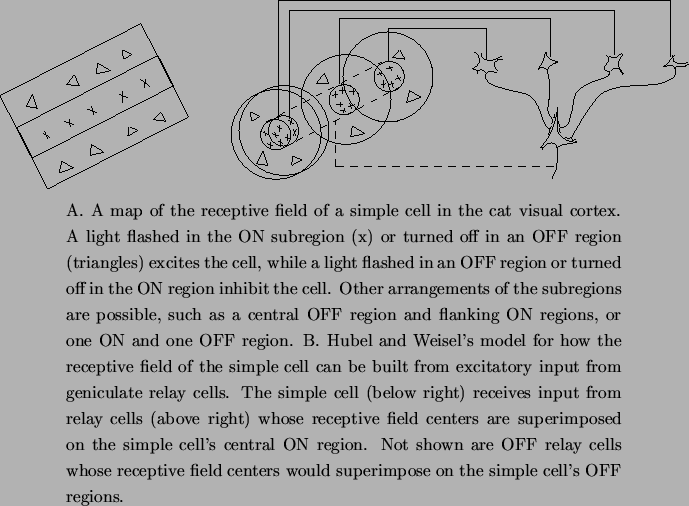
When Hubel and Wiesel (1962) first described orientation selectivity in the neurons of the cat visual cortex, they proposed an elegantly direct model that remains at the center of the debate. Their model represents the feedforward model in its simplest form, explaining orientation selectivity solely from the organization of the thalamic input to a simple cell in cortical layer 4.
Simple cells in the cat are defined by the elongated ON and OFF subfields into which their receptive fields can be divided. These subfields are arranged side-by-side, with their long axes parallel to the axis of the preferred orientation of the cell. They are strongly reminiscent, in their width and sensitivity to light, of the ON and OFF centers of the receptive fields of geniculate relay cells. Hubel and Wiesel proposed that they were derived directly from thalamic input. According to their scheme, a cortical ON region arises from the excitatory input from several ON-center relay cells whose receptive field centers lie along the axis of the subfield (Figure 1). Similarly, an OFF region would be derived from the input from several OFF-center neurons.
Orientation selectivity emerges automatically from this simple arrangement. A bar of light at the orientation of an ON subfield that is moved or flashed within the subfield will simultaneously activate all of the presynaptic geniculate ON-center cells. The resulting barrage of synaptic excitation will depolarize the cortical cell and cause it to fire spikes. In contrast, a bar moved or flashed at right angles to the subfield will only activate a small subset of the underlying geniculate relay cells at one time. The resulting depolarization of the simple cell would be too small to reach threshold, leaving the simple cell inactive. The essence of the feedforward model, then, is a linear summation stage, in which the input from the presynaptic geniculate neurons is summed on the membrane of the simple cell, followed by a non-linear rectification stage, in which the action potential threshold filters out the small synaptic inputs that are evoked by improperly oriented stimuli.