| Trying Times |
Anthropology in the Backlash of "Black Tuesday"
By Brant Stevenson
Knoxville Tennessee, Nov. 25th - Dr. Mildred Hossfrau sits at her workbench, carefully measuring a piece of bone. It is an act she has engaged in many times before, a kind of meditation that quiets her mind for analytical theorizing. And what an analysis she must undertake: the bone against which she holds her calipers is the mandible of gargo gargolis, or Gargoyle Man.
Dr. Hossfrau is a professor of physical anthropology and a member of the board of the Hokes Institute at the University of Tennessee in Knoxville, home to the scientists who first discovered the mandible in South Australia in September. Their discovery came hot on the heels of that of the team led by Dr. Bedevere Lambert of the University of Wisconsisn in Oshkosh, who discovered the remains of most of a skull and left foot of the same species in the same area the month before. August 24th subsequently became known as "Black Tuesday," due to the chaos it has rendered upon the field of anthropology.
"We were just beginning to conceptualize the changes wrought on popular theory of australopithicenes by the discoveries of australopithicus anamensis, and a. garhi, when fate dropped this in our laps," says Dr. Hossfrau. "It's the equivalent of a toddler learning that people are violent and then being shipped off to war."
Such hyperbole is perhaps warranted in this case. Gargo gargolis defies numerous expectations about the process of evolution in hominids, including the development of cranial space, the role of dentition, primary anatomical markers for bipedalism, and, of course, there's the horns.
|
| |
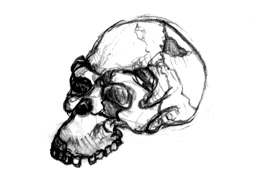
| Above: The source of all the controversy. |
The skull recovered by Dr. Lambert shows clear signs of horn beds above the brow ridges, indicating the g. gargolis grew horns, much like a deer or antelope today. The arguments in the scientific community about the nature of these horns are the most vociferous. Members of one camp, like Oswald Parker of Halifax College, argue that the horns are simply a matter of pathology, that is, abnormal deviations from the standard anatomy due to disease or injury in the specimen; for instance, if a person today grew a horn, it would be seen as a medical issue. Members of the other camp, like Dr. Lambert, argue that the horns were a standard feature, and compare the horn beds to those of modern day animals: "These horns are symmetrically spaced and would have been well-balanced on g. gargolis' head. It is very doubtful that they are the result of some dermatological or skeletal defect."
Other anthropologists, like Dr. Hossfrau, are not so sure. They tend to take a reserved stance on judging the Gargoyle Man. "We're working off of one cranial specimen here. While I'll admit that the horn structure does not show evidence of pathology, I cannot resolutely take a stance without additional finds to back it up."
Of course, some finds may be late in coming, if ever. It is a common thing for anthropologists to extrapolate entire and detailed lifestyles of hominids, waiting years for an additional find might support or debunk their theories entirely.
For instance, consider the matter of Gargoyle Man's splayed toe . . .
- Excerpt from Uncover
December 2000 Issue
| Return to Main | Return to Main | Next Article | ||
|---|---|---|---|---|
All contents © Stephen Grant. All rights reserved.