| Gargo Gargolis: |
An Overview
There is yet to be established a definite taxonomic designation for this species. Current proposals include homo gargolis, gargo gargolis, and homo lambertis. Gargo gargolis will be the designtaion used for this article.
|
|
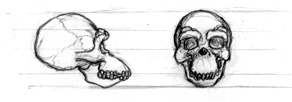
| Above: Skull of g. gargolis. |
The first discovery of g. gargolis was of a nearly-complete skull and left foot unearthed in Lake Eyre Australia on August 24th of 2000. Geological analysis of the rock layers around g. gargolis indicate that the specimen is 1.9 to 1.4 million years old. Later discovery of a mandible dated between 1.6 and 1.2 million years was made south of the first Lake Eyre site on September 20th, and was subsequently attributed to g. gargolis.
Appearance
Extremely prognathic face. Heavy, separated brow ridges. Pronounced cheek bones, yet only slightly more separated from the face than homo sapiens. Nasal orifice is small and sits relatively high on the face. No saggital crest, slight keel. Evidence for two backwards-bending horns, one situated above each brow ridge.
Dentition
Dental formula of 2123. What appears to be a C/P3 complex, yet strangely canines are not nearly pronounced enough to warrant this. Molar and premolar size nearly reduced to that of h. sapiens in relation to incisors and canines. Nearly parabolic dental arcade. These elements coupled with the lightly built face and lack of crest would indicate g. gargolis was not a heavy chewer, and likely partook of an omnivorous diet similar to h. erectus or perhaps h. sapiens.
Locomotion
Post-cranials recovered from the Lake Eyre site include 85% of the left foot. Ankle bone is heavily built, indicating perpetual bipedalism. This is supported by the presence of a definite arch in the foot. Strangely, the big toe is significantly distended. The lack of additional limb information cannot confirm whether g. gargolis maintained the perpetual proportionally long arms retained by every hominid species up to h. erectus, nor whether it had striding gait similar to h. erectus.
Cranial Capacity
Cranial capacity of the find at Lake Eyre measured at 1350 cc's. The position of the lunate sulcus indicates that the brain of the g. gargolis was reorganized along h. sapiens lines, indicating possibility of advanced intelligence perhaps equivalent to modern humans.
Lifestyle
All these factors would seem to indicate that g. gargolis was a thinking creature on par with h. erectus or possibly h. sapiens. The find fits well with the traditional model of large, associatively-organized brain and diminished chewing strength of recent homo species. If such is the case, than we might assume g. gargolis was exceptionally advanced for its time. No tools have been found with the species at the discovery sites, so we cannot assume that g. gargolis was a tool user. Also, basocranial analysis precludes the possiblity of human speech.
Questions
Most questions about gargoyle man would obviously center on its bizarre appearance and the oddly primitive anatomical structures of its otherwise advanced morphology. The horns of the find imply that this specimen might be pathologically unsound, yet the horns are too regular and even to be considered aberrations, the distended toe too well accounted for anatomically. In addition, the prognathic face is reinforced by the mandible from the later Lake Eyre find.
The most controversial questions currently consider whether g. gargolis is even part of the human evolutionary tree, or whether it is some altogether separate species. If it is a separate species, then what is that species' history? Or, if it is a human ancestor, how can we account for what seems like an extremely divergent evolutionary dead-end of what very well might have been a fully sentient species?
- Excerpt from Science Legacy
November 2000 Issue
| Previous Article | Return to Main | Next Article | ||
|---|---|---|---|---|
All contents © Stephen Grant. All rights reserved.