
Sites 31,
33
and
35 are similar in their population and
activities. All appear to be areas of production and consumption;
that is, all members of the population performed tasks for the survival
and well-being of each community, with some trading of farming implements,
pottery and probably fabrics between the three village sites. Adults
of both sexes farmed, but other tasks were divided along gender lines.
Women spun thread, wove cloth and 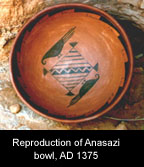 sewed;
a small number also wove tapestries or embroidered. All men hunted,
and a few produced stone implements. In each village, pottery was
produced by about a quarter of the households, but no evidence indicates
whether the work was done by women, men or both. The related cemetery
sites,
32, 34 and
36,
support the picture of uniformity. Individuals were alike in stature
and age-specific mortality, suggesting similar level s of nutrition and
stress.
sewed;
a small number also wove tapestries or embroidered. All men hunted,
and a few produced stone implements. In each village, pottery was
produced by about a quarter of the households, but no evidence indicates
whether the work was done by women, men or both. The related cemetery
sites,
32, 34 and
36,
support the picture of uniformity. Individuals were alike in stature
and age-specific mortality, suggesting similar level s of nutrition and
stress.
The next site, 37, was
most likely a production center only. It was inhabited by about 60
men and women for 3 to 4 months in the fall. The occupants came to
make stone tools and weave, living off food produced in the farming villages
of Sites 31,
33
and
35. The evidence of discarded cloth
and stone tools in the refuse associated with the site suggests that the
inhabitants came from those villages. One structure was occupied
year-round, perhaps by people who acted as guards, overseers, or caretakers
and did not participate in food production. In this light, it is
a reasonable assumption to make that the labor of the individuals from
the villages was engaged in producing tribute payments to a ruling class,
possibly overseen by a socially superior class of warriors from Site 38.
Residents of Site 38 did not engage in any
kind of food production. The associated cemetery, Site
39,
reveals that men were buried with weapons  and
trophy heads—all adult males were warriors. In addition, the stature
of men at this site was greater, indicating that they enjoyed better nutrition
in childhood than the men of the farming villages. On the other hand,
women interred in Site
39 were of the same
stature as their counterparts in the villages. In light of these
differences, men in this community probably came from a different class,
while women likely originated in the farming villages. People at
Site 38 lived longer than those in the food-producing
communities, also suggesting that they generally enjoyed better health.
They used jade necklaces as a symbol of status.
and
trophy heads—all adult males were warriors. In addition, the stature
of men at this site was greater, indicating that they enjoyed better nutrition
in childhood than the men of the farming villages. On the other hand,
women interred in Site
39 were of the same
stature as their counterparts in the villages. In light of these
differences, men in this community probably came from a different class,
while women likely originated in the farming villages. People at
Site 38 lived longer than those in the food-producing
communities, also suggesting that they generally enjoyed better health.
They used jade necklaces as a symbol of status.
Like the inhabitants of Site 38,
people at Site 40 lived entirely off of the
food produced by the three farming communities and stored at Site 37.
This was a class of artisans or craftsmen who transformed many different
raw materials into finished products. Both men and women acquired
and processed materials such as mineral ores, turquoise, jade, and spondylus
(spiny oyster). At Site 41, the inhabitants
were buried with grave goods indicating that both men and women were potters,
woodcarvers, metalsmiths, and jeweler-lapidaries, but only women made carved
stone objects. 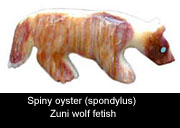 Also
like the occupants of Site 38, these people
marked their status with necklaces, this time turquoise. But their
stature and age-specific mortality did not differ significantly from those
at the farming villages (see Charts).
This class, while perhaps socially closer in status to the warrior class
as indicated by the presence of the necklaces and by the fact that they
consume food they do not produce without returning any items of comparable
usefulness to immediate survival, nevertheless seem to lack the status
or strength for enough food to be healthier than the farmer-peasants.
Also
like the occupants of Site 38, these people
marked their status with necklaces, this time turquoise. But their
stature and age-specific mortality did not differ significantly from those
at the farming villages (see Charts).
This class, while perhaps socially closer in status to the warrior class
as indicated by the presence of the necklaces and by the fact that they
consume food they do not produce without returning any items of comparable
usefulness to immediate survival, nevertheless seem to lack the status
or strength for enough food to be healthier than the farmer-peasants.
Perhaps the most interesting structure is the pyramid at Site 42. It appears that the construction of the pyramid involved the sacrifice of sixteen adolescents. Regular or seasonal offerings of spondylus, fish and plant foods were placed in pits at each corner. All the men buried here came from the ruling class, as shown by their greater stature. The woman in the more recent burial shares that trait, but the woman in the earlier tomb may have come from one of the farming villages, judging by her stature and age at death. Those with the greater stature were also buried with jade necklaces and silver pins, lending credence to the theory that they came from the ruling class.
The structure at Site 43 was most likely the palace inhabited by members of the ruling family. Their status is marked by the fact that they consumed on an extravagant scale, yet produced nothing. Everything they used came from either the farming villages, Site 37 or Site 40. In addition, the associated burial grounds at Site 44 consist of elaborate tombs, costly in terms of skilled and unskilled labor. Most likely unskilled labor was pulled from the farming communities, while skilled artisans were enlisted from Site 40. Overall, six million person-days of labor were reserved for the task of building the three vaults; that is, over a period of seventy-five years, the work required eight hundred individuals for one hundred days each year.
The earlier burial contained four adults whose stature
indicates that they probably came from the farming villages. The
same inference may be made about two of the women in the later vault, while the man and the eldest
woman probably originated in the ruling class. Gold and silver grave
goods seem here to be exclusive to the ruling family.
about two of the women in the later vault, while the man and the eldest
woman probably originated in the ruling class. Gold and silver grave
goods seem here to be exclusive to the ruling family.
It appears that a complex social system existed with
a political hierarchy and social division of labor leading to class formation.
Direct producers had the lowest social rank, indicated by their lack of
luxury items and by the tribute payments they apparently had to provide
to the ruling class. Somewhat higher in the social scale were the
artisans. They did not need to produce their own food, but nevertheless
lacked the means to superior nutrition. Most likely, therefore, they
were kept by the ruling family, fed from the tribute payments of the farmers
to provide luxury goods. A sign of higher status was the turquoise necklaces
they wore. More power resided in the warrior class. While not
producing food, they functioned, perhaps, as a more necessary group than
the artisans. Certainly they enjoyed a more elevated status as evidenced
by their greater health generally than the farmers or the artisans, and
by the use of jade necklaces. While the artisans’ relationship with
the ruling family had an economic basis, that is, they were hired to perform
a function for the ruling family, the warrior class seemed to have more
of a social connection with the rulers. The ruling family emerged
from the warrior class, perhaps subjugating the farmers through force or
by providing protection in return for tribute. The ruling family
showed their power through appropriating the labor of the farming communities
and through the sacrifice of sixteen of their adolescents. Their
presence in the pyramid indicates a spiritual or religious status as well.