

Schism, shmism
Columbia University's traveling reporters left Russia today for Ukraine and immediately threw themselves into a controversial schism in the Orthodox church. On this cold and rainy morning, the students hurriedly packed their bags to make the 8 a.m. bus to the Moscow airport. Feelings were mixed. The student reporters had seen the possibilities of reporting in Moscow, but after six days of struggling with the language, brushes with the law and a robbery, some were glad for the change in scenery. "I would come back as a journalist, but not as a tourist," said Jenny Ho. "As a journalist you need to put up with that kind of stuff. It's part of the job." Ailis Brown said she was more than ready to leave Moscow. But she recalled a meaningful moment in the city. "When I went to Catholic mass on Friday, I felt at home," she said. "That was probably the most at ease I felt in Moscow. It made me realize the need for religious freedom, to make people feel at home." The stay had given the student reporters a rare look at a Russia that would be hard to see as a solo tourist, said Michael Gartland. As examples, he named getting the chance to meet important clergy members, visiting an Old Believer church and eating in the seminary of Sergiev Posad, one of the four exalted monasteries in Russia. "We had all this access to stuff we wouldn't have had if we'd come by ourselves," Gartland said. The leader of the group, Professor Ari Goldman, said he was ready to move on to Kiev, a smaller and more manageable city. "I had enough," Goldman said. "I find Moscow overwhelming. I've been to Moscow three times and I feel like I don't know it." The student reporters had to earn their exit from Russia. They shuffled through crowded lines for check-in, customs and passport control. Ho and Goldman had to pay fines for luggage weighing more than 20 kilograms. The fines began at $50, but with the assistance of our Russian guide Andrei Zolotov, that price was lowered to $10. Meanwhile others lugging large bags dealt with more honest airport employees. Not a single seat was free aboard our flight on Aerosvit, the Ukrainian airline. Most fell asleep quickly, only to be awakened by flight attendants forcing drinks and lunch on them. The groggy students accepted their sandwiches of ham and fat-speckled sausage, and soon after they touched ground. The sun was shining and it was warm when the students arrived in Kiev. Everybody was looking forward to this part of the trip. Moscow had been packed with meetings and tours, but Kiev promised to be more loosely structured. "It's the tail end of the trip and people want to unwind a bit," said Brian McGuire. "Kiev was advertised as a more manageable city. This will be kind of icing on the cake to get a chance to relax and enjoy each other's company." Lunch was at Domoshnaya Kykhna, a restaurant where it seemed half of Kiev came for lunch. The cafeteria line was filled with food choices that looked delicious, repulsive or just plain mysterious. The student reporters fought their way through the crowds, trying to find order where there was none. In the end, everybody came away with some kind of dish; many had chosen the familiar-looking chicken with rice, but others had gone the more adventurous route, trying some of the national dishes like borsch, potato peroshkis, shredded beets and shish kebabs. The group took a tour of Kiev's religious sites. The first stop was St. Volodymyr's Cathedral, home of the Kiev patriarchate that split from the Russian church. The group had a meeting scheduled with the leader of the church, Patriarch Filaret, later in the afternoon. The rest of the time until then was spent seeing the sights by bus. Everbody seemed impressed with Kiev. "I could honeymoon here," said Manya Brachear. "It's just charming. The people seem much friendlier and happier here." The students had a meeting scheduled with Filaret, the former metropolitan of Kiev and K.G.B. man who broke from the Russian Orthodox Church when the Soviet Union fell apart. He named himself the head of a new Kiev patriarchate of the Russian Orthodox Church. The Moscow patriarchate denounced Filaret as a schismatic and excommunicated him. Filaret and the Kiev church are now seeking legitimacy by appealing to the patriarch of Constantinople, the leader of the five patriarchs in Orthodoxy. A priest led the students through Filaret's residence. As they were filed into the dining room, Filaret, imposing with his flowing white beard and black kaftan, appeared in a doorway. He said nothing, but just watched the procession. After a moment, he disappeared back into the room and shut the door behind him. That was the last the students would see of Filaret. Instead, they were received by Archpriest Boris Tabachek, the chancellor of the Kiev patriarchate. He spoke for nearly an hour, on the split of the Moscow and Kiev churches. He called the break with the Russian church an administrative separation instead of a schism, and said Ukraine could never be truly independent unless it had an independent church. He compared Filaret to Martin Luther of the Protestant reformation and accused the Russian church of complicity with communists. "My take is he was a silver-tongued PR man for the separation of the Ukrainian Orthodox church from the Russian Orthodox church," said Darren Foster. At the end of the visit, most of the group filed back to the bus, except for Nicole Neroulias, who wandered through a wrong door in search of a bathroom. She had to find her way out, hoping she would not run into the patriarch. "I totally got lost," she said. "I ended up in a weird part of the house. I was afraid that I would walk into his bedroom." Afterward, the students checked into their hotel rooms then went off alone or in groups to explore the city. Everybody, that is, except for this correspondent, who had the task of writing the daily dispatch. But Kiev came to me. While writing, I received a phone call. A young woman was on the other line.
"Do you speak Russian?" she asked in Russian.
|
|||||||
|
QUICK LINKS: Feature Stories | Dispatches | Photo Essays | Itinerary | Maps | About This Class
A project of the Columbia University Graduate School of Journalism made possible by the Scripps Howard Foundation. Comments? E-mail us. Copyright © 2002 The Graduate School of Journalism at Columbia University. All rights reserved. Reproduction in whole or in part without permission is prohibited. |


 |
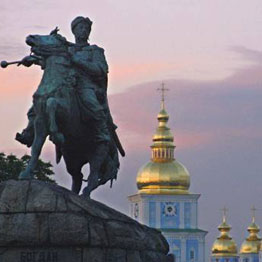 |
PHOTO BY VIKTOR POBEDINSKY/AP
The Golden cupolas of St. Michael Cathedral are seen behind the monument to
Bohdan Khmelnytskiy, Ukraine's greatest military and political leader of the
17th century, on the central square in Ukrainian capital Kiev |
 ITINERARY MAPS OF RUSSIA AND UKRAINE ABOUT THIS CLASS E-MAIL US ITINERARY MAPS OF RUSSIA AND UKRAINE ABOUT THIS CLASS E-MAIL US |