

Kiev Comfort
On Saturday, the last full day of our study tour, students finally tackled the question posed by Prof. Ari Goldman early in the trip, "Are you tourists, pilgrims or journalists?" Students spent their free day in Kiev at more churches, services, museums, memorials and interviewing members of religious communities and exploring how free faith really is in Russia and Ukraine. "In the end, we wanted to ask more questions, see more people and find more stories," said Nada El Sawy, in favor of the journalist. However, students� discoveries on that last day were more than professional. They were also personal and even spiritual. As traveling companions, members of the class had grown closer to each other; and perhaps too, as pilgrims, a little closer to God. Forgoing extra sleep, most students left Hotel Rus around 10 a.m., attempting to pack as much as possible into the day. Informal groups were created based on destinations. Darren Foster, Matt Volz, Noah Haglund and Alan Rappeport began their day at the Chernobyl Museum. Although the signs that accompanied the before and after photos were not in English, the images spoke well enough of the worst nuclear disaster in history that has left up to 100,000 people dead. Afterward, like many of the students, the four shopped in the shadow of St. Andrews Cathedral on an avenue lined with vendors selling Ukrainian and Russian crafts, including the famous matryoshka dolls. Darren conducted an impromptu interview with one vendor whose dolls were painted with images of Osama Bin Laden and Al Quaeda terrorists. The quartet then headed to the barber, where they put their faith, and hair, into the hands of the locals. Matt split from the group at that point to visit Babi Yar, the mass grave of 34,000 Jews that, in two days — September 29 and 30, 1941 — were massacred by Germans during World War II. In the months that followed the slaughter about 100,000 Jews were executed and buried under a thin layer of soil at Babi Yar. Manya Brachear, intrigued by a theology professor from the Monastery of the Caves the day before, spent the day interviewing him for a profile. In addition to the interview, the professor, Dimitri Volovnikov, granted her a history lesson on the foundation of Kiev. Nearby, Brian McGuire, Michael Gartland, Nicole Still and Ailis Brown took a tour of Saint Sophia and St. Michael Golden Domes cathedrals. The 13-domed Saint Sophia's is the oldest surviving church in the FSU. The images on the gilded iconostasis, frescoes and mosaics, provided a rare window not only into the religious, but also the secular life of Ukraine in the 11th century, as it was from there that the Orthodox religion spread throughout Ukraine and Russia. St. Michael�s traditional baroque styling and gleaming domes reap the faith of old Kiev. But its reminiscent charms are somewhat of an illusion. Like Christ the Savior Cathedral in Moscow, St. Michael's, named for Kiev�s patron saint, was destroyed by the communists in 1935 and rebuilt exactly as was, reopening for worship in 2000. Elizabeth O'Brien, who considered the group, "cultural ambassadors representing the United States," spent her day with Charnicia Huggins and Anusha Shrivastava, investigating culture at an outdoor craft museum, where they mingled with the locals while viewing traditional Ukrainian dwellings and several churches. Anusha, who managed to cram four museums into our trip, had been to the FSU ten years ago and commented that she was amazed at the progress in Kiev. Most of the students shared the sentiment that Kiev was cleaner and greener than Moscow. The architecture of the buildings had charm and the city itself, color. Unlike the gray and brown palette of Moscow, Kiev boasts yellows from mustard to lemon, reds from maroon to cherry, and blues bespeckled with white, all wrapped together by cobblestone streets and dotted with golden cupolas. Hotel Rus, perched atop a hill, gave us a commanding view of the city. The class met there at the end of the day to reflect on the past week. "To my mind, I think it couldn't be better," said our guide Andrei Zolotov, a religion reporter for the English-language daily The Moscow Times. "It was a blessed trip." Dinner followed and it couldn�t have been staged better. The class sat in the "traveler's room" of a restaurant called D�j� Vu, and ate dinner as a band played John Lennon's "Imagine. All the elements came together to bring out the tourist, pilgrim and journalist in all. After toasting the students' success and enthusiasm, Goldman inquired how this trip had affected each students� own faith and religious life. For some, Finding Faith, as the trip's on-line chronicle had been named, had permeated the objective journalist wall, making the question personal. Silence and uncertainty answered. After more than a week of togetherness and questioning the faith of others, it became apparent that some students didn't know the faith of the person sitting next to them. What the class sought to find in others, they found among themselves: religious diversity. Nada, the first to answer, said the trip gave her an inside view of different faiths. "It is important to learn about other religions and be open to them," said Nada, a Muslim. "I don't think people can see my faith from the outside at all." After her brave step, the rest of the students gave their input. Manya admitted that this trip was more a pilgrimage for her, an opportunity to explore part of her family�s history and Jewish faith, as well as her own spiritual aims. Brian said the trip awakened him to his own Roman Catholic faith as well as the faith of others. "I overcame my own ignorance and weakness to understand others," said Brian, who assessed that every day is a day of spiritual awakening - a daily effort at conversion. Molly Knight, a Presbyterian, also mentioned that this trip helped her overcome her naivet� about religion and gain understanding as she tries to figure out where her own faith fits in and how to make it fit in." For Nicole Neroulias, who is Greek Orthodox, the journey revealed feelings of uncertainty. "I was always proud to be Greek, but I wasn't always proud to be Orthodox." Zolotov, a faithful Russian Orthodox Christian, sat quietly at the dinner table beside Brian, and nodded vigorously when Brian addressed the strife between the Catholic and Orthodox churches. "This trip made me long for unity of churches and made me see how difficult the task is," Brian said. Why do people of different faiths but similar doctrine struggle to get along? Part of that answer came when Goldman pointed out that faith is personal and that to an individual, their faith is the greatest religion. Charnicia Huggins, a Pentecostal, agreed. "If I didn't think it was better than anyone else's, I wouldn't believe in what I am or who I am, she said. It was exactly that type of confidence that Goldman witnessed within the group. By the end of the trip, whether they were Jewish, Muslim, Pentecostal, Catholic or other faiths, students found "comfort in saying, this is who I am," Goldman said. "Believe in yours and respect others," Anusha added. Although not all the students felt comfortable sharing a personal assessment of their faith, they all listened. "The class was candid and respectful with one another," said Michael, something he considers the most important aspect of studying faith. It was perhaps our candor that prompted Goldman to finish the conversation quoting the Talmud. "From all my teachers I've learned, with my students I've learned the most." On Sunday, several students woke early to catch Palm Sunday mass at a Catholic cathedral. Andrei went to an Orthodox service. Manya went to Babi Yar. When everyone returned, we boarded a bus to the airport. My quick survey found that the 16 students left with 40 sets of matryoshka dolls, drank 63 shots of vodka, ate 282 Lenten pancakes and learned 62 Russian and Ukrainian words. It was impossible to quantify any more. For what we learned about religion, about another world, and about each other, we are now barely able to speak of, let alone measure.
|
|||||||
|
QUICK LINKS: Feature Stories | Dispatches | Photo Essays | Itinerary | Maps | About This Class
A project of the Columbia University Graduate School of Journalism made possible by the Scripps Howard Foundation. Comments? E-mail us. Copyright © 2002 The Graduate School of Journalism at Columbia University. All rights reserved. Reproduction in whole or in part without permission is prohibited. |


 |
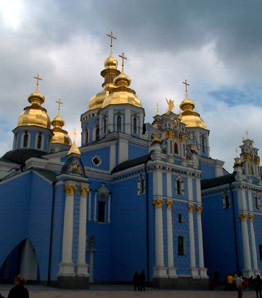 |
PHOTO BY NICOLE STILL
St. Michael Golden Domes Cathedral in Kiev |
 ITINERARY MAPS OF RUSSIA AND UKRAINE ABOUT THIS CLASS E-MAIL US ITINERARY MAPS OF RUSSIA AND UKRAINE ABOUT THIS CLASS E-MAIL US |