

Under Siege?
In a Hare Krishna temple in the Russian capital, about 60 devotees surged back and forth across the room, like a human sea, with hands clasped, singing the Hare Krishna mantra. As time passed and some members beat drums and others clanged cymbals, the dancing became more frenzied and ecstatic, until after some 20 minutes the noise finally trailed off and worshippers, still on their feet, hunched over, slightly exhausted. Hare Krishna devotees in Moscow worship as they do in countries around the world, but in this historically Orthodox Christian nation they have been accused of being a dangerous cult that drives members to violence and depravity. Vipina Purandera, the spokesman for the Hare Krishna movement in Russia, thinks influential members of the Russian Orthodox Church are waging a campaign against his faith. "It's very threatening," the slight, 50-year-old monk in a saffron gown said from his office in the group's pink-walled compound in northwest Moscow. He maintained that the Hare Krishna is a legitimate form of Hinduism that deserves full rights in the Russian Federation. "We have a peaceful mission and they can penalize us if they amend the law." The law in question is the Russian Federation's 1997 religion law, originally drafted to protect its citizens from the growing influence of cults and sects. It granted some faiths, chiefly Russian Orthodoxy, the state religion throughout most of the country's history, the status of traditional religion. Islam and Judaism received a similar status, having been arrived on native soil centuries before Christianity did in 988. Other religions, including the Hare Krishnas, the Jehovah's Witnesses and some Protestant groups, were registered as legitimate religious organizations, even though lawmakers decided they did not deserve traditional status because of their relatively recent introduction to the country. Purandera argues that the historical connection with the Krishna movement runs deep. "Russia's pre-Christian culture was definitely Vedic," he said. "You can say that their memory of culture is revived by Krishna Consciousness." One of the main tenets of Krishna Consciousness is that God occasionally appears on earth to reveal himself to mortals, as he did in the form of Lord Krishna, the blue-skinned deity who appears in the religion's temples and literature. So, Purandera explained, "The main problem of teaching in the West is the impersonal way of thinking. But Russians are personalists in nature. So for them to think of God as a person is quite natural." He noted the Soviet Union's practical deification of Lenin and Stalin as an example. Alexander L. Dvorkin, a doctor of philosophy and the director of the St. Irenaeus of Lyons Information Consultation Center of the Russian Orthodox Church, is probably Russia's foremost anti-cult crusader today and has led repeated verbal attacks on the Krishna worshipers. In a 1997 pamphlet written for the Church, Dvorkin belittled the Hare Krishna assertion that it is part of the ancient Hindu religion. "In fact it was founded in New York by an Indian immigrant, Abhay Charan De, who modestly called himself His Divine Grace, A.C. Bhaktivedanta Swami Prabhupada," he wrote. Russian and Western experts on Indian religion have consistently found the International Society of Krishna Consciousness, as the group is formally known, to follow a traditional form of Krishna worship, originally taught by 16th century Bengali preacher, Lord Chaitanya. In his 1997 statement, Dvorkin further alleged that the International Society for Krishna Consciousness, "has been involved in the drug trade, weapons trade, murders, violence, rape and their leaders have been leading a luxurious lifestyle." Last October, he accused the movement of being in league with the Armenian mafia. Krishna devotees have vigorously denied of these charges. "It's not personal, they are puppets," said Purandera. "There are puppeteers somewhere. Dvorkin is such a puppet as well." A few horrendous crimes committed in the past few years by Krishna devotees, or people who claimed to be devotees, grabbed headlines and provided critics with much ammunition. The most grisly of these occurred in March, 2000, when a man stabbed and beheaded a Russian Orthodox village priest in Eastern Siberia, claiming the act as a sacrifice to "his god, Krishna," according to Russian press accounts of the incident. After the gruesome act, the man placed the priest's severed head on the altar. The murderer was a drifter from another town who the priest had housed and fed for several days after meeting him on the road. Last fall, Orthodox priests in Ekaterinburg, the capital of the Ural region, which is 1,500 miles away from where the murders took place, marched the streets with banners that read, "Krishnaites are murderers." The protest was intended to disrupt local Krishna devotees as they performed a Harinama, their regular practice of singing, chanting and playing drums in the streets. Purandera has denied that the Siberian killer was ever affiliated with the movement, and has underscored the nonviolent nature of the Hare Krishna movement. In early 2000, another national scandal arose when one Krishna devotee who had lived at the Moscow temple for six years was convicted of molesting an 11-year old girl. At the same temple on a recent Tuesday morning, about 60 worshippers gathered for morning prayers at 7 a.m., in a room 50 foot square, as they do every day. Some of the fulltime members, monks who live at the compound, had been chanting and praying since 4:30 a.m. surrounded by the smell of incense and flowers. A curtain lifted at the front of the room to reveal an altar, ornately decorated with fresh flowers and figurines of Hindu deities. Across the room was a life-sized figure of founder Prabhupada sitting cross-legged on a raised throne. The devotees chanted: Hare Krishna, Hare Krishna, Krishna Krishna, Hare Hare. Hare Rama, Hare Rama, Krishna Krishna, Hare Hare. The Sanskrit words mean "Praise God, praise God, God, God, praise, praise. Praise the pleasure of God, praise the pleasure of God, God, God, praise, praise." Song is at the center of the movement's communal worship and serves to glorify the beauty of God, who becomes happy when he hears the faithful praising him. After expanding rapidly in the early and mid 1990s, membership for this faith in Russia has leveled off at about 3,000 fulltime devotees and 100,000 casual ones, figures roughly equivalent to the United States Arriving at the temple later that day, Vishvamitra Das, 55, served as a physical reminder of past persecution. A physicist who spent six years in jail and penal colonies for practicing Krishna Consciousness, he was released for good in 1989, during the twilight years of the Soviet Union. He now lives with his wife and 13 year- old son in southern district of Moscow, and teaches Vedic history to adolescents at a school run by the International Society for Krishna Consciousness. Purandera spoke of the movement in 1986, when he joined. "There were only a handful of devotees who weren't in prison," he recalled, noting that this deprived the movement of more experienced members. The KGB had the group under constant surveillance. "It was exactly like a spy movie," Purandera said. "Krishna Consciousness was a thriller."
|
|||||||
|
QUICK LINKS: Feature Stories | Dispatches | Photo Essays | Itinerary | Maps | About This Class
A project of the Columbia University Graduate School of Journalism made possible by the Scripps Howard Foundation. Comments? E-mail us. Copyright © 2002 The Graduate School of Journalism at Columbia University. All rights reserved. Reproduction in whole or in part without permission is prohibited. |


 |
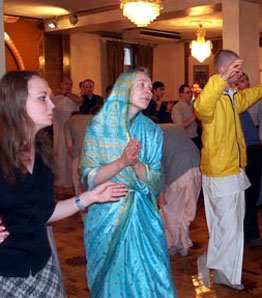 |
PHOTO BY NOAH HAGLUND
Krishna devotees perform the morning Kirtan, ritual chanting and
singing in praise of Lord Krishna, in a temple within their Moscow compound |
 ITINERARY MAPS OF RUSSIA AND UKRAINE ABOUT THIS CLASS E-MAIL US ITINERARY MAPS OF RUSSIA AND UKRAINE ABOUT THIS CLASS E-MAIL US |