

Treasures Forever?
An icon of the new commercialized Russia stands nine minutes out of Moscow's Sheremetyevo airport — it is an Ikea store that drew 50,000 visitors on its launch day two years ago. In stark contrast is the Museum of Handicrafts and Folk Art, located a few blocks away from the Kremlin. Housed in a 19th century mansion that was used as the office of the Council of Ministers of the Russian state until 1981, the museum has few visitors and no money to add to its collection. "In Russia it is difficult for museums to buy new things," said Sergei Vasin, an employee of the museum who was transferred to the Folk Art museum in 1983. "The museum I used to work for shut down and its entire collection was m oved to this one." A clue to the poor economics of running the state—owned Folk Art museum is its low entrance fee — 10 rubles for Masha Kramarenko, a Russian student, and 30 rubles for me, a foreigner. Right by the ticket counter is the gift store where 5-piece hand-painted Matryoshka dolls are sold for as low as 28 rubles. Similar wooden dolls sell for more than five times this price at Arbat Street, a short cab ride away. A range of Matryoshka dolls is displayed inside the museum but these are by no means its only treasures. On the first floor, it houses traditional art-work like hand-painted trays, wooden boxes and bowls. Some boxes have pictures of political figures on them, including those of Lenin and Brezhnev. Inlay work, using special paint called perlamutr which resembles mother-of-pearl, adorns others. Carved wooden birds hang from the ceiling. These were used as symbols of good luck and happiness in Russian homes, often being suspended atop babies' cradles. Blue-and-white porcelain dishes, tea-sets, sugar pots and bowls made in the Gzhel style are kept in several cabinets lining two rooms. A fourth room has several mannequins dressed in peasant clothes — long bright skirts with red, gold, white and black stripes, a long white shirt and a multi-hued, embroidered vest. The second floor houses 20th century art. Rugs, lace garments and sequined hats are kept in the first room. Row after row of ceramic pitchers, tea-sets, porcelain figurines and cut glass bowls are on display in the next two rooms. 10 small teapot-shaped china bowls are kept on a bamboo tray, as if part of a special set. "Used for babies to drink milk, 1930," said Kramarenko, reading the card lying next to it. The only other people in the museum are a group of elementary school students who are clearly not enthused by the handicrafts. A display of wooden toys with moving parts catches their eye. They hover around the cabinet for a bit and then move away. "At least they saw these things," said Kramarenko. "I never came here before. If I had, I would have known more about Russian culture and handicrafts."
|
|||||||
|
QUICK LINKS: Feature Stories | Dispatches | Photo Essays | Itinerary | Maps | About This Class
A project of the Columbia University Graduate School of Journalism made possible by the Scripps Howard Foundation. Comments? E-mail us. Copyright © 2002 The Graduate School of Journalism at Columbia University. All rights reserved. Reproduction in whole or in part without permission is prohibited. |


 |
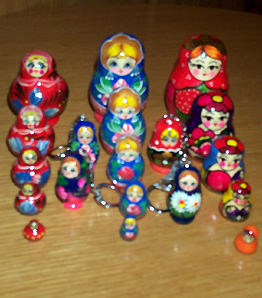 |
PHOTO BY NICOLE STILL
A range of Matryoshka dolls are among the museum's many wares |
 ITINERARY MAPS OF RUSSIA AND UKRAINE ABOUT THIS CLASS E-MAIL US ITINERARY MAPS OF RUSSIA AND UKRAINE ABOUT THIS CLASS E-MAIL US |