Introduction to Earth Sciences I
4.3.3 The Parkfield Prediction Experiment
The Parkfield experiment is a long-term earthquake research
project on the San Andreas fault in California. The ultimate goal of the project
is to better understand the physics of earthquakes and provide a scientific basis
for earthquake prediction. An elaborate and dense network of instruments has been
set up in Parkfield in order to allow scientists to study what actually happens on
the fault and in the surrounding region before, during, and after an earthquake.
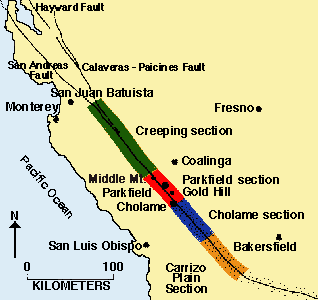
Figure 4.3.4
The San Andreas fault in central California. A "creeping" section (green) separates
locked stretches north of San Juan Bautista and South of Cholame. The Parkfield
section (red) is a transition zone between the creeping and southern locked section.
Spotted areas mark the surface rupture in the 1857 Fort Tejon earthquake.
Parkfield was chosen as an ideal location because of its unique earthquake history.
Moderate-size earthquakes of about magnitude 6 have occurred on the Parkfield
section of the San Andreas Fault at fairly regular intervals - in 1857, 1881,
1901, 1922, 1934, and 1966 (a repetition rate of around 22 years). In addition,
the seismographs recorded from the 1922, 1934, and 1966 earthquakes are strikingly
similar, suggesting that these earthquakes all ruptured the same area of the fault.
Adding to this pattern of repetition, similar-size foreshocks occurred 17 minutes
before both the 1934 and 1966 Parkfield earthquakes. These observations suggest
that there may be some predictability in the occurrence of earthquakes, at least
in Parkfield. In the figure below, the similarity of the seismographs recorded
in the 1922, 1934, and 1966 earthquakes are shown. This similarity is only possible
if the ruptured area of the fault is the same for all three events.
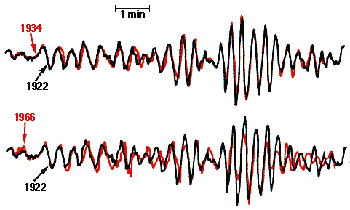
Figure 4.3.5
The investigations at Parkfield have advanced scientists' understanding of the
earthquake process. For example, the link below allows you to view earthquakes
at Parkfield in 3-D. Rotate and zoom with your mouse. These earthquake locations
were obtained with the "double difference" method, which provides extremely high
resolution and reveals structure not seen in earthquake catalogs produced with
conventional methodology.
http://quake.wr.usgs.gov/3D/parkfield.html?file=parkfield.3d&Submit=Start+Display.
Many hypotheses have been proposed to explain the regular behavior of the Parkfield
earthquakes as well as why there has not been one of significant size since 1966.
In addition, scientists have been reworking prediction models to take into account
the information they have learned from the Parkfield research. The Parkfield
Prediction Experiment predicted that a moderate-size earthquake would occur at
Parkfield between 1985 and 1993. This prediction was unusual both in its precision
(as to location, time and magnitude) and high degree of confidence (95% within the
9-year window). However, there has not been a moderate size earthquake in Parkfield
since 1966.
While the Parkfield experiment can no longer serve as a confirmation of
time-predictability, it is very much alive as a test of slip-predictability,
in which the longer the wait, the larger the next earthquake. Some argue that
an earthquake of magnitude 6.6-6.9 would balance the moment deficit that has
accumulated since 1966, and the magnitude increases with each passing year.
When the next Parkfield earthquake occurs, if its magnitude approaches this
expectation, the Parkfield experiment would be transformed from a lesson in
patience to a successful tracking the nucleation and propagation of a much larger
earthquake with Parkfield's dense array of instruments. This would be a scientific
prize. Perhaps in the end the delay will appear beneficial and Parkfield will
turn out to be an inspired long-term investment for science.
Next