Introduction to Earth Sciences I
1.3.3. The Earth Bends When A Weight Is Placed On It, Continued
Volcanic Islands -
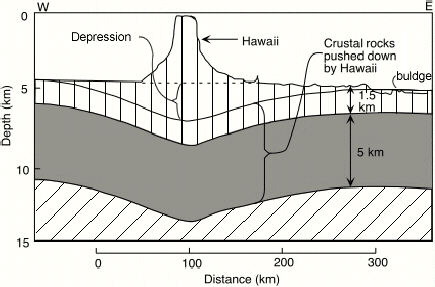
The formation of a volcano involves the transfer of a very large amount of molten material from deep in the Earth to the surface. Lava erupts at the surface and builds up in a pile that is extremely heavy. The weight presses down on the Earth's surface and, if the volcano is large enough, will cause the layers beneath to bend. This process is very apparent in the Hawaiian Islands where the weight of the newly forming islands is pushing the layers beneath downward. This means that the layers must have finite strength or they would carry the load without changing shape. The amount by which the underlying layers bend is a measure (indirect) of their strength - the more they bend the weaker they are.
In fact, almost all the islands in the Pacific Ocean show evidence that they are bending the layers beneath. Bending seems to be greater in some places than others but the shape always seems to be much the same - a depression around the island and a bulge further out. This depression and bulge shape tells us that the layers beneath are deforming in an elastic manner. By this we mean that if the weight were removed the Earth would spring back (slowly) to its original shape. It is the size of the depression and the distance from the islands to bulge that tells us the strength, or rigidity, as it is usually stated.
When we look at these strength measures from islands in the Pacific we find there are systematic patterns. The layers are weaker near to mid-ocean ridge spreading centers (more on this later) and stronger further away. What we are seeing is that the Earth's outer layers get stronger as they get older - basically, they freeze harden.