Introduction to Earth Sciences I
1.1 The Earth's Size and Shape, continued
Shape of the Earth
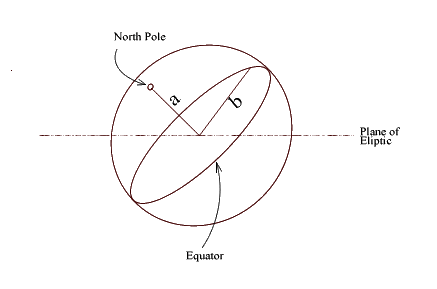
What Erastosthenes couldn't know is that the Earth is actually oblate; its equatorial radius being greater than the polar radius. This took many more years of very accurate geodetic measurements and the shape of the Earth has only been determined with any significant accuracy in the 20th century.
The Earth departs from a purely spherical shape in having an equatorial radius that is greater than its polar radius.

The same number for the Moon is about  . The Moon is more nearly
spherical. The oblate shape of the Earth is prima faci evidence that it is not
completely solid throughout. That it bulges at its equator suggests that it
must be somewhat liquid-like. If we were to spin a water-filled balloon it would
bulge out - that's essentially what the Earth does. If you were to spin a balloon
at the same rate of spin, but filled with maple syrup it would still bulge out
but by a smaller amount. For any particular fluid in the balloon, the faster
you spun it the more it would bulge. Even a solid sphere spun fast enough will
budge a bit. Because the Moon does not do have the same extent of bulge as the
Earth suggests that it is more nearly solid. In fact the Moon presents the same
face to the Earth and is not rotating on its axis like the Earth. The Moon's
elliptically is a relic feature from a time when it was less solid and rotating.
. The Moon is more nearly
spherical. The oblate shape of the Earth is prima faci evidence that it is not
completely solid throughout. That it bulges at its equator suggests that it
must be somewhat liquid-like. If we were to spin a water-filled balloon it would
bulge out - that's essentially what the Earth does. If you were to spin a balloon
at the same rate of spin, but filled with maple syrup it would still bulge out
but by a smaller amount. For any particular fluid in the balloon, the faster
you spun it the more it would bulge. Even a solid sphere spun fast enough will
budge a bit. Because the Moon does not do have the same extent of bulge as the
Earth suggests that it is more nearly solid. In fact the Moon presents the same
face to the Earth and is not rotating on its axis like the Earth. The Moon's
elliptically is a relic feature from a time when it was less solid and rotating.