Environmental
Chemistry U6220
Lab #4
Arsenic mass balance and water management
Note: Please work in teams of 3-5 students (I’ll let you chose your teams)
Part I
You are the manager of man-made reservoir that supplies drinking water to a community of close to half a million people. In the table below, please find all monthly inputs/outputs to and out of the reservoir as well as the values for withdrawals (municipal use) for the period of April to March.
|
Month |
Pi |
Fi |
Eo |
Fo |
Withdrawal |
|
April |
1.73E+01 |
2.37E+03 |
7.04E+03 |
8.33E+03 |
4.90E+03 |
|
May |
2.19E+03 |
5.88E+03 |
8.42E+03 |
8.11E+03 |
5.31E+03 |
|
June |
6.81E+01 |
3.07E+04 |
9.85E+03 |
1.89E+04 |
6.45E+03 |
|
July |
3.58E+01 |
2.17E+03 |
1.29E+04 |
1.72E+04 |
7.72E+03 |
|
August |
3.87E+02 |
2.01E+03 |
8.18E+03 |
8.85E+03 |
8.92E+03 |
|
Sept |
5.29E+00 |
1.99E+03 |
6.97E+03 |
8.86E+03 |
8.68E+03 |
|
Oct |
6.45E+03 |
3.28E+03 |
5.76E+03 |
1.07E+04 |
6.64E+03 |
|
Nov |
2.47E+03 |
4.44E+04 |
5.40E+03 |
9.69E+03 |
4.81E+03 |
|
Dec |
7.71E+02 |
1.73E+04 |
5.40E+03 |
6.51E+03 |
2.86E+03 |
|
Jan |
4.64E+03 |
1.29E+04 |
5.37E+03 |
7.93E+03 |
2.86E+03 |
|
Feb |
3.35E+03 |
7.22E+03 |
6.07E+03 |
6.11E+03 |
3.27E+03 |
|
March |
4.68E+03 |
8.36E+03 |
6.85E+03 |
8.17E+03 |
4.09E+03 |
|
Table 1. Monthly inputs and outputs to and out of the reservoir. Fi, surface inflow into the reservoir; Fo, surface outflow from the reservoir; Pi, precipitation onto the reservoir; Eo, evaporation from the reservoir; withdrawals, the fraction of Fo that is diverted for municipal use. All values are given in Acre Feet. |
|||||
1) Please rewrite the Table 1, converting all values to m3.
2) Calculate the %capacity of the reservoir (consider that the amount of water in the reservoir at t0 is 144,511 AcFt and that the reservoir is at 100% percent capacity at 241,241 AcFt) and include this in an additional column in your new table.
3) On one graph (or two if you prefer for clarity), plot the four parameters of the reservoir's water balance (Fi, Fo, Pi, Eo). Please make sure that all are plotted on similar units.
4) Knowing that this reservoir is in the Southwest of the United States, please explain the precipitation and evaporation curves you obtained (Pi and Eo).
You have recently hired a team of environmental geochemists from the local university to perform a study of the water quality in the reservoir. You need to monitor the presence of certain metals in the waters that may be released from a series of surface uranium mines in the counties within the drainage basin and upstream from the reservoir. Particularly, you are concerned with potential leaching of arsenic (a toxic metal – abbreviation: As) from these mines into the surface watershed and eventually into the major source of fresh water that supplies (so far) all the municipal water needs for the community. After a very thorough temporal and spatial study, the team of scientists provides you with a data series of dissolved As (see “Lake As Data”) from water profiles collected during three different seasons and at several different stations (see Figure 1 below). Your management team will need to graph these data to be able to construct a temporal mass balance of dissolved As in the reservoir. You will be doing this in steps:
5) Graph As concentrations ([As]) vs. depth for all stations on a separate graph for each season.
6) Can you demonstrate that the reservoir remains fully mixed with respect to As concentrations at any specific point in time during the period of study? (Please justify your answer using both the raw data in the Table and the graphs of spatial and temporal distribution of As in the reservoir). Be aware that you will use this assumption in the construction of the temporal As mass balance needed in the following section.
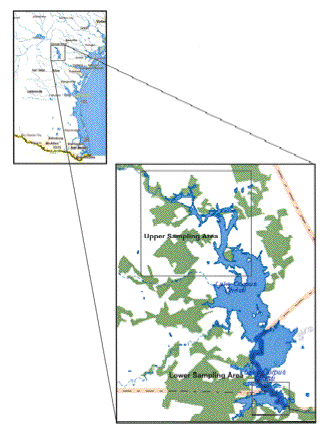
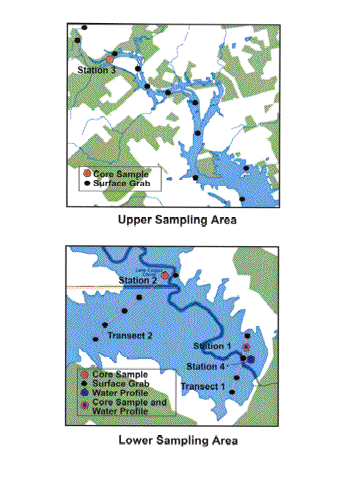
Figure 1. Location of Lake Corpus Christi (a man-made reservoir in the Coastal Bend of South Texas used mostly for delivery of fresh water to the communities of the region). In the blown up sections, the position of water profiles and surface grabs (just below the water surface) are given. The station numbers correspond to those presented in the data table.
7) Using your answer to question 6 above, the water mass balance data provided in Table 1, an average As concentration in the reservoir at the end of March (8.6 µg/L), and the data provided in the first column of Table 2 below, please construct a mass balance for As (for this, you may need to read this short section on lake mass balance from Benner and Benner (1997) Global environment : water, air, and geochemical cycles, Prentice Hall). Fill in the missing columns in Table 2.
|
Month |
[As]i µg/L |
[As]Model µg/L |
[As]o µg/L |
|
April |
6.8 |
|
|
|
May |
6.8 |
|
|
|
June |
6.0 |
|
|
|
July |
6.8 |
|
|
|
August |
6.8 |
|
|
|
Sept |
6.8 |
|
|
|
Oct |
6.8 |
|
|
|
Nov |
5.0 |
|
|
|
Dec |
5.0 |
|
|
|
Jan |
5.0 |
|
|
|
Feb |
5.0 |
|
|
|
March |
6.0 |
|
|
|
Table 2. Monthly arsenic concentrations (in µg/L) in the tributary to the reservoir (surface inflow; [As]i), modeled from your calculations ([As] Model) and in the outflow of the reservoir ([As]o). |
|||
8) Graph the calculated monthly As concentrations along with the curve for %capacity of the reservoir (question 2).
9) On the same graph, also plot the averages of the measured As concentrations for the three sampling periods. Is there a correspondence between estimated As values (calculated) and measured values? What does this mean for your model? Can you then use it as a tool for monitoring (and taking decisions on) As concentrations in the reservoir?
10) Looking at the curves for the [As]Model and the reservoir capacity, as well as the evaporation curve (Eo; question 3), please give a plausible explanation for the predicted and observed seasonal variations in As concentrations in the reservoir.
Part II
As any water utility in the nation, you are suddenly facing a strict enforcement of the new As standard in drinking water of 10 ppb (µg/L) which entails a fine of $40,000 per month during which you distribute water at levels above the standard. To avoid undesired fines and comply with the new regulation, you need to take into account the following information:
a) All water out of the reservoir diverted for consumptive use is sent to a treatment plant prior to being incorporated into the municipal water grid. The price of treatment is $920 per Acre Foot.
b) The present filtration and chemical treatment (i.e. disinfection) you operate in the treatment plant is completely inefficient in removing dissolved As (assume that 100% of any initial dissolved As remains in the water after treatment).
c) You have the option to 1) change the filtration process to a more efficient but costly reverse osmosis system to remove As from solution (cost: $1/1000 gallons treated. This is considering that capital investment has been made earlier to install the system in the plant), or 2) to purchase treated water from the neighboring watershed (Lake Texana) and blend it with your source from Lake Corpus Christi knowing that the As concentration in Lake Texana's treated water is 2 ppb and that it will cost you $0.17 per 1000 gallons of purchased water.
11) Before you can evaluate any course of action you need to determine the monthly per capita use for each month of the period of study. Enter these values in a Table (i.e. see below) and graph them in gpc (gallons/per capita). How can you explain the seasonal variation in per capita use?
12) Calculate your overall revenues from selling water to each citizen at the following rate: $8 for the first 3000 gallons and then at $1.85 for each additional 1000 gallons (to be conservative in your estimate assume that water consumption is uniform in your population). Fill in the column in your data table below.
13) Taking into considerations your sources of revenues and your needs to comply with the new As standard, take the appropriate decision(s) to minimize your costs of operation during the year of study (the time for which you have data). Consider that all budgetary surpluses will go directly to your division (with a 20% as a direct end-of-the-year bonus divided between each individuals in the team!). Please note that you need to report all your decisions and calculations and use tables of monthly costs and compare the three scenarios (no treatment, reverse osmosis, and blending).
|
Month |
Per Capita use (gpc) |
Overall Revenues |
Cost without As treatment |
Cost with RO filtration |
Cost with blending |
|
April |
|
|
|
|
|
|
May |
|
|
|
|
|
|
June |
|
|
|
|
|
|
July |
|
|
|
|
|
|
August |
|
|
|
|
|
|
Sept |
|
|
|
|
|
|
Oct |
|
|
|
|
|
|
Nov |
|
|
|
|
|
|
Dec |
|
|
|
|
|
|
Jan |
|
|
|
|
|
|
Feb |
|
|
|
|
|
|
March |
|
|
|
|
|
|
Total |
|
|
|
|
|