This page explains different models of available ICT access and evaluates their strengths, weaknesses, opportunities and threats.
Models of ICT Access
Internet access is predicated on point-to-point access (with individual users being the points), usually served through some type of
fiberoptic backbone, which provides the highest bandwidth—the highest volume of data transmission at the highest speeds.
See the
general ICT page for a more technical overview of some key terms and acronyms.
Urban-Suburban-Rural Model of Access
If your region has access to the aforementioned resources, you are likely in some kind of urban-suburban-rural (USR) regional model, and can tap into existing resources in the following manner. This USR model is expandable, sustainable and capitalizes on existing infrastructure. It calls for a hierarchical implementation of access:
- Urban fiberoptic core served by backhaul Mesh WiMAX and Access-Mesh WiFi
- Suburban network of backhaul WiMAX and access long-distance WiFi
- Rural satellite access via backhaul VSAT and access long-distance WiFi
This model provides for a dense urban core, with mesh servers building redundancy into the system for improved consistency and compatibility with wireless devices.
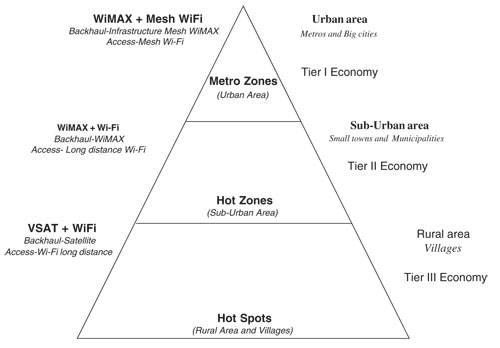 Figure 1
: Urban-Suburban-Rural Model
Source: Gunasekaran and Harmantzis, 2007.
Strengths
Builds a strong core region that will be reliable for a long period of time
Utilizes existing resources
Creates redundancies in the network
Expandable
High bandwidth at low cost
Weaknesses
Can be capital-intensive
Human capital-intensive for maintenance, education
Opportunities
Highly inclusive access can stimulate growth of information economy
Threats
Mesh network dependency relies on number of network participants
Relatively short (2-3 year) lifespan of VSAT
Corporate control over fiber backbone and access points
Extra-Rural Model of Access
Extra-rural regions that cannot benefit from piggybacking on an existing urban or suburban link can look into the following model of wireless networks with caching capabilities for saved access over long distances.
- Hub region: wLAN surrounding hub
- Spoke region: wWAN (wireless wide area network) 5-15 km of hub
- Extra rural: MAP (mobile access point) up to 100 km of hub
Strengths
Inexpensive: baseline implementation for one hub, one spoke, and one MAP of $10,000.
Easily expandable
Weaknesses
Does not provide real-time access to Internet in extra-rural regions
Requires human resources to provide mobile access, maintenance
Opportunities
Can create demand and motivation for Internet access
Can create jobs for provision of mobile access, maintenance
Potential for relative network autonomy
Threats
Relatively short (2-3 year) lifespan of VSAT
Inconsistency of mobile access
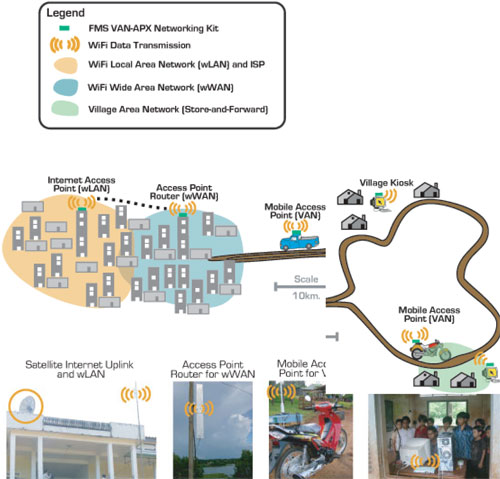 Figure 2:
 Extra-rural access provided through "cached" WiFi
Source: firstmilesolutions.com
Resources
First-mile Solutions
- a. VoIP model
- b. Other access components for low-bandwidth situations
- OSS solutions can be ideal for otherwise obsolete hardware
- Digital couriers with "web cache" principles like Wizzy are available for newer machines
Resources
- SourceForgeis the central OSS project repository. Here you can post new projects, down existing projects and tailor them to your individual needs, and find support for problems.
- Free and Open Source Software Foundation for Africa promotes OSS as a model for sustainable ICT development and can connect communities with volunteers, hardware donations, and other sponsorship programs.
- The Rule Project (Run Up to-date-Linux Everywhere) aims to get working OSS on older machines. The site offers downloads and support.
- Open Source Africa gives background on OSS migration studies and other resources.
(3) Conclusion: Future of real access in developing regions
Sources:
- Bridges.org
- Gunasekaran, Vinoth; and Harmantzis, Fotios C. “Emerging wireless technologies for developing countries.” Technology in Society: No. 29, 23-24: 2007.
- Krakowski, Pia. “ICT and Free Open Source Software in Developing Countries.” IFIP International Federation for Information Processing, Vol. 223, Social Informatics: An Information Society for All? Eds. Berleur, J.; Numinem, M.I.; Impagliazzo, J., pp. 319-330: 2006.
- Osterwalder, Alexander. “ICT in developing countries: A cross-sectoral snapshot.”
- Woods, Bernard. (1993) Digital technology systems for public use and Implications and Applications. Communication, Technology and the Development of People. Routledge, London. Ch. 4-5, pp. 64-130.
Back to
ICT Access and Resource Assessment
Back to
Online Adaptation Main Page
