Haruki Murakami’s 1Q84
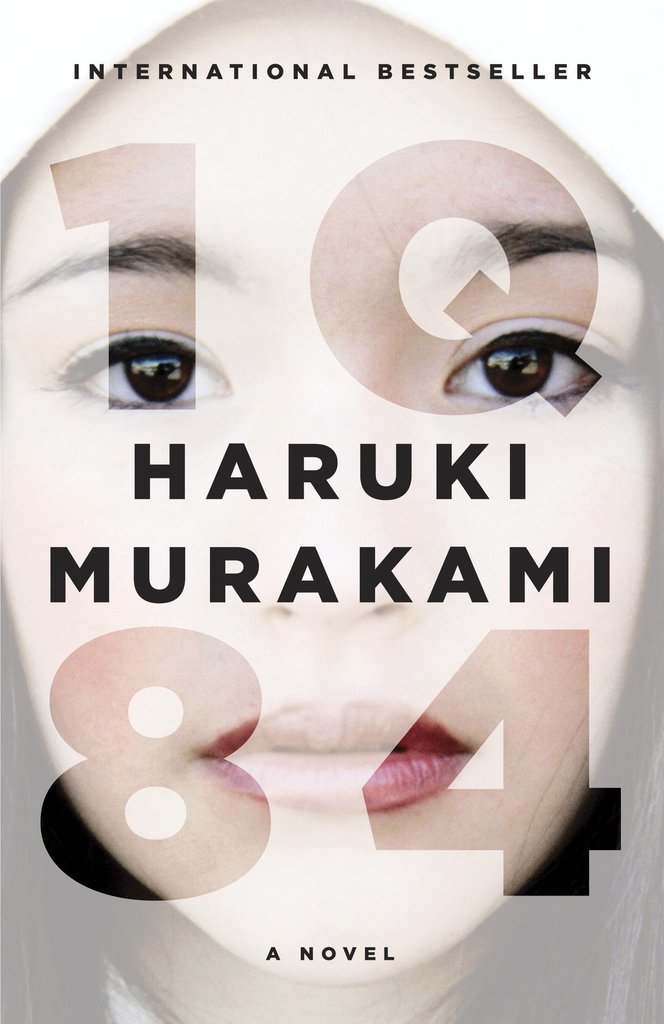
I must have picked up and started this book at least four or five times before I actually sat down to read the damn thing. I spoke to other Murakami fans who had read 1Q84. It was actually the hype around the book that introduced me to Murakami (though I had started with The Wind-Up Bird Chronicle). And for some reason, I left it to the very end. In between the time I first learned of Murakami and came around to 1Q84, I had read every other piece of fiction he had written and that had been translated—even Wind/Pinball and Colorless Tsukuru Tazaki, which came out four or five years later. Why did it take me so long to get to 1Q84?
In short because I knew what to expect. Even though I love Murakami, and even though I already had the book, from numerous conversations in person and on-line and from countless online reviews, I knew that 1) it would be a slow start and 2) it would be a long read. Number one explains why it took me so long to really get into it. And number two explains why I was glad it was over.
Don’t get me wrong. I love Murakami and 1Q84 is no exception. It’s a wonderful novel filled with superb and subtle details that come to a head at just the right time. Though after reading 1Q84, I can’t tell if it’s either him losing his edge at world craft or me picking up on his tricks. I would find myself reading a detail or a passage, and it would seem almost obvious what the connection was—and lo and behold, 100 or 200 pages later, the connection I made was the right one.
Of course this could easily be explained as a case of confirmation bias, though I don’t think so. For what it is, 1Q84 is a monster of a terribly predictable book. I don’t mean to say that it was straightforward. Who are the Little People? What happened to the mysterious sixteen-year-old girl who was sexually attracted (or at least sexually bound) to the balding, middle-age male protagonist (as in every Murakami novel)? But the twists were predictable, the world building less than top-notch and the characters completely flat and desperate for each other in a way that seems to defy even the strangeness that is Murakami’s reality.
I really, really wanted this book to be an epic on the level of Wind-Up Bird. I wanted to fall in love with it and still think about it five years later. But I don’t think I will, if only because it was just too long. The story was good, but not great. There was little compelling enough to demand over one-thousand pages of my attention, and it seemed like Murakami perhaps could have benefitted from taking what would have been his to-date magnum opus and cutting it down at least by a third. Maybe then he could have built a much tighter story that would have attracted thoughts years in the future.
Of course, if you’re a Murakami fan like I am, then it goes without saying that you should read this book. But any novice should stay away, if only because you might be turned off by Murakami forever. Maybe us Murakami fans are just spoiled, demanding well-written, moving, surreal and sublime books at every level. But I can’t help but feel what could have, what should have been a bullseye ended up missing the mark.