Guest Post: The Poor Image
In big production cinema, there is a standard amongst directors and producers to use 35 mm film as a guarantee of high quality. 35 mm film stock was officially named the international standard gauge in 1909—it was considered to be the a good compromise between the quality of its image and the cost of the film stock.
Digital video formats weren’t around in 1909, and they have certainly improved since their creation, but the film industry sticks to its old ways. These old ways, so to speak, are perpetuated because for many reasons, but I think it’s best to focus on one: the poor image.
“Poor image” is a term coined by German visual artist Hito Steyerl. The poor image is really the antithesis of a high resolution image. For example, let’s say I go to stream an episode of Bob’s Burgers from my phone, through my Google Chromecast, and onto my “Full HD” 1080p television (something that occurs on a regular basis at my house). This is the standard, set forth and accepted by society because we have reason to believe this is a very clear, high resolution image.
This clear image exists only in juxtaposition with a poor image however. So, let’s say my Chromecast is acting up (also a regular occurrence) and I decide to find a free streaming website online and get my Bob’s Burgers fix that way. This video stream is full of artifacts, little blemishes on the pixels of the image, caused by its low resolution, and that it is obviously a recording of another stream. This is a poor image, one that is dilapidated and suffers from a loss of origin, compressed and spread through the Internet to find itself in a less concrete existence.
What does this mean for anybody, though? Well the Internet is a cool place where lots of people can share nuanced ideas about art and visual media. Glitch art and other low resolution aesthetics, like the low-fi look in the 90’s or cyberpunk before that, are all very popular aesthetics in art and is also beginning to percolate through pop culture.
Check out this really engaging photo:
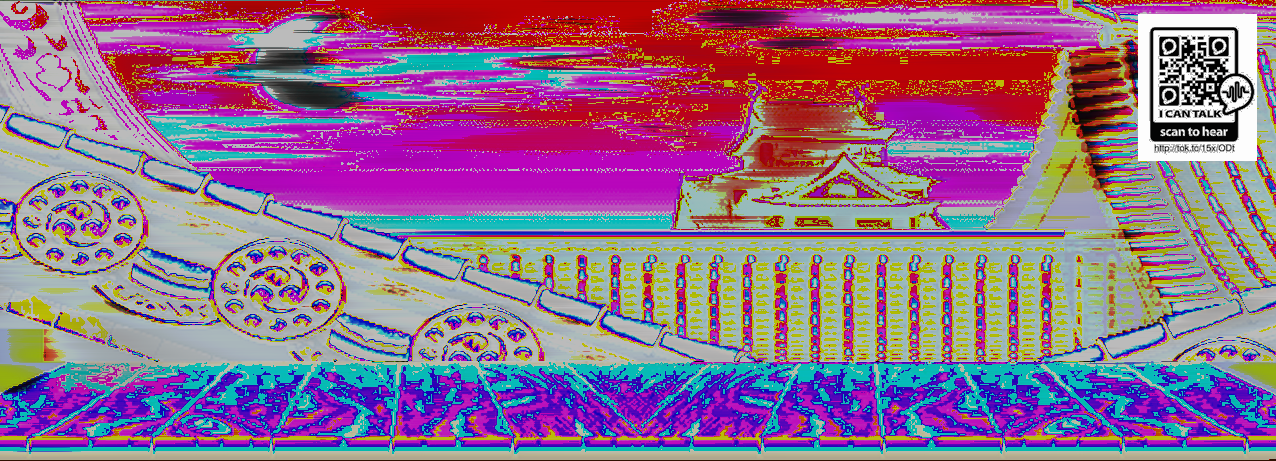
This is a glitched image of a Street Fighter background that I made using Audacity for a class project. (If you scan the QR code, an audio transcoding of the image will play! Cool right?). Often times, glitch art is comprised of these very rich-colored images that are quite visually pleasing.
I mentioned Hito Steyerl before, she’s a popular media theorist and artist who is often featured in exhibitions and at the MoMA. She had a piece there not long ago called How Not to be Seen: A Fucking Didactic Education .MOV File that explored image resolution in a very sarcastic and quirky way. Watch below and notice how she engages the viewer with ideas about traditional and experimental methods of filming: