Definition |
|
|
Sage Identified in America |
The Medical Use of Sage |
How to Prepare it? |
Selected Links |
|
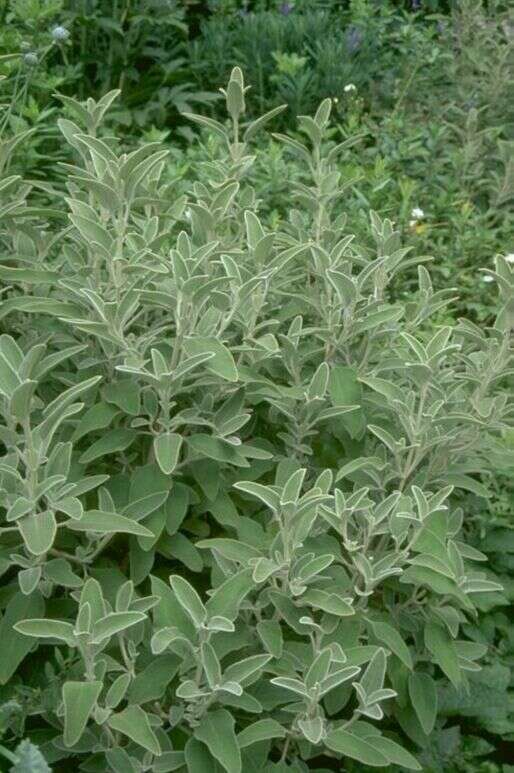
Mediterranean sage (Salvia aethiopis) is an erect, coarse biennial or short-lived perennial, with a stout taproot. The squarish stem, opposite leaves and bilabiate flowers are typical of the mint family. When crushed, a sage-like odor is emitted. The mature plant can reach 3 feet tall. The overall plant is covered with dense, woolly hairs, especially when young. Leaves of mature plants loose this felt-like covering of hairs, and become wrinkled, showing the prominent venation. During the first year of growth, Mediterranean sage is a basal rosette of grayish green leaves. The second year rosette is leafier, and the leaves are somewhat fleshy, with an almost felt-like appearance due to the hairs. The overall rosette is about 1 foot in diameter, although it can reach 4 feet wide. Most leaves are basal, with irregular or indented margins, ranging from 4 to 12 inches long, and petiolate, with 1½ to 3½ inch long stalks. The upper leaves are opposite, they are smaller and they clasp the stem. The uppermost leaves are reduced to bracts with long tapering points, and they are often tinged purple. Flowering stems bolt as a single, squarish stalk, developing into a much-branched inflorescence, with many small white flowers. The whole inflorescence resembles a candelabra. Wooly clusters of four to six flowers are found in whorls at branch tips. The individual flowers are white to yellowish, about ½ inch long. The 2 upper petals form a lip resembling a hooked beak, and the 3 lower petals form 3 lobes, with outer lobes larger than the central. Each flower produces four smooth, egg-shaped seeds. The brown seeds are about 1/8 inch long, with dark veins. Reproduction: |