
|
|
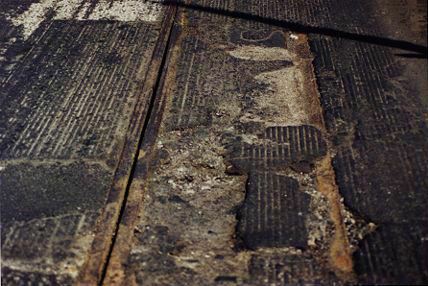
Along with the terrifically bad pavement, which is loose and wearing away further under the pounding of daily traffic, are rusty rails of sorts. They are most often seen in pairs, as at this exposure at 111th Street, but where the wearing away is more complete, we see all three of them.
The streetcars of Manhattan (with a very few exceptions far uptown) were not trolley cars. In two US cities, Manhattan and Washington DC, local ordinances prohibited overhead wires, and so the power wire had to be taken underground, into a conduit.
The usual analogy was to a trolley wire under the car instead of over. It's also the same idea as Lionel O-gauge toy trains, except that their low-powered center rail does not need to be hidden from accidental touch. And it's the same as the subway's third rail along one side of the track. In the conduit system, there were a pair of T shaped rails with the "tops" facing each other: -| |- , charged at the usual trolley power of 500 to 600 volts of direct current, and contacted by a sliding collector called a plough that extended down from the car.