E4400
apma4400: introduction to biophysical modeling
Instructor: Professor Wiggins, rm 428 S. W. Mudd
Space-time: Mondays+Wednesdays 10:10-11:25. Location 503 Hamilton
Office hours: by appointment. Email me please.
URL: http://www.columbia.edu/~chw2/4400.htm
Book: "Quantitative Biology" (Chris Wiggins) students email me w/your uni (columbia ID) and your GitHub ID for access
Audience: advanced undergraduates and beginning graduate students with some exposure to probability, statistics, dynamical systems, classical mechanics, statistical mechanics, linear algebra. Previous students have come from such departments as APAM, biology, BME, CS, DBMI, EE, physics, ..., and probably several that I'm forgetting and/or don't know about.
Homework: due 2 classes after it's assigned (usually 1 week), at start of class
Grader: Bigeng Wang, [email protected]
ESTIMATED outline/schedule, i.e., the dates for checkups, tests, etc. are estimates until you hear otherwise. Don't make travel or other plans around these dates unless I tell you by email. Then it's real.
Lecture 1: Wednesday, Jan 20, 2016.
- course overview (title/audience)
- who are you?
- who am i?
- grading policy
- checkups: 50% (hopefully there will be 2-3 of them, depending on progress of lectures)
- homework: 10% (to be turned in, email preferred, or hard copy, at the start of class 1 week after it's assigned (or at the start of the next class after 1 week has elapsed in case of schedule irregularities)) Late HW is 0 credit.
- final: 40%
- check here later in the term
- course history (f01,s03,s04,s05,s06,s07,s08,s10,s11)
- prerequisites/useful background
- math (ode,pde,lin alg,prob,stat)
- physics
- no quantum mechanics
- stat mech will be "derived"
- it would be good to know some classical mechanics, but there will be no Lagrangians
- electrostatics will show up briefly
- books
- Goodsell (lecture 0 only)
- berg (lecture 1 only)
- PCN (part I only)
- mine
- note: appendices to this book have as their origin students' questions. therefore, please ask questions when anything is unclear.
- things we will discuss: 3 revolutions
- single molecule biophysics and the physics of biological materials
- systems biology
- data-driven biology
- things we will not discuss
- physiology
- immunology
- neuroscience
- physics at the scale of the cell
- the scale of the cell
- scales of things in general
- what's inside a cell? (cf. Goodsell's site and book)
- verbs: dynamics at the scale of the cell
This lecture will involve some simple physics, some simple mathematics, and some dimensional estimation of things.
- HW #1
- Learn the Greek alphabet
Lecture 2: Monday, Jan 25, 2016.
- Review from last time
- scale of the cell
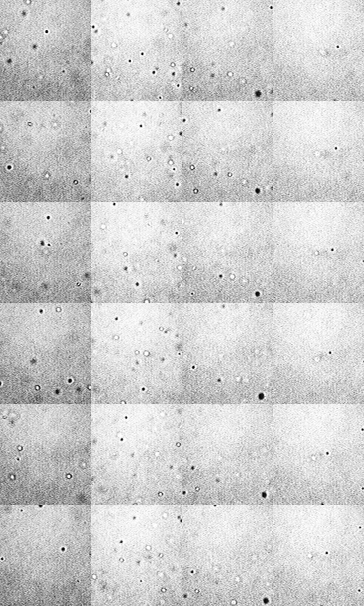
- Brownian motion, demo, diffusion
- dimensions of temperature, viscosity, and "drag constants", suggestion of Stokes
- dimensional suggestion of Stokes-Einstein
- Langevin approach to understanding Stokes-Einstein
- How big is viscosity? (Re)
- Universality of diffusion: stocks, polymers
- probability: 2 properties, 2 rules
- HW #2:
- How many cells make up you?
- Go to the RCSB protein data bank ( http://www.rcsb.org/ ) and look up your favorite protein. If you don't have one yet, try "kinesin", or "Gene Regulating Protein". How big is it? (in volume? in mass? in Daltons?) How many proteins could fit in a cell?
- Convert kT, at room temperature, into picoNewtons and nanometers
- what is the ``molar concentration" of 1 object in a bacterium? (a concentration is just a number of objects per volume -- irrespective of what the object is)
- Estimate how high you jump if you stay in the air for 1 second. (hint: use the natural acceleration given by gravity)
- Estimate the stall force of kinesin given that it takes 8 nm steps (hint: use the natural energy given by room temperature)
- Estimate deceleration time for a bacterium: Use the fact that it's decelerating with a force given by the drag force $F=-bv,$ and this balances $mass* (dv/dt).$ Then estimate the size of the exponential decay time. Assume a spherical bacterium made of water, and a drag constant given by Stokes relation (as we discussed in class).)
- Estimate coasting distance for a bacterium, assuming it is swimming initially at its own body length/second, and then comes to rest over one stall time
Lecture 3: Wednesday, Jan 27, 2016.
- Step size model as a probability
- Derivation of a statistic (an expectation) from a probability (a distribution)
- the flow of a probability
- derivation of diffusion equation equation and is normalized for the right choice of A and B
Lecture 4: Monday, Feb 1, 2016.
- diffusion with drift
- J=0
- Boltzmann
- partition functions $U\propto x$
- HW #3:
- show that $\exp(-x^2/(2Bt))/\sqrt(At)$ (the Gaussian with width given by Bt) is normalized and solves the diffusion for appropriate A and B.
- find ρ such that Jtotal = Jdrift + Jdiffusion = 0 and bv = −∂xU(x).
Lecture 5: Wednesday, Feb 3, 2016.
- review:
- 2 properties of probability
- 2 rules of probability
- Bayes theorem
- random walks
- diffusion with drift
- conservation laws
- statistical steady state implies Boltzmann
- diffusion with drift
- The Boltzmann distribution
- intuition-building / putting Boltzmann to work in biology by choices of "U"
- $U=x$: pollen grains in gravity
- The partition function --- a moment generating function for the
- relating $Z''$ to $\sigma_U^2$. energy
- HW #4:
- prove ∫0∞dvvexp(−v)=1
- prove var(x)= < x2 > − < x>2 = <(x − (x))2>
- calculate <U> for U = αxnu, with either x=0..infinity or x=-infinity..infinity if nu=odd or even, respectively
Lecture 6: Monday, Feb 8, 2016.
- THE moment generation function; A moment generation function
- more intuition-building / putting Boltzmann to work in biology by choices of "U"
- $U=\pm 1$: Ising model/pulled DNA/"two-state systems"
Lecture 7: Wednesday, Feb 10, 2016: fluctuations
Lecture 8: Monday, Feb 15, 2016.
- linear response theory
- Review for checkup on Wednesday, Feb 17, 2016.
Checkup 1: Wednesday, Feb 17, 2016.
Lecture 9: Monday, Feb 22, 2016.
- J nonzero
- motor proteins (U ∝ x)
- HW #5
- derive J[U]
- derive J for U=fx
- derive J for Kramer's escape (double well)
Lecture 10: Wednesday, Feb 24, 2016.
- J nonzero
- Kramers and double well (U ∝ x2)
- 2-state dynamics for probability
Guest 1: Monday Feb 29, 2016.
Lecture 11: Wednesday, Mar 2, 2016.
- MMK
- standard dogma
- transcriptional regulation as a dynamical system
- Literature/context
- HW #6:
- derive P+/P− from rates
- find fixed points of xt = λx(1 − x)
- find stability of each fixed point from the above
- HW for me: confirm book diagram of MMK
Lecture 12: Monday, Mar 7, 2016 (due Monday Mar 21)
- MMK and regulation
- fixed points and dynamical systems for auto-up and auto-down-regulation
- HW #7:
- classify stability for all fixed points for the auto-up-regulating and auto-down-regulating gene. Feel free to start with y′=1/(1 + y)−ay and y′=y/(1 + y)−ay for the 2 cases.
Lecture 13: Wednesday, Mar 9, 2016 (due Wednesday Mar 23)
- Cooperativity and regulation
- Literature/Context: synthetic biology
- Redo MMK-style view of up- and down-regulation but with cooperativity
- HW #8:
- Starting with MMK-style modeling of transcription factor binding, but including cooperativity (i.e., F ↔ nX), derive y′=yn/(1 + yn)−αy for an auto-up-regulating gene.
- Same question but for down-regulation, y′=1/(1 + yn)−αy.
Monday, Mar 14, 2016.: spring break
Wednesday, Mar 16, 2016.: spring break
Lecture 14: Monday Mar 21
- New business: checkup #2 on April 13
- Review of MMK approach with cooperativity
- Dynamical systems with cooperativity
- Review bifurcation diagrams for n=1
- Pictoral view of cooperative autoregulation
Lecture 15: Wednesday, Mar 23, 2016.
- Critical parameter for n=2 case
- general n case
- 2D dynamics
- 2D eigenspace
- det, trace, and stability
- comparison with 1-D case
- HW #9:
- show that, for a d-dimensional dynamical system yt = g(y), near a fixed point y* (i.e., g(y*)=0), if the Jacobian of the velocity Jik = ∂yigk admits d distinct eigenvalues λα with corresponding eigenvectors vα, i.e., enjoying Jvα = λαvα, then η(t)=∑αcαexp(tλα)vα is a solution for y(t) near a fixed point.
- Show that the dimensionful equations for transcription and translation (in terms of rt and xt) can be nondimensionalized as rt = f±(xn)−βr, xt = r − γx for suitable β, γ.
- Show that in 2 dimensions we have stability of fixed points ⇔ ∂xf(x*)<βγ
Lecture 16: Monday, Mar 28, 2016.
- Cellular noise
- stochastics and BDP (birth death process)
- micro-macro correspondence
- decay
- production
- combination
- steady state for 'constant' birth-death
- HW #10
- show that Poisson is steady state for BDP
- compute 1st moment from Poisson distribution
- compute 2nd moment from Poisson distribution
Lecture 17: Wednesday, Mar 30, 2016.
- BDP
- general form
- familiar conservation law form
- dynamics of 1st moment
- Literature examples
Lecture 18: Monday, Apr 4, 2016.
Lecture 19: Wednesday, Apr 6, 2016.
- linear noise approximation
- multiple reacting species
- review for Checkup #2
Lecture 20: Monday, Apr 11, 2016. - review for Checkup #2
Special event: Wednesday, Apr 13, 2016. - Checkup #2
Lecture 21: Monday, Apr 18, 2016.
- Data
- reduce
- regression
- regularization
- likelihood
- cross validation
- HW #12
- Show that the minimizer of |y − βTx|2 enjoys the matrix equation M1β = b1 (i.e., find M1 and b1).
- Show that the maximizer of P(D, β) with the prior P(β) a Gaussian (one independent Gaussian for each component) enjoys the matrix equation M2β = b2 (i.e., find the appropriate M2 and b2) (Hint: in a limit as one of your paramters goes to 0, you should recover M1 and b1).
Lecture 22: Wednesday, Apr 20, 2016.
Lecture 23: Monday, Apr 25, 2016.
Lecture 24: Wednesday, Apr 27, 2016.
Lecture 25: Monday, May 2, 2016. (last day of class)
- Reduction from prescriptive to predictive
- Hot topics in biology: 2007-2015
- Review for final
 (image from Eric Weeks, physics department, Emory)