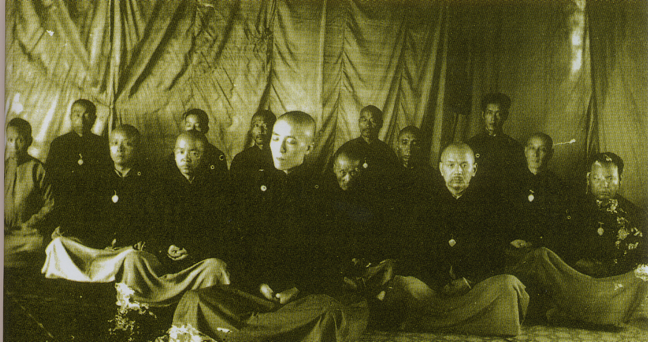
Figure 1 |
|
My presentation is drawn from a much larger project: a biography of Chinese religious leader Li Yujie. Li (1901 - 1994) founded a redemptive society, the Tiandijiao (Teachings of the Heavenly Emperor), in Taiwan in 1979 after decades of implication in various religious and cultivation activities. He practiced Jiang Weiqing’s qigong in the 1920s and became a disciple of Xiao Changming, leader of the Tiandejiao (Teachings of the Heavenly Virtues) in the 1930s. In 1934, Xiao dispatched Li to Xi’an where he was to evangelize the vast northwestern region, spreading the Tiandejiao through such organizations as the Study of Religion and Philosophy (Zongjiao zhexue yanjiushe)—the intellectual/academic form of the Tiandejiao —and the Hongxin zihui (The Red Heart Society), its charitable/philanthropic wing. In fact, Li spent most of the wartime period—8 years—in a cave on Huashan mountain, meditating, communing with the celestial realm, composing scriptures, and protecting China from Japan through various spiritual interventions. It was during this period that Li became a religious leader in his own right, inheriting the leadership of the Tiandejiao on the occasion of Xiao Changming’s death in 1943, at which point Li changed the name of the society to Tianrenjiao (Teachings of Heaven and Man). Li’s experience closely tracks that of other redemptive society leaders in twentieth century China, as he combined a charismatic personality with claims to healing power (through qigong, among other things), and original scriptures and teachings based on a combination of traditional moral practice, ecumenical embrace of world-wide religious teachings, and eager acceptance of modern scientific discourse. At the same time, Li’s life was not limited to his involvement in redemptive societies. He studied at Shanghai’s Zhongguo gongxue, which occupies an important place in the history of student activism and radicalization, and indeed served as a student leader in Shanghai during the May Fourth movement. He joined the GMD in 1919 and later served as a technocrat in the GMD government, working with T.V. Soong to draft China’s first national and modern tax code. He maintained his contacts with GMD civil and military officials even while retiring to Huashan; the famed GMD general Hu Zongren was a particularly close friend, and climbed Huashan on repeated occasions to meet with Li. Moving to Taiwan with the GMD in the late 1940s, Li took up journalism and became editor of the well-known independent newspaper, the Zili wanbao, in which role he served as an influential advocate for press freedom until his retirement in the mid-sixties. Much of my interest in Li’s life and career was sparked by the diversity of his interests and the breadth of his political and social networks. Historians of Chinese religion generally depict the relationship between politics and religion in twentieth-century China as being particularly fraught, but Li seems to have navigated these tensions with ease, moving seamlessly between government service, religion, and journalism. In the context of this panel I will concentrate on Li’s transition from religion to journalism in the 1950s. Specific points to be developed include:
At the most basic level, Li’s experience reminds us that the world of Chinese religion was not limited to events on the Chinese mainland, nor to policies connected with the Communist regime. The broader history of Chinese religion in the modern and contemporary periods must include events in the larger sinophone world. |