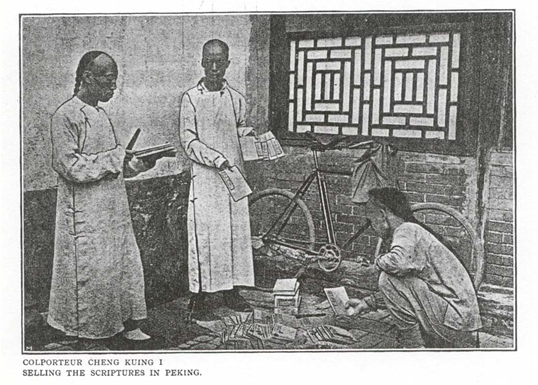
A Chinese Colporteur of the British and Foreign Bible Society Selling Chinese Bibles in Beijing, circa 1905. The Bible in the World, 1905, p. 333. |
|
Throughout the 19th and the early 20th centuries, the British and Foreign Bible Society (BFBS), the first Bible Society entering China, was a keen supporter to Chinese Protestant Bible translation. Founded in London in 1804, the BFBS is an interdenominational Protestant organization whose "sole object shall be to encourage the wider circulation of the Holy Scriptures, without note or comment". Although the BFBS was based in London in the 19th century, its work reached throughout the world and was coincident with the expansion of the British Empire. In China, in addition to providing financial support to Bible translators and publishing their outcomes, the BFBS advocated the circulation of Chinese Bibles through its distribution network relying on a corps of travelling Bible distributors called colporteurs, who carried "God's Book from door to door and pass it from hand to hand" and aimed to "ensure every Chinese has a Bible in his hands". A member of evangelicalism, the BFBS believed the Bible is a "single, self-contained, coherent text" which contains all things necessary to salvation and is self-sufficient to be its own interpreter. The BFBS's duty was to distribute the Bible as widely as possible and the biblical text itself would do the rest. The BFBS often reported that so many Chinese were attracted to the Christian faith by its Chinese Bible without note or comment. Nonetheless, Protestant missionaries in China depicted their mission field quite differently: In many cases, such kind of Bible was not understood or even misinterpreted by the Chinese people, if it was read by them alone. This paper will first offer an overview of the BFBS's colportage work in late Qing China. It will then examine the debate provoked by the BFBS’s colportage work about the usefulness of Chinese Bibles without note or comment between the BFBS and Protestant missionaries in China. Their arguments indeed throw light on the difficulties in practising and the different understandings of the doctrine of the Bible’s self-sufficiency in the context of China as a mission field. |