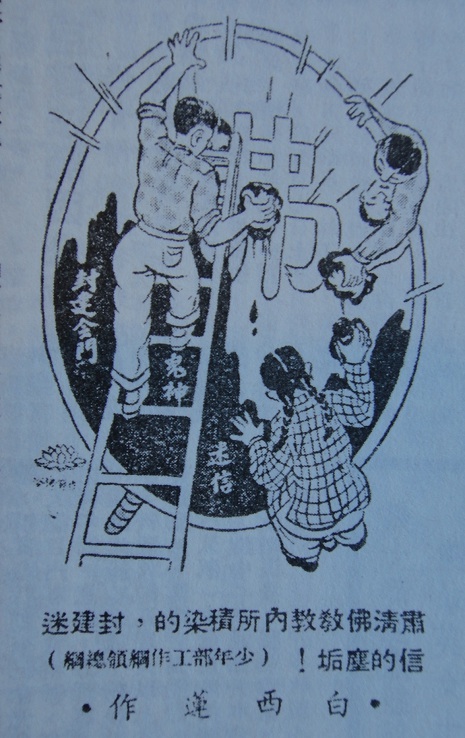
Figure 1: |
Abstract:The 1950s was a pivotal age in the twentieth-century transformation of China’s religious landscape. It was in this first decade of the People’s Republic of China (PRC) that many religious groups first encountered the newly ascendant Communist party-state. The focal point for the new regime’s governance of religion was Shanghai, the cosmopolitan urban metropolis that had rapidly become a national center of religious activism over preceding decades. This paper examines the impact of Communist governance on the Chinese religious landscape during the 1950s through the case of the Young Buddhist Association of Shanghai. The Young Buddhist Association (YBA) arose amidst the warfare of the 1940s to rejuvenate an aging community of urban Buddhist activists. Rapid expansion of the YBA continued to gain momentum after the Communist takeover in 1949, making it perhaps the most active and influential grassroots Buddhist organization in the early PRC. However, at the end of 1955 the YBA experienced a sudden reversal, as it became the first Buddhist group to be targeted in a national campaign against counterrevolutionaries in the Buddhist community. Denunciation of the YBA became the starting point for the party-state’s systematic dismantling of Buddhist activism in Shanghai and elsewhere. This paper argues that, prior to its dramatic downfall at the end of 1955, for six years the YBA had successfully integrated the political script of the Communist party-state without undermining its original religious character and mission. The YBA’s flipping of the script in the 1950s both drew on earlier Buddhist responses to regime change prior to 1949, and laid a foundation for the rehabilitation of Buddhist leaders and organizations after 1978 in the post-Mao era. |