From the Introduction:
Religion’s role and fate on the Internet emerged in the 1990s as a hot new topic in
religious studies and has stayed with us since then, spawning for example a panel at
this AAR meeting on "Surveying Our Understanding of Digital Religion" (organized
by the "Religion, Media, and Culture" group). Drawing on Walter Ong's theories of
the impact of communication technologies on human consciousness and cultural
innovation, in the early years expectations were high that online religion would create
radically novel (and perhaps even better) ways of being religious and doing religion.
This optimism has of late been dampened. Stephen D. O'Leary, one of the field’s
early "prophets," is now taking a more guarded view, pointing out that by the mid-
2000's few religious websites had utilized the full communicative potential of the
Web. While religious groups have rushed to embrace the Web as a largely one-way
platform to get their message across, they have been more reluctant to come up with
new interactive modes of religious communication and action. In the same conference
volume as O'Leary's piece, Lorne L. Dawson considers the limitations of online
religiosity in terms of the inbuilt reflexivity of computer-mediated communication.
This may work well for fringe religious forms such as techno-paganism, but seems
hard to reconcile with more traditional notions of authentic religious experience.
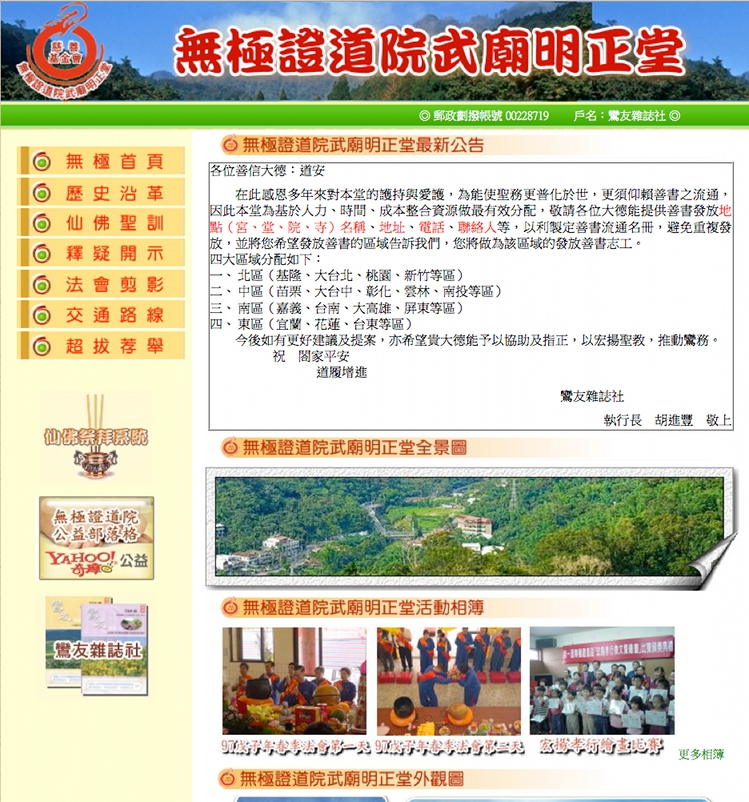
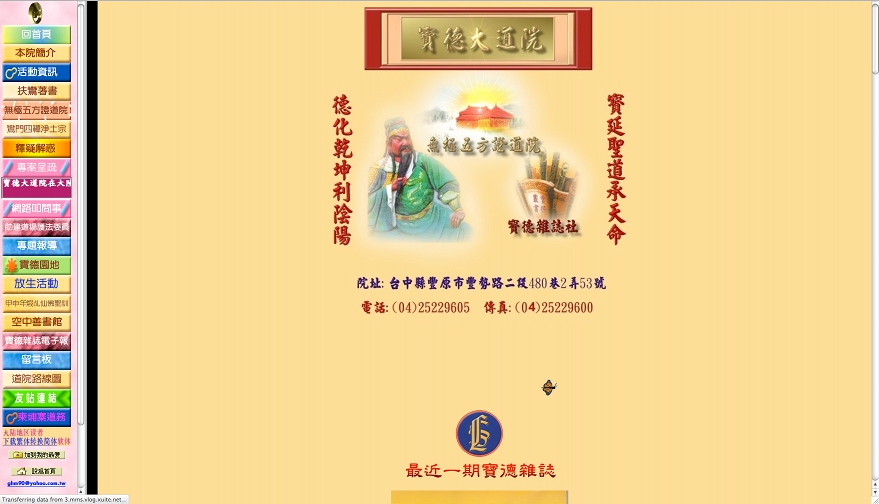
The present paper seeks to examine the forays into the Internet of one type of
religious organization in Taiwan: spirit-writing cults, a.k.a. "phoenix halls" (luantang
鸞堂). The key activity of any phoenix hall is spirit-writing (fuji 扶乩, fuluan 扶鸞),
i.e., the recording of texts authored by the cult group's gods through the services of a
human medium wielding either a pen on paper, or a wooden, Y-shaped "planchette"
(mubi 木筆, taobi 桃筆) on the sand-covered surface of a tray. Most of the texts thus
produced are classified as "morality books" (shanshu 善書), texts admonishing
people to moral reform and spiritual cultivation. Spirit-writing is not the only activity
of a luantang, but is supplemented with numerous ritual and spiritual services, many
of which are also performed by other groups. These include, for example, divinatory
counselling (jishi 濟世), spiritual healing (lingliao 靈療), salvation of ancestors
(chaoba 超拔), release of captive animals (fangsheng 放生), scripture recitation
(songjing 誦經) etc. However, spirit-writing is the key (or perhaps, trademark)
activity in that it defines the identity of a luantang vis-à-vis other religious groups that
do not practise this form of mediumistic communication.
|