The year 2005 was unusual in that this is the first time in five years that I did not go to Germany to continue research there. Want of free time and money, especially with an unfavorable exchange rate, makes overseas travel difficult, as we all know. Be that as it is, I continued research here on the Felbinger and Prahl families and their relatives. As the following report will show, it was a most fruitful year in learning more about the families in the New York metropolitan area, and some research has provided preliminary work for further research in Germany.
Felbinger families
For the Felbinger families, I spent much of the year at the Mormon Family History Center in Woodside, researching the Brenner-Archiv from Middle Franconia. I finished researching the Felbingers and continued with the Siebers, the Beierleins and the Sturms. For the Siebers and Beierleins the results were meager at best. I have often thought the process of going through so many records with little result is analogous to processing tons of pitchblende for a few precious ounces of radium; it is tedious work, but the result for that little bit of radiant, illuminating ore is often worth the effort. For the Sturms I had much better results. There are two sheets in the Archiv for Johannes Sturm (1751-1799). Johannes Sturm is no immediate relation to me, but his descendants are important in the Felbinger family history in 19th century Ickelheim, and from these the Illinois and California Felbingers are descended. The first sheet records his marriage to Anna Barbara Schmidt in 1781 and the children of that marriage. This record is important, because I have not known the name of his first wife, the older sister of Schmidt's second wife, my great-great-great-grandmother Anna Sibylla Schmidt, who on Sturm's death in 1799 married Jobst Felbinger. Additionally, the sheet records Sturm's birth (1751 in Sontheim) and their fathers' names: Georg Sturm, communal shepherd in Gerbersdorf, and Johan(nes) Schmidt of Sontheim. The record confirms the name of my great-great-great-great grandfather Schmidt. The second sheet records the marriage of Johannes Sturm and Anna Sibylla Schmidt and their two children Johann Georg (*1797) and Johann Georg (*1798). In the new year, I will continue to search the Brenner-Archiv records to determine if I can trace the Sturms further back, before undertaking the arduous task of searching through 12 reels of microfilm for the Schmidts. Certainly this much information warrants another trip to Germany to copy out the Sturm records, as well as to continue research on the Felbingers.
The really big piece of Felbinger news in this year came, as is often the way of these things, through an unexpected source. After some e-mail correspondence with Elizabeth Lovaglio, President of German Genealogy Group, I decided to search (yet again) the Group's website that has a number of church records, including that of the Zion German Evangelical Lutheran Church on Henry Street in Brooklyn. I had searched this site once before, because Aunt Gene (Felbinger) Campbell mentioned that the Meyers had attended the church, indeed had been married there, but I had no success on the initial search. This time I thought to search using the soundex approach, and lo, up pops "Gessina Dorothea Margaretha Meyer". At first look, this would be my grandmother Cenie Felbinger, and I had always known the first name as "Gesina", which falsified the first search. Liz very graciously sent me a photocopy of the full record, and it is indeed Grandmother. Grandmother Gesine Felbinger (b. Meyer) was born on December 18, 1868 (U.S. Grant had just been elected President the month before), and was baptized on February 21st, 1869. Up to now no one in the family has known exactly when Cenie was born, as she herself was always rather vague on the subject; there are several family stories that relate to this one matter alone. A mystery of almost 140 years has been solved. Of course, I had to order the entire microfilm at the Family History Center and work my way through the registers of the Zion Church. On this line of research, I have not progressed too far. A preliminary search seems to indicate that Cenie was the only one of the nine surviving Meyer children to be baptized in the church. There is some indication that some of great-grandmother (Catarina) Margaretha (Doppmann) Meyer's nieces and nephews were also baptized in the church, but I have not pursued this research too far as well.
In other Felbinger news, I was able to assist cousin Mary Lou Benjamin by finding the passenger record for her ancestor Friedrich Fichtelmann in "Germans to America" (her Fred #1). Though the record indicates his original destination was New Orleans, there is no subsequent information whether he went there or got off the ship in New York in May 1852 and stayed in the immediate area. Indeed, there is strong evidence that he traveled no further because there is a record of his marriage in New Jersey in 1856. Finally, I received from cousin Dieter Kett in Germany a note that there is a map of Ickelheim available on the Internet. He managed to download its several pieces and put them together, and sent me the result. The map is from 1828, the heyday of the Felbingers in Ickelheim. More important, great-great-great-grandfather Jobst Felbinger is listed in the left margin of the map among those who are considered "Grundbesitzer ohne Häuser". The term itself is clear enough, but without further information about conditions in Ickelheim, it is not exactly clear why Jobst would not have possession of a house.
Prahl families
The Prahl families were the "big winners" in 2005. In the beginning months of 2005, I undertook computer searches for the various Prahl families in the Genealogical Division of the New York Public Library. Why pay Ancestry.com their fees when my tax dollars allow me to do the searches for free at 5th Avenue and 42nd Street? It has been my intent to find the passenger record for the arrival of great-great-grandfather Charles Prahl in 1853, as the register for the alleged time of his departure from Hamburg, Germany that year went missing in the 1920's. I was initially hopeful that the newer computer websites might be helpful in this search, because the passenger manifests for New York arrivals are finally on-line. This search is no easy task, however. In Germans to America, great-great-grandmother Friedrika Anna Prahl's name is listed as "Prahe", because the transcriber misread the final manuscript "l". In the Ancestry.com index, her name is listed as "Trahe", a misreading of both the initial ornate manuscript "P" and the final"l". With accuracy like this, it's a wonder people find their ancestors at all, yet the misreadings give some sense of variant forms of the name, some not so obvious. If all other information is correct, I assume Charles Prahl left Germany sometime in May 1853 and arrived perhaps seven weeks later, late June/early July. A computer search has turned up nothing, even under several variant spellings. The only thing I can now think to do is write the municipal archives in Bad Oldesloe for information as to when Charles renounced his citizenship, and to make a hand search of every passenger manifest for ships arriving in New York.
Of course, an actual record of Charles Prahl's passage may in fact not exist. I am also not encouraged by what might be in Germany, either. In May I discovered the emmigrants' website of the Amerika-Gesellschaft e.V. in Bad Segeberg, Schleswig-Holstein (know the town well, having been there two years ago), and found they have a listing for Charles Prahl, though none for Friedrika Prahl. I immediately e-mailed them, inquiring what additional information they might possibly have. I received an answer within a month. The Gesellschaft sent information from a book Idstedt und danach : Schleswig-Holsteiner in den USA / hersg. von Holger Andersen. Plon : Sönksen, 1987, p. 57. Essentially, the information is from Schlegel (cited in the bibliography), and of course comes from Grampa! I'm sure he would be glad to know he is such an authority to be cited in scholarly works. The entry is conflated somewhat by indicating *exactly* what Charles did to get himself into trouble: he joined the rebels and fought at the battle of the Bov in April, 1848. This information I already have in hand from other sources, but it is interesting to note that Andersen did *not* cite those sources. Hmmmm, the joys of scholarship. Happily, GD-NYPL has a copy of the book, so I retrieved it, and those portions most relevent to my research are photocopied and residing in the files. Still, the incident does not make me too sanguine about ever finding a record of Charles' passage.
Continuing with the search of the ship records on-line for other family members, I found nothing particularly promising for great-great-grandfather Ignaz Merkel. However, I did find an intriging record that might be great-great-grandmother Elisabeth Merkel, born Stephan. The record cites one Elisabeth Stephen, age 19, arriving with George Stephan, age 27, on the ship "Gallia" from Le Harve in New York on May 9, 1850. There is no mention of their relationship, so it might be sibling rather than marital. The age for Elisabeth is right, but they are listed as coming from France. Still, the manifest indicates that many of the passengers on the "Gallia" were from Austria, Bavaria and Baden, so it is possibly her, but not definite without other corroborating information.
I also searched several Federal censuses online for records concerning the Prahl families. Before starting on the Prahls in Staten Island, I consulted two indexes: New York South 1860 / edited by Ronald Vern Jackson, and Long Island (+ Duchess, Queens, Suffolk & Richmond) New York 1870 (same editor). These indexes indicated a Charles "Prall" and Charles "Prawl" living in Middleton and Middletown townships in the respective years. Subsequent help from Linda Carco of German Genealogy Group proved these entries are for great-great-grandfather Charles and Friedrika and family. I did manage to finally find the 1900 record for grandfather Edward Prahl (listed in the Ancestry.com index as "Edmund"; a *very* careful examination of the handwriting indicates "Edward", but could be easily mistaken for "Edmund") his mother Delia, and his sisters Adelaide and Mathilde ("Tilda" in the record). They were living with Ignaz and Elisabeth Merkel at 507 Lenox Avenue in Manhattan (now the site of the Schomburg Center for Research in Black Culture of the New York Public Library). The record is interesting as it lists Grampa and Tilda as being each born ten years later than they were, though their ages in the record are correct. It also indicates Grampa was still in the United States, before going off to the Army and overseas to China and the Philippines (family stories). Also, I found several census records for Blaicher, especially the 1900 census record (listed as "Bleicher" in the index, because on the original record the manuscript "a" is blotted); all members of the family are present, except for grandmother Christina, who was 17 at the time and perhaps living with other relatives.
In an attempt to find out more about great-great uncle Charles Edward Prahl, the first Prahl born in America, I did a search of printed materials at the GD-NYPL for the 71st New York Infantry Regiment, in which he allegedly served after the Civil War. There are two standard histories of the regiment: Whittemore, Henry, History of the Seventy-First Regiment N.G.S.N.Y. : including the history of the Veteran Association with biographical sketches of members, New York : W. McDonald, 1886; and Francis, Augustus Theodore, History of the 71st Regiment, N.G., N.Y. : the American Guard, New York : Veterans Association, 71st Regiment, N.G., N.Y., 1919. The books proved unhelpful. Both authors note their histories are derived principally from newpaper sources, because of the carelessness of record keeping in the early days of the regiment before the Civil War, that no official papers were retained, and what became of orders and correspondence is not known. Post-war record keeping and preservation were better, but Francis comments that on February 22, 1902 the regimental records and memorabilia went up in flames in a disastrous fire in the regiment's armory, and by this time not a member of the regiment prior to 1857 was known to be alive, and "even those of the '70's and '80s were somewhat hazy as to facts". Whittemore's book indeed contains biographical sketches of the Regiment's personnel, but officers rather than enlisted men. The two courses of action here are to try and contact the successor organization of the 71st Regiment, and to inquire of the New York State Adjutant-General's office in Albany.
At the time I found the information about grandmother Cenie Felbinger, I felt inspired to take another look at the New York City Death Index on the German Genealogical Group website. Where previously I had only found a couple Prahls, I now found just about all of them, including Charles Edward (d. 1892 of intestinal blockage and septicemia), and lo, great-grandmother Delia Prahl, died 1928 in the Bronx, when previously I had thought she probably died in New Jersey because she was living there in 1920 with her sister Margaret Kuhlmann. I also found a number of Blaichers as well, especially Violet ("Aunt Vy" to Mom and Aunt Chris). Finding this information necessitated another trip to the New York City Municipal Archives to retrieve the death certificates. It was very gratifying to find that Charles Edward is buried in Woodland Cemetery (the count now up to four), and that Delia is buried in Lutheran Cemetery. I did not find great-grandmother Henrietta Blaicher in the online NYC Death Index. But because the index went up to 1936, on a hunch I continued to look later in the Archives and finally found her listed as dying in 1942 in the Bronx and being buried in Brookside Cemetery in Englewood, NJ. This record is significant because it was signed by her son Arthur (whose ashes rested several years under the eaves of our home in Valley Stream before Mom thought to have him buried in the cemetery on Merrick Road in Rockville Center, NY), and names her father George and mother Anna Margaretha Ortnaug(?)(the handwriting is unclear). In addition, I also obtained the death certificate for uncle Ernest Raymond Prahl, Mom and Aunt Chris's brother, died at age 4 months on August 20, 1916 of broncho-pneumonia, and also buried in Lutheran Cemetery. Upon inquiry, I learned, not without a touch of irony, that his birth certificate is still in the active files of Public Records at 125 Worth St. A search for great-grandfather Carl Blaicher at least indicates he did not die in New York City, but whether in New York State, New Jersey or somewhere else is a guess.
Armed with this much information, I started to make plans for a significant trip. I wrote to Lutheran and Brookside cemeteries, and obtained information about the graves. But first, I asked my fellow Woodland Cemetery trustee Luann Martin to check the interrment registers for the grave number of Charles Edward. She did better than this. She perused the registers and determined not only Charles Edward's grave number, but that a Fredrich W. Prahl and an Alfred Prahl are also buried in the same grave with great-great-grandmother Friedrika. This was an astounding find, totally unexpected, that eliminated the need to search for these two youngest sons of Charles and Friedrika Prahl. It explains why in the Prahl family history in Schlegel the names of Emil (Alfred?) and Fred are only mentioned: Grampa was only 4-6 years old at the time of their deaths as teenagers in 1887 and 1889 respectively, and so had no information about them. This brings the total number of ancestors in Woodland Cemetery, Staten Island up to six. And checking the death certificate again, I found that Adelaide Hagedorn, the oldest Prahl girl, is buried in Moravian Cemetery, also in Staten Island. So, except for the daughters Emma and Alma Prahl, who may well be buried in Orange County, New York with their husbands, all the Prahls of that particular generation are accounted for. It also puts to rest (bad pun!) a theory I have often entertained: the Felbingers are all in Greenwood, but the Prahls are spread out all over. Well, yes, they are, but they are also clustered in specific cemeteries. After this search only great-grandfather Carl Blaicher is really among the missing.
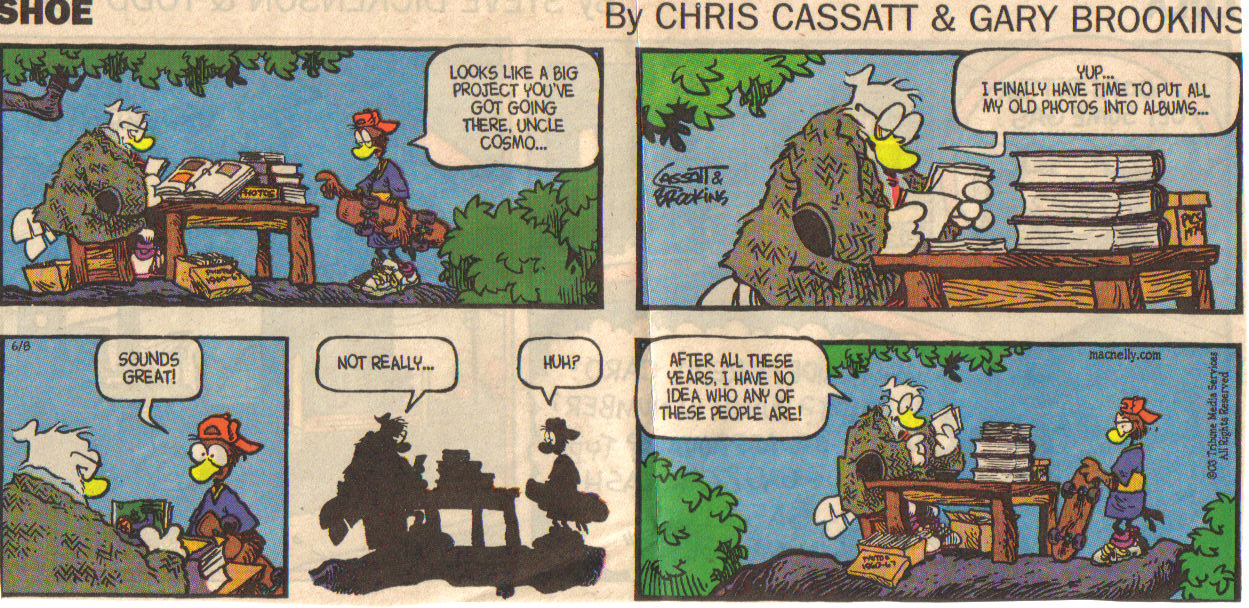
In June my sister Alice made her annual visit to New York. As part of her efforts (I confess it here: I seem to have infected her with the "genealogical bug") she went through the boxes of photographs left to us by Mom and Aunt Chris and arranged them into broad categories. This is one of those chores requiring lots of time and energy, and Alice did a masterful job, especially as we were able to identify several of the people in the photographs through association and guesswork. Yet it is sad to relate that many of the photographs have no identification other than that they were friends of Mom and Aunt Chris, and the names of the people shown are now lost. Another cartoon expresses the amusing, yet bittersweet aspect of this part of genealogical work:
Well, to get Alice out of the apartment and away from all the dusty pictures, I
had planned an "expedition" for the two of us. I suggested that
rather than "hit the high tourist spots" of New York City we "go
for the low tourist spots" and visit as many of the cemeteries in the
immediate area as we could. We did this on the long weekend of June 24-26th. We
took the ferry over to Staten Island so that Alice could make a visit to
Woodland Cemetery. Then we took a bus across the Verrazano Bridge and via the
subway up to Greenwood Cemetery where we found the graves of our uncle and aunt
Jim and Etta Cooper, visited the Felbinger family grave and visited the grave
of great-grandparents Meyer as well. We found the Coopers only because our
Vermont Cooper cousins had mentioned the family name of Appleyard (related to
the Coopers), and I remembered the conversation. We found the Felbinger family
grave, still slightly sunken (Dad always complained to the Cemetery about this;
to little effect, we found). And it took us a bit to find the Meyers' grave.
Dad had shown me the grave along the northern fence of the Cemetery on our
last visit in the early 1970's, so I was relying on a memory of some 30-35
years. We did find it, but I was confused because I distinctly remembered a
tree being just over the grave; Alice pointed out the stump of a tree along the
fence just at the grave. We continued back to Manhattan and took a long walk to
Avenue C and 8th Street to the northwest corner where the Prahls first lived
when they arrived, and then further on to where they lived on East 3rd Street
before moving to Staten Island. A thoroughly exhausting day, considering the
summer heat. Refreshed after a night's sleep (and having a rental car rather
than relying on public transportation) we proceeded on Saturday to Lutheran
Cemetery in Queens to find the graves of Elisabeth Merkel, Delia and Ernest
Prahl. Lutheran had supplied only sufficient information to tell me that there
are two graves. Only after the visit did I determine to pay the required fees
to find out who are actually in the graves. Yet at the time of our visit and on
a hunch, I did ask whether Ignaz Merkel might be buried in the Cemetery. The
staff confirmed the fact that he is so buried: oh happy day, Alice and I had
found our Civil War ancestor. Obviously he died in New Jersey, but either he
requested or the family decided to bury him with his wife Elisabeth. We visited
both graves and took pictures. Next day Sunday Alice and I had planned to visit
friends of hers in New Jersey, so we stopped in Englewood to go through
Brookside Cemetery. Another hot day and a fruitless search: the office was
closed and after 90 minutes of walking through an airless cemetery, we decided
to give up the search. Only as we were exiting the Cemetery did we realize
there is another section on the west side of Engle Avenue, and thought the
grave might be there.
Subsequent information concerning Brookside and Lutheran cemeteries proved particularly interesting. On my way to a short vacation in Vermont in August, I drove back to Brookside Cemetery, found the office staff who graciously led me over to the Blaicher grave (on the west side of the road, of course). We did spend a few minutes looking for it. At one point I took a turn to the right to go to another row, went down a short decline and just about fell over the grave stone of great-grandmother Hernrietta Blaicher. She is buried in the Bergman grave along with her daughter Violet. Took the requisite pictures and went on my way. Returning from Vermont, I received the additional information from Lutheran Cemetery. Ignaz and Elisabeth Merkel are buried in the grave of Margaret Geldermann, another of their daugthers who had bought the grave originally for herself and her first husband and family, the Moessners. This grave is located in the Cemetery section, north of Metropolitan Avenue. The surprise is that great-grandmother Delia Prahl is not buried with them, but rather with her grandson, my Uncle Ernest Prahl, in the grave in the south side of Metropolitan Avenue.
In October I made a return visit to Greenwood and Lutheran cemeteries. First, because I misplaced all of the paperwork I had collected during the visits in June. For all I know I may have inadvertently thrown them out with other paper trash (the amount of paper going out each week into the recycling bins is staggering). As of this writing they have not turned up, so I needed to collect the paperwork again. Second, I wanted to find in Greenwood the graves of Barbara Margaretha Felbinger (d. 1871) and Alma Felbinger (d. 1884; buried with great-great grandfather John Ulrich Fichtelmann), and the location of the Fichtelmann graves. I was sucessful to the extent that I found the lots where they are buried, but again there are no markers, so the exact locations of the graves within the lots are unknown. Third, I wanted to take additional pictures. In this effort I was particularly successful. And it was easier traveling: October is a much cooler time for "cemetery crawling" than June.
In addition to finding all these graves in New York/New Jersey, I have also tried to pursue additional research on Ignaz Merkel and the 45th New York Infantry. There is a lot of basic information available about the regiment: time of recruitment, battles and skirmishes fought, mustering out. Unfortunately, there has never been to my knowledge a full regimental history written, though I have seen on the Internet hints of one in preparation. I may have to do this one myself, even if only to gather as much of the documentary material as possible before looking for manuscript resources also known to exist. I let one researcher run up every citation in the Official records of the War of the Rebellion, the standard collection of field reports from Union and Confederate officers. I have read through The Union preserved : a guide to Civil War records in the New York State Archives; my copy is now heavily annotated with call numbers and other information I have garnered. I also sent off to the New York State Archives to obtain whatever service record they might have on Ignaz Merkel; the Archives returned the basic extract to me. The extract cites his enlistment and mustering out dates, and that in April 1863 he was listed as a "wagoner". Either he was a "wagoner" for the duration of the war, or detached to that duty in 1863. In any event, it would explain that he was not on the firing lines for the battles of Chancellorsville, Gettysburg and subsequent battles; at the least, it means he was relatively out of harm's way, though his pension records do mention an alleged wound received on May 1, 1863, the day before the Chancellorsville debacle. Last, I wrote to the Fredericksburg and Spottsylvania County National Park for some additional information about the 45th during the Chancellorsville battle, and received from them an interesting article about picket duty by the 45th not easily found elsewhere.
Considering how much information I have collected about the Prahl families the last two years, the time is long past to actually write up the results of my research. In October I began to write Der Super-Schlegel; or, Schlegel revisited, a sequel, update and revision to the work on the Prahl families originally presented in Schlegel's German-American families in the United States. Even while writing this report I found additional informaion on the Prahls in Germany. In my files, I discovered a letter written in 1901 by Charles Prahl, ostensibly to his granddaughters, my great aunts Adelaide and Matilda. How I obtained the letter I do not really know, except that either Mom gave me the letter at some point, or Alice found the material when we were cleaning out Mom's condominium in Copiague, NY. In the letter, great-great-grandfather Charles goes on to relate that his grandfather died fighting for the Danes at the battle of Sehestedt. Of course I was obliged to do additional research and write up this material for the new sequel. By the time of early December I have completed "Super-Schlegel" to the events of the uprising in Schleswig-Holstein in 1848 which brought Charles Prahl to the United States. The writing of this project will continue in the new year.
One other matter relating to the Prahl family should be noted here. On my morning walk one day in July I noticed that the front door of the apartment building at 983 Amsterdam Avenue, where grandmother Christina (Blaicher) Prahl lived and worked with her aunt and uncle Anrig in his confectioner's store in the first decade of the 20th century, was padlocked. In NYC this is usually not a good sign. My attempts to find out what was happening met only with "No comprendo, Señor." It was only in October that I was able to find out from supervisors on site that the building is being renovated, not demolished. This is good to know of course; I have a couple photographs of Gramma standing in front of the building, so the building holds a sentimental significance. From what little I was able to ascertain from direct observation, the building internally was most probably in its original construction and configuration as a five-story "tenement"-style building since its construction in the ... 1880s/1890s? Still, I am sorry I could not enter the building earlier, to obtain some sense of the original floor plans.
Last, as part of my duties as a trustee of Woodland Cemetery (I have been graced with the title of "Historian"), I wrote a brief paper on the genealogy of John King Vanderbilt, who donated the original piece of land for the Cemetery to the German Mission Society of the Episcopal Church in 1854. John King Vanderbilt was modestly successful as a grocer both in Manhattan and Staten Island, but his real passion was real estate. His other claim to fame is his relation to his more illustrious (some might say infamous) first cousin Cornelius Vanderbilt, "The Commodore", who became the founding father of the Vanderbilt dynasty in the 19th and 20th centuries. Also, I transcribed one historical document found among the Cemetery registers. This document is a history of the Cemetery from its founding in 1854 to 1937, written by Henry L. Koffer, president of the Trustees at that time.
The work is not complete; much work remains to be done.