The Collins/Kaufmann Forum for Modern Architectural History
The Department of Art History and Archaeology is launching its Spring 2021 Collins/Kaufmann Forum for Modern Architectural History with an experimental approach. This year, presented with the challenges of this ongoing global pandemic, we instead consider this situation as an opportunity to expand the geographies of research interest in a global architectural history. This new series of 6 lectures, curated by doctoral students, is thus entitled “Global Dialogues” and will invite scholars from around the world to share their recent research or work-in-process over Zoom, with the aim of surveying trends in different sub-fields of the period since 1750 and with specific attention to current methodologies, approaches, and themes of research. Each event will be hosted by a different graduate student in modern architectural history from the Department, generally in liaison with their own doctoral research.
All events in Spring 2021 are held over Zoom and open to the public.
Spring 2021
Patricio del Real
 Tropical Whiteness: Architectural Adventures in a Brazilian Ideology
with response by Mabel O. Wilson, hosted by Rebecca Yuste-Golob
Wednesday, February 3, 2021, 6:30 p.m. EST
Columbia University
Live Zoom Webinar: Register Here
In the early 1950s, U.S. citizens were encouraged to travel to Brazil to “have fun” and come back home “the wiser” by visiting modern architecture, with architects among these tourists. Brazilians, for one, knew a trick or two about living comfortably in hot, tropical weather, leading the world in Climate Control with designs that could be adapted to U.S. suburban living in regions that needed “privacy, shade and breeze.” Moreover, Brazilian examples of modern living carried important social lessons on how to be “free of racial prejudices.”
This talk explores the dissemination of the Brazilian ideology of racial harmony as it circulated through exhibitions, architecture journals, and popular magazines entangled with modern architecture as a discourse on “whiteness.” Traveling through north-Atlantic networks, as what I call tropical whiteness, modernism became a Trojan Horse of Brazil’s racial imaginary. Celebrated, contested, and challenged, it will “colorize” Brazil’s modern architecture, losing the “clarity” that local white elites and cultural officialdom sought to promote. This presentation advances the notion of tropical whiteness to reframe Brazilian modernism, explore a contested field of racial meaning, and uncover the dialogic relationship between cultural whiteness and tropical exoticism that in the 1940s and early ‘50s underwrote its architectural imaginary.
Richard Anderson

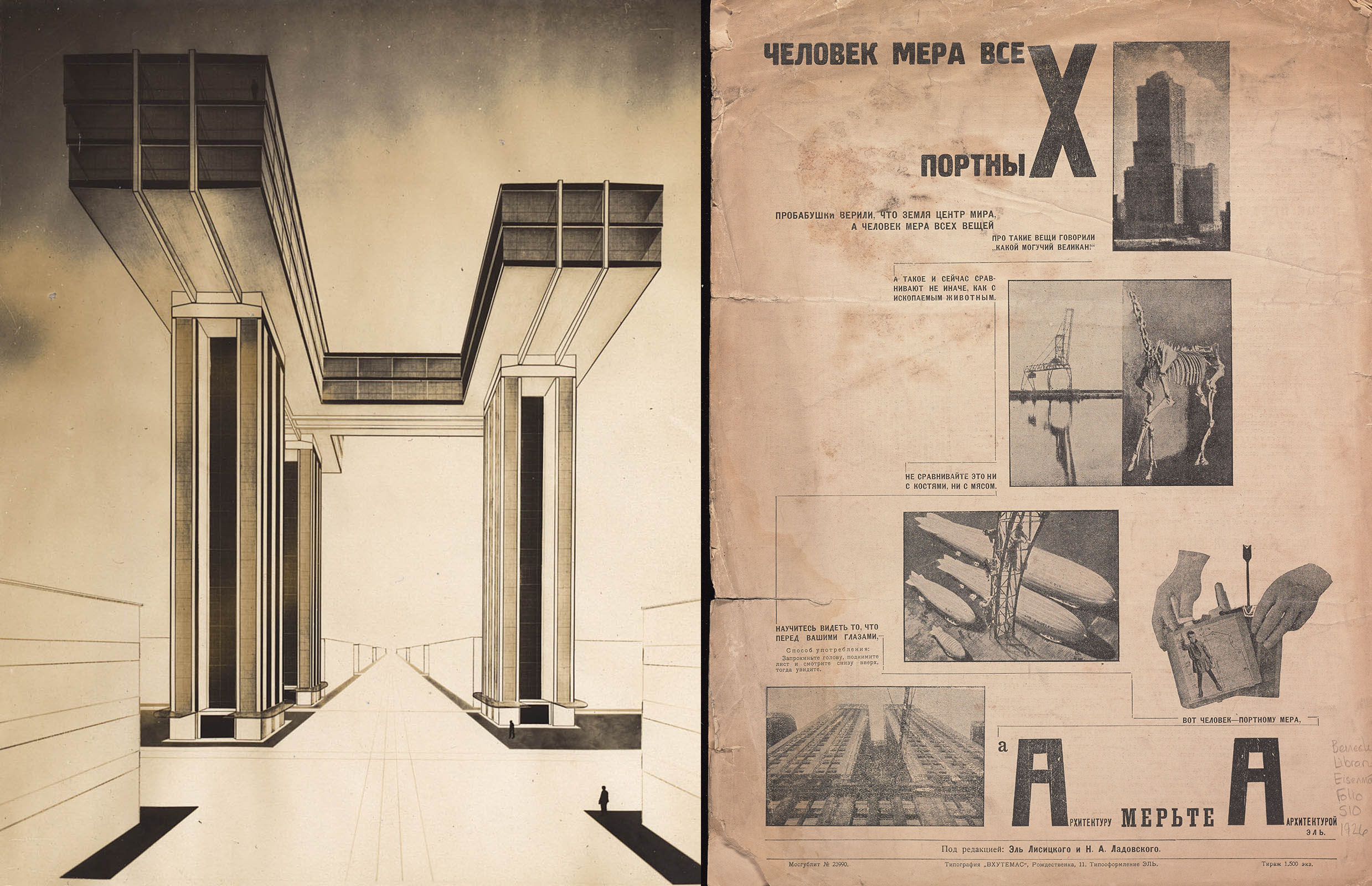
Left: El Lissitzky, Wolkenbügel, 1923-26
Right: El Lissitzky, ‘Man is the measure of
all tailors…,’ typo-photo montage for
Izvestiia ASNOVA, 1926
Learning to See: El Lissitzky’s Wolkenbügel
Hosted by Kasiet Toktomusheva
Friday, February 12, 2021, 12:30 p.m. EST
Columbia University
Live Zoom Webinar: Register Here
Variously described as a "sky stirrup," a "cloud iron," or a "cloud presser," the Wolkenbügel was El Lissitzky's most provocative contribution to architectural culture in the 1920s. Lissitzky conceived the Wolkenbügel during a period of intense productivity while undergoing treatment for tuberculosis in 1924-25 in Switzerland. First exhibited in Mannheim and Berlin, the project was described most fully in the pages of Izvestiia ASNOVA [ASNOVA News], which Lissitzky designed and edited for the Moscow-based Association of New Architects in 1926. The project emerged from, and was informed by, Lissitzky’s network of relationships that spanned Europe and the Soviet Union. As scholars have noted, the Wolkenbügel registered Lissitzky's deep engagement with "Americanism" and the emergence of new technologies and building types. Likewise, the Wolkenbügel clearly drew on Lissitzky's earlier painterly practice, evoking the forms that feature in his “PROUN” paintings. This paper addresses Lissitzky's project by synthesizing his preoccupations with scale, movement, and the conditions of visuality in the modern city. A key to understanding the Wolkenbügel is the enigmatic "Feuilleton of images" that Lissitzky published on the final page of Izvestiia ASNOVA. Using bold phrases such as "measure architecture by architecture" and "learn to see what is in front of your eyes," this typo-photo composition presented the incommensurability of human and architectural scales, suggesting that a new art of seeing was required to understand and inhabit the contemporary city. Attending to Lissitzky's concerns with visuality, orientation, and dynamism, this analysis asks how the Wolkenbügel manifested his interest in activated spectatorship and explores how the project served as a complement to his contemporaneous designs for demonstration spaces (Demonstrationsräume).
Jacqueline Taylor
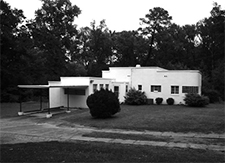 Azurest South (built 1939). Petersburg,
VA (Amaza Lee Meredith, 1895-1984)
Complicating the Canon: Modern Architecture and the Black Middle Class
with response by Mario Gooden & moderated by Mary McLeod
Friday, March 19, 2021, 12:00 p.m. EDT
Columbia University
Live Zoom Webinar: Register Here
In the late 1930s, Amaza Lee Meredith (1895-1984), an African American woman from Lynchburg, Virginia, designed and built a Modern style house for herself and her female companion. Situated on the edge of the Historically Black Virginia State College, in Petersburg, VA, the modest structure, built of concrete blocks, emphasizes the horizontal in a cube-like form. A smooth white planar surface is punctuated by glass bricks, has rounded ends, and a flat roof terrace framed by curved metal coping and accessed by means of a steel ship’s ladder. In other words, the building reflects clear principles of Modern architecture. Yet these formal and aesthetic considerations typically, to this day, conjure the designs of the white European male: the slick shiny cube of a Le Corbusier dwelling or the refractive glass and steel of a Mies van der Rohe facade.
In her life and work, Amaza Lee Meredith shattered behavioral norms on multiple levels. The house she designed provides a provocative place to explore the choices she made, the influences she absorbed, and the new norms she desired to reflect. This lecture offers a reconsideration of the Modernist canon, but more importantly, provides a candid lens into the world of the emergent Black professional class of the early 20th century. Asking critical questions to enrich the discourse of race and gender identity politics, while broadening histories of social representation, this presentation illustrates the importance of mining minority histories of material culture, to enhance our appreciation of American history and life in all its complexity.
Delin Lai
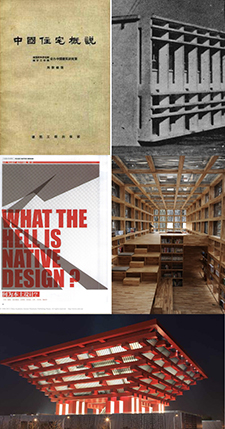 Regionality: A Resistant Issue and Keyword in Modern Chinese Architecture
Hosted by Qisen Song
Monday, April 12, 2021, 6:30 p.m. EDT
Columbia University
Live Zoom Webinar: Register Here
This talk decodes various manifestations of “regionality”, an important issue and keyword in modern Chinese architectural discourse. It argues that each manifestation was a response to cultural, political, social, or even professional challenges faced by architectural scholars, officials, or practitioners. The notion of regionality thus may be interpreted as strategies of criticism or resistance. As “vernacular architecture” it was to criticize monument-dominated historical study, as “the study of local geography” to resist the International Style, as “regional styles” to resist the monopoly of the state discourse, as “Critical Regionalism” or “land-based rationalism” to resist the hegemony of globalized architectural practice, and as “cultural-oriented regionalism” to strive for self-justification in the competition for a national expression.
Grace Lees-Maffei
 Handprint in a blanket
Hands at Home? Textures, Tactility and Touch in Interior Design
Handprint in a blanket
Hands at Home? Textures, Tactility and Touch in Interior Design
Hosted by Hannah Pivo
Wednesday, April 21, 2021, 12:30 p.m. EDT
Columbia University
Live Zoom Webinar: Register Here
Interior design is the result of a range of designed elements being brought together to produce an orchestrated space. Just as the interior spaces that accommodate much of our lives are designed, so the sensory experiences we have in those spaces are also designed, whether by professionals or by householders. Some interiors are put together with all of the senses in mind, while others prioritise one sense over the rest, for example in appealing to the eye. This presentation will examine a variety of ways in which interior designers, mediators and consumers accommodate and stimulate the sense of touch.
Landmark examples of designers’ appeal to the hand range from Adolf Loos’ furry bedroom for Lina Loos, to the smooth plastic curves favoured by Charles and Ray Eames, Verner Panton and, latterly, Karim Rashid, and are demonstrated too in the ubiquitous Monobloc chair.
Design mediators such as retailers, curators and journalists are well aware of the importance of touch in both promoting and understanding designed objects and interiors. For instance, a 2019 retrospective exhibition of Charlotte Perriand’s work encouraged visitors to sit on her furniture to experience of its ergonomic excellence, while texture has been emphasised by writers and editors such as Ilse Crawford and Michelle Ogundehin, as an antidote to the visuality of the interior design press.
Users/consumers identify affordances unanticipated by designers; we use tables as chairs, benches as tables, chairs as ladders. We fondly use familiar furnishings long after their ostensible lifespans have expired. The habitation practices of visually impaired people demonstrate how we learn to inhabit our interiors using touch sense-memory, reaching out for the expected door knob, stair rail, drawer and light pull, and the soft cushion, flock wallpaper, leather seat.
By foregrounding touch in design ideation or production, mediation and consumption, this presentation offers an alternative to interior design histories which focus exclusively on eye appeal.
Cole Roskam
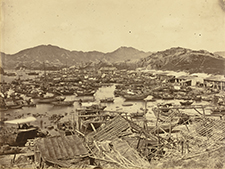 Aftermath of the 1874 Typhoon in Yau Ma
Tei, photo by Lai Afong
Constructing Climate in Colonial Hong Kong, 1842-1912
Hosted by Y. L. Lucy Wang
Tuesday, May 4, 2021, 8:00 p.m. EDT
Columbia University
Live Zoom Webinar: Register Here
Meteorology emerged as an important science in late-nineteenth century colonial Hong Kong that deepened imperial knowledge concerning the environmental forces affecting the colony’s economic, political, and social affairs and the region at large. This talk traces the historical study of Hong Kong’s climate through the architecture that enabled it, namely, the design and construction of the Hong Kong Observatory, which was initiated in 1879 at the behest of the London-based Meteorological Society and eventually completed in 1883. Overlooked not only in the architectural history of colonial Hong Kong and Great Britain’s imperial sphere, but in the architectural study of climate more generally, analysis of the observatory and attending controversy surrounding its materialization offers insight into the spaces, systems, and information that gave definition to the colony as an environment and proved critical to Hong Kong’s governance, commercial culture, and physical development over time.
Daniel M. Abramson

© "We Know How To Order," Bryony
Roberts and the South Shore Drill
Team, Chicago, 2015.
Governance, Governmentality, and Government Centers
Thursday, November 19, 2020, 6:30pm EST
Columbia University
How has architecture mediated relations within and between American government and society? Specifically, how have contradictions of federal governance been enacted architecturally? How has governmentality - the conduct and struggles of citizenship - been activated through architecture? And, how have tensions between government and capitalism played out between American government centers and surrounding cities? This talk focuses upon Boston's notorious 1960s combination of federal, state, and municipal buildings in vast open spaces, which embodied contradictions of the postwar American welfare state and activated complex citizen subjectivities - a fairground federalism continuous with both City Beautiful and modernist civic center conceptions. This talk, too, as precursor for a possible larger project on American governance, governmentality, and postwar government centers, proffers additional examples, including Mies' Chicago Federal Center, as site of a 2015 youth drill team performance.
Thomas Daniell
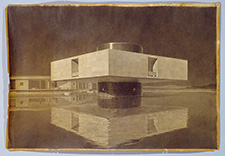 The Temple of Atomic Catastrophes
Monday, November 30, 2020, 6:30pm EST
Columbia University
Live Zoom Webinar: Register Here
Kyoto-born architect Sei’ichi Shirai (1905–83) is perhaps best known for his Temple of Atomic Catastrophes, first published in 1955. In part a tacit counterproposal to Kenzo Tange’s Hiroshima Peace Museum, completed the same year, Shirai’s design was also an unsolicited response to a call by artists Iri and Toshi Maruki for a venue to display a series of huge paintings they titled The Hiroshima Panels. The Temple of Atomic Catastrophes was never built, but it contributed to Shirai almost becoming the first Japanese Pritzker Prize laureate. Selected by the jury to be awarded the 1984 prize, Shirai unfortunately died before the official announcement, and a few years later Kenzo Tange became the first Japanese Pritzker. If Shirai had lived a little longer, international perceptions of modern Japanese architecture may have been profoundly different. This talk will examine Shirai’s background, the sources of his design philosophy and motifs, and his ongoing influence on contemporary Japanese architecture.
Martin Bressani
 Architecture as Dramatization: A.W.N. Pugin’s Saint Marie’s Grange
Thursday, January 23, 2020, 6:30pm
Room 832, Schermerhorn Hall
Columbia University
The talk presents a detailed analysis of British Neo-Gothic architect A.W.N. Pugin’s Saint Marie’s Grange, a house he built for himself near Salisbury in 1835. It contends that Saint Marie’s Grange embodies a need for melodramatic dramatization, tending towards an excessive representation of life which situates its inhabitants within the grandiose terms of a moral battle: not within the domain of realism, as its robust functionalist distinction of building elements has often led commentators to place it, but in the higher domain of truth. The house embodies how, for Pugin, a spiritual reality lies just below the surface of daily life, how gestures within the world of the everyday refer to another, hyperbolic set of gestures implicating the fight between good and evil.
Andres Lepik and Daniel Talesnik
 Access for All: São Paulo's Architectural Infrastructures
Monday, February 10, 2020, 5:00pm
Room 832, Schermerhorn Hall
Columbia University
For decades, São Paulo has seen investments in architectural infrastructures that help alleviate the lack of public space in the megacity. Many of these projects also provide São Paulo’s 12 million inhabitants with access to recreational, cultural, and athletic programs, much-needed in this dense metropolis of tremendous inequality, high crime rates, severe traffic issues, and serious public health problems. Access for All: São Paulo’s Architectural Infrastructures presents a selection of these public-, public-private-, and privately-owned buildings, public spaces, and infrastructure projects at different scales that attempt to create inclusive places for urban society.
The 13 featured projects were built from the 1950s to the present—from the establishment and consolidation of modern architecture in Brazil onward. The exhibition thus serves both as an historical survey and an analysis of current architectural production. The projects are presented with a focus on their programmatic characteristics, rather than their formal qualities, which are usually the emphasis in scholarship on Brazilian architecture. Regardless of when they were constructed, the projects are analyzed as they stand today, through newly commissioned photographs, films, architectural drawings, illustrations, models, and interviews, as well as archival documents.
Access for All looks partly at how the city is designed incrementally by architects working at the building scale and, conversely, how the accumulated built logic of the city has an impact on its architecture and public spaces. The exhibition emphasizes how architecture weaves in and out of the city, blurring the boundaries between buildings and the public realm. Sidewalks merge into ramps, stairs, and escalators, and at times reappear in the cityscape as elevated or sunken plazas, rooftop terraces, and gardens.
While many cities around the world are still chasing the Bilbao effect—the creation of a monofunctional, signature architectural work by a famous architect to attract tourism—Access for All advocates for architecture that serves diverse cultural, social, and recreational functions, all aimed at sustaining the needs of São Paulo’s residents.
Veronique Boone
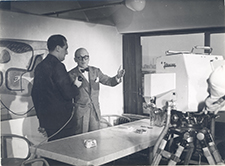 "This Film Will be a Big Banger!" Le Corbusier at the Cinematic Frontline
Thursday, September 26, 2019, 12:00pm
Room 806, Schermerhorn Hall
Columbia University
In 1919, Le Corbusier refuses to show his face on a Gaumont Newsreel on the Purism exhibition he led with Amedée Ozenfant. In 1964, one year before his death, he agrees with a film documentary on his life and work. Between those two dates, in the span of his whole career, Le Corbusier tried and assured numerous projects on the realization of film and television documentaries on his work and his person, in order to promote it to the large public. This lecture will discuss the mediation of the work of Le Corbusier by film and television, a rich and unexplored history, that stood until today in the shadow of the studies on his use of photography, books, and magazines, but which measure up to it.
Clara Teresa Pollak
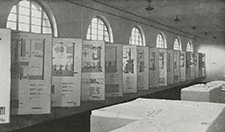 CIAM's Exhibition Concept. The Analysis of the Exhibition "The Dwelling for Minimal Existence"
Monday, November 11, 2019, 12:30pm
Room 832, Schermerhorn Hall
Columbia University
The Congrès Internationaux d’Architecture Moderne (CIAM), or International Congresses of Modern Architecture, was founded at La Sarraz Castle in Switzerland in 1928. In eleven congresses, CIAM explored central issues of modern architecture and became the most important institution for the development and dissemination of architectural modernity in the 20th century. The CIAM congresses are extensively documented and researched. The exhibitions, however, have received little attention in the form of short mentions or brief explanations, and many questions still remain unaddressed.
Arguably, the first CIAM exhibition accompanied the second CIAM Congress (“The Dwelling for Minimal Existence”) that took place on October 1929 in Frankfurt am Main at the Werkbundhaus of the Deutscher Werkbund. After Frankfurt, the exhibition traveled to other European cities until 1931 and was shown in Basel, Zurich, Warsaw, Munich, Magdeburg, Brussels, and Milan. Despite broad investigations into the questions of content of the second Congress, there remain no differentiated studies available to date about the exhibition in Frankfurt and the traveling exhibition that examined the material objects of the exhibitions and their spatial presentations.
In her master’s thesis, Clara Teresa Pollak used materials from the CIAM archives of the Institute for History and Theory of Architecture (gta Archives) at the Swiss Federal Institute of Technology (ETH) in Zurich as well as contemporary photographs and journalistic reports to elaborate on the historical origin of the main exhibition and the traveling exhibition and to discuss goals, expectations, and functions associated with the exhibitions. She also addressed their spatial designs and content-related conceptions under the term “CIAM’s exhibition concept.” The lecture presents an overview of the results of her master’s thesis and offers possible starting points for new research on CIAM’s history.
Alen Žunić
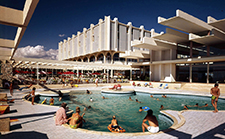 Architecture in Socialist Yugoslavia: The Iconic Buildings of Boris Magaš
Tuesday, November 19, 2019, 6:30pm
Room 832, Schermerhorn Hall
Columbia University
At a time when there is a rising interest in the world in the architectural heritage of the former Yugoslavia, the revaluation of which is starting at the international level – as witnessed to by the major Concrete Utopia exhibition recently put on in MoMA in New York – there is a need to endorse the work of individuals who have contributed to the success and recognisability of Yugoslav architecture in the world. Accordingly, this lecture will focus on one of the actors on the scene most to be credited with this reputation – the Zagreb architect Boris Magaš – to whom in his 1985 book Zeitgenössische Architektur in Osteuropa Udo Kultermann devoted a whole chapter, as the most important architect from the area of Yugoslavia.
Magaš proved himself to be a superlative architectural designer most of all along the Adriatic coast, producing hotel complexes drawing on the basic elements of the Mondrian aesthetics of square forms. In other parts of Yugoslavia, he concerned himself with cultural and social buildings in the style of late modernity, with white, "levitating volumes." Through a few key designs and built works, the lecture will show that during the 20th century, although working in a socialist environment, Magaš came closest to what might be called a starchitect from behind the Iron Curtain.
Philip Goad
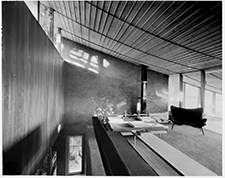 "Something like a Sturdy Little Boat Battling Across Lonely Waters": Robin Boyd and the Construction of an Australian Modernism
Thursday, December 5, 2019, 6:30pm
Room 930, Schermerhorn Hall
Columbia University
Acutely aware of a lack of discourse at a professional and public level, Melbourne-based architect and critic Robin Boyd made the construction and dissemination of Australian modernism a career-long preoccupation. His life, 1919 to 1971, overlaps with the emergence and formation of modern architecture in the Antipodes and, arguably, its dissolution. But he had a readership that was local and global. Through the international architectural press, he engaged in debates on decoration, shape architecture, New Brutalism, and the architecture of world expositions. He wrote the first book on Japanese architect Kenzo Tange and followed it with another on contemporary Japanese architecture. Boyd was also a talented architect, and the intent of his buildings and exhibition designs frequently intersected with his writing.
Within the context of his recently co-edited volume, Australia Modern: architecture, design and landscape architecture 1925-1975 (2019) and his current research for the forthcoming monograph, Robin Boyd: Australian architect, international critic, Philip Goad highlights the fraught quest of an architect who wrote but did not teach, whose prolific production reflected, on the one hand, an anxiety of the perceptive observer at the periphery, and on the other, consolidated his position in Australia, rare for an architect and never experienced since, as a public intellectual.
Eric Paul Mumford
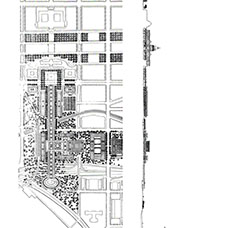 I.M. Pei and Urban Design, 1948-60
Wednesday, March 6, 2019, 6:30pm
Room 930, Schermerhorn Hall
Columbia University
Architect Ieoh Ming Pei began working for the New York developer William Zeckendorf in 1948, and went on to design a series of major urban projects for him in North American cities until founding his own firm in 1960. While these projects themselves—which include two in downtown Denver, the Place Ville-Marie in Montreal, and mixed use urban renewal projects for Washington, Chicago, New York, Philadelphia, and Pittsburgh—were widely publicized at the time, the intellectual context that informed them and their importance to the history of urbanism are not as clearly understood.
In this paper I argue that Pei’s urban design work for Zeckendorf was closely related to the modified modernist approach to urban design that began to be advocated in the early 1950s by Philadelphia city planner Edmund N. Bacon, and the architects Louis I. Kahn, and Josep Luis Sert, Dean at the Harvard Graduate School of Design from 1953-69. That direction, which was made public at the First Harvard Urban Design conference in 1956 and further developed at the third Harvard Urban Design conference (1959), was an internal critique of earlier CIAM ideas. It put a new emphasis on pedestrian street life and urban connectivity, anticipating some of the ideas of Jane Jacobs’s The Death and Life of Great American Cities (1961), while still advancing the model of master planning in an era of extensive Federal investment in cities.
Salomon Frausto
A Game of Infinite Dimensions
Wednesday, March 27, 2019, 6:30pm
Room 832, Schermerhorn Hall
Columbia University
From April to June 1973 the exhibition entitled “How to Play the Environment Game” hung on the walls of London’s South Bank Hayward Gallery, marking one of the first attempts to put on display for a general public the major urban issue of the day: London’s redevelopment after reconstruction. This talk will explore not only how this didactic exhibition was a critique of postwar planning but also how its curator challenged the traditional role of the architect by interrelating message and medium to reach a broader public audience. It will argue that “How to Play the Environment Game” is a progenitor of the kinds of socially and politically engaged architecture and design exhibitions we expect today.
Conceived, designed, and organized by the South African-born architect and designer Theo Crosby for the Arts Council of Great Britain, the exhibition presented the multiple determinants defining the physical aspects of London. Crosby attempted to distill the complex processes that led to the elimination of neighborhoods, the deconstruction of monuments, and the relocation of communities as part of the city’s redevelopment. Using the idea of a game, Crosby showcased historical and contemporary case studies to shed light on the mutual and conflictual interests of the players involved—including property developers, contractors, politicians, architects, and citizens—arguing that each win in proportion to their involvement. Square-formatted panels of black-and-white aerial photographs, montages, drawings, and diagrams were placed on polychromatic walls, interspersed with textual interventions from contemporary luminaries such as Andrea Branzi, Peter Cook, Jane Jacobs, among others. Crosby also initiated the experimental installation of immersive projections and an accompanying multimedia propaganda van to reach an audience outside the gallery. In a further attempt to extend the exhibition beyond its limited lifespan in the gallery, Crosby released a Penguin paperback featuring the exhibition’s content and designed a condensed version of the exhibition that traveled throughout the United Kingdom.
But in London, for three months, Crosby reconstituted the Hayward Gallery as a space for discursive display on the built environment. This talk will analyze how “How to Play the Environment Game” brought to the forefront what was at stake in London’s redevelopment under evolving political circumstances, commercial interests, and market realities, and how it was also paradigmatic of Crosby’s half-century career of merging message and medium.
Peter Christensen
 Krupp and the Global Spoliation of Steel
Thursday, April 11, 2019, 6:30pm
Room 930, Schermerhorn Hall
Columbia University
Steel, introduced into architecture on a broad scale during the nineteenth century, had a radical impact on architecture, forever changing the way we perceive and inhabit buildings. It also produced a radical new ecology, one that reflected a parasitic new relationship between both man and the environment as well as between cultures. This talk will detail one of several ways of reading steel in architecture and visual culture that moves beyond steel’s familiar guise as a heroic aid to the “genius” architects and “masterpieces” of Modernism by tracing the ways in which steel building units originating at Krupp’s headquarters in Germany were dispersed, reinterpreted and even reinvented outside of the West. This reinvention fostered a new culture of “open source” architecture that forces us to rethink the very definition of ingenuity in the history of architecture and construction.
Alex Bremner
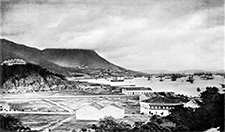 (Re)considering Empire: Networks, Infrastructure, Identity and Other Themes in the Architecture of the British Imperial World
Tuesday, April 30, 2019, 1pm
Room 930, Schermerhorn Hall
Columbia University
In this talk, Alex Bremner will discuss aspects of his latest research on the relationship between architecture and empire. He will focus mainly on his recent work dealing with the corporate infrastructures of the China Trade firm Jardine, Matheson & Co., considering the company’s physical networks of office, storage, and transhipping facilities in the context of early global capitalism. He will also touch upon his Leverhulme Trust funded project "Building Greater Britain," which is a major study looking at the global dimensions of the "Edwardian Baroque" phase in the history of British architecture and its imperial objectives.
Ruth Lo
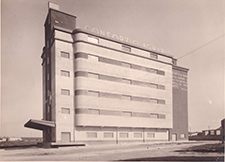 Mediator/Mediated: Granaries and the Politics of Wheat in Fascist Italy
Monday, May 6, 2019, 6:30pm
Room 832, Schermerhorn Hall
Columbia University
In the 1930s, Mussolini’s regime (1922–1943) embarked on a large building campaign to construct granaries across the Italian peninsula and in Italian territories abroad. This building mania was a direct result of Italy’s invasion of Ethiopia in 1935: following the imposition of sanctions by the League of Nations, the regime ordered the obligatory consignment of wheat by producers to public storage facilities to centrally manage a critical alimentary resource and publicize the government’s efforts to insure national food security. In this way, fascist politics transformed the granary from banal industrial structure into symbolic architecture that conveyed self-sufficiency and embodied imperial ambitions.
The grain silo occupies a distinct place in the history and historiography of modern architecture. Walter Gropius, Le Corbusier, and Erich Mendelsohn were among the first European architects to proclaim the monumental North American grain elevator as a formal inspiration for the basic vocabulary of modernism. However, this iconic model with its soaring verticality and prominent cylindrical bins was eschewed by the fascist regime as impractical and in contradiction to Italy’s economic objectives. Fascism sought, instead, a wholly different type of grain storage with horizontal floors and flexible interiors, due in no small part to politically driven material constraints.
This talk examines two aspects of fascist Italian granaries: 1) the regime’s deliberate positioning of the granary as a mediator of seemingly contradictory roles in fascist ideologies, and 2) the ways in which fascism mediated the granary to create an illusion of food abundance to allay worries of an unstable future. Thus, the granary’s ontological position was one of betweenness that negotiated the push and pull of opposing poles, portrayed in state-sponsored media as striking a necessary balance between urban and rural, ancient and modern, and past and future. Heavily mediated, the granary as mediator was a visual palliative, a structure that represented the culmination of the regime’s arduous, decade-long battle for wheat.
María González Pendás
Holy Modern: East, West, and the Constructs of Empire in Fascist Spain
Tuesday, September 25, 2018, 6:30pm
Room 934, Schermerhorn Hall
Columbia University
An opaque and hovering concrete cube that opened to an interior of richly ornamented patios, the building was readily celebrated as the “the jewel” of the fair, exemplar of a refined modernism unlike much of the technological kitsch taking over the grounds of the 1964 Worlds' Fair in New York. The reception of the architecture that the dictatorial regime of Francisco Franco brought into the world scene in 1964 echoed the praise stirred by the Spanish pavilion at Expo 58 in Brussels, a gridded structure of steel and glass likewise applauded as an “unexpected gem of architecture.” Despite the formal and material discrepancies between the two buildings, both were quintessentially modern—and seemingly at odds with the fascist regime they were called to represent. As the Italian Bruno Zevi put it in 1958: “The Spanish Pavilion makes one wonder: maybe this country is no longer fascist? Or, is Franco now tired and allows artists an unusual freedom?”
Fascism was of course alive and well, and architecture continued to be as crucial an instrument for its production as it had been in the 1930s across Europe. Only now the world stage was shifting under Cold War dynamics and with it the ideological configurations, images, and techniques of fascism. In this talk, I will chronicle how architects, State officials, and intellectuals worked together to redefine the cultural narrative and aesthetic register of fascism at mid-century in Spain, a project aimed at securing the regime a place within the modernizing and modernist West all the while retaining, and in many ways reinforcing the myth of empire and religious essentialism that was at the core of the Spanish radical right. The historian and Secretary of Censorship Florentino Pérez-Embid coined this two-sided ideal most fittingly as “Westernization in the means, Hispanization in the ends.” This talk will focus on the architectural strategy that Pérez-Embid proposed to project, namely, the re-inscription of the country’s Islamic past into an abstract and modernized representation of Catholicism. With this synthesis, architecture was called to perform the Spanish Reconquista and western modernization in the very same aesthetic breadth and, in doing so, to transfer a colonial campaign then definitely waning in North Africa to the realm of cultural politics. Beginning with a series of historical revisions on the architecture of Al-Andalus and the Mudejar style between 1944 and 1952 and concluding with the 1958 and 1964 pavilions, this talk follows Spanish architects in navigating the East/West, Islam/modern divide as a predicament to the regime’s imperial imagination—and a Western scene in welcoming this agenda within its ranks.
Pippo Ciorra
"Being Bruno Zevi"
Wednesday, October 31, 2018, 6:15pm
Room 934, Schermerhorn Hall
Columbia University
Bruno Zevi is one of the key figures both to investigate some of the essential features of architecture in critical decades of the twentieth century and to track back the reasons and clues for a full understanding of the contemporary conditions of our discipline. The exhibition Jean-Louis Cohen and I just curated in Rome had both these tasks. On the one hand, we looked into Zevi’s agency as a historian and critic, in order to disclose a wide set of figures who can complete a picture of postwar Italian architecture, which was so far heavily and incompletely tailored by a retroactive ideological frame designed mainly by Manfredo Tafuri. On the other hand, we shadowed Zevi’s restless life and work to trace the roots of the complicated relations between design, history, (geo)politics, communication, art, and even religion that weigh on the present, fragile identity of architecture. The lecture will mainly focus on this second aspect, trying to highlight the parts of Zevi’s biography that most help us to understand the present intricacies of architecture culture. We'll follow his traces as a smooth operator in the world of historiography, which he transformed into a battlefield for his idea of modernity. We’ll look into the birth of a new idea of the architecture critic, as an active agent in the architecture confrontation. We’ll discuss his contribution as a political “agent” nearly literally, counting on architecture as a device to propagate democracy. We’ll see how Zevi has an influence on basically every means of architecture communication before the digital: publishing, lobbying, editing, exhibiting, and broadcasting on mass media, all topics that are very much under discussion today. Finally, we’ll emphasize his legacy as a typical European public intellectual of the twentieth century, tirelessly devoted to taking sides and searching for confrontation, cultural battles, and dialectical oppositions.
Sheila Crane
Algerian Socialism and the Architecture of Autogestion
Monday, December 3, 2018, 6:30pm
Room 930, Schermerhorn Hall
Columbia University
In a series of essays published in 1966, L’Arceau qui chante [The Arch That Sings], architect Abderrahman Bouchama outlined a new path for a post-revolutionary Algerian architecture. Bouchama’s text responded directly to ambitious efforts to construct a revolutionary socialist state immediately following Algeria’s independence in 1962. Significantly, President Ahmed Ben Bella’s policies of autogestion, or self-management, intended to fuel the reallocation of property, the redistribution of resources, the restructuring of labor, and the redefinition of national culture, efforts that encouraged a radical rethinking of architecture and the construction industry in Algeria. Whereas Bouchama’s built projects have frequently been dismissed as narrowly historicist in their conception, his writings articulated a critical ethics and aesthetics for architecture that is worth reconsidering. In this talk, Bouchama’s endeavors are situated in relation to his early political engagement and to contemporaneous initiatives by Anatole Kopp, Pierre Chazanoff, and Georgette Cottin-Euziol.
Algeria’s brief, if ultimately failed, experiment with autogestion imagined a path towards socialism rooted in the new nation’s revolutionary origins, even as it repositioned the Maghrib as a defining center for Afro-Asian solidarity and an emergent Third Worldism, an impulse that shaped Bouchama’s L’Arceau qui chante. The architecture of autogestion might best be understood an expanded field, one encompassing noteworthy architectural projects and radical attempts to restructure the training and practice of architects and the construction industry––from the manufacturing of building materials to the reorganization of labor––as well as the sustained articulation of a post-revolutionary architectural aesthetics.
Anooradha Iyer Siddiqi
From Sri Lanka to the World: Minnette De Silva, Architecture, and History
Wednesday, January 24, 2018, 6:30pm
Room 934, Schermerhorn Hall
Columbia University
Few careers lay open the complexities of architectural entanglements with gender, labor, and the politics of cultural heritage in the twentieth century as does that of Minnette De Silva (1918-1998): R.I.B.A. Associate, Sri Lanka Institute of Architects Gold Medalist, C.I.A.M. participant, and co-founder of the journal MARG. She combined progressive and revivalist thrusts together, from her student work in the 1940s at the Sir J.J. College of Architecture and the Architectural Association to later studies of Asian architecture for MARG, Ekistics, and Sir Banister Fletcher’s A History of Architecture. Her designs combined reinforced concrete technology and Surrealist composition techniques with Ceylonese arts and crafts and a gendered, village-based system of fabrication.
Though she was a fixture in modernist Bombay and London and engaged in some of the most important modern architectural interventions in South Asia, her appearances in the institutional record, and thus the history, are erratic. No formal archive documents her practice or professional biography, but her international itineraries and localized productions appear in her scrapbook-style memoir, The Life and Work of an Asian Woman Architect. Part Bildungsroman and part architectural portfolio, the lone volume of the two she intended to publish offers an amputated narrative of engagements with significant institutions and figures and a similarly remarkable body of built works and writings. This aborted map offers a possible model for historiography—for histories of women, of South Asia, of architecture, of modernism—by throwing into question the reliance upon the catalogue raisonné and instead giving space to its occlusions, which may better serve to trace the creative life and intellectual labor of an architect in the world.
Basile Baudez
Between Convention and Seduction: European Architectural Drawings and Color
Thursday, March 1, 2018, 6:30pm
Room 930, 9th Floor, Schermerhorn Hall
Columbia University
This talk will trace the use of color in European architectural drawing and prints between the Renaissance and the early nineteenth century. Its most basic premise posits that color was never an essential feature of architectural drawing but made so by an increasingly codified and precise system of architectural representation that responded to the demands of political institutions and the general public. Color provided a visual means of communication that sidestepped textual explication of technically and structurally complex building programs. Looking across national borders yet attentive to the eventual supremacy of a French model, this talk will address color as a key player in the long history of rivalry and exchange between European traditions in architectural representation and practice.
Anna Bokov
Institutionalizing the Avant-Garde: Vkhutemas, 1920-1930
Tuesday, April 10, 2018, 6:30pm
Room 832, 8th Floor, Schermerhorn Hall
Columbia University
In his canonical 1936 chart mapping the development of modern art, Alfred H. Barr, Jr., the founding director of MoMA, prominently placed Constructivism and Suprematism right beneath Cubism. The two Russian avant-garde movements were considered its two more prominent outcomes, along with De Stijl and Neoplasticism – all of which drew on what he called, the “machine esthetic.” The Staatliche Bauhaus is placed just below—in turn, a product of these, also powered by the esthetic of the machine. Notwithstanding the prominent role assigned to the avant-garde, Barr chose to omit a contemporary of the Bauhaus—a school that, arguably, played a central role in articulating both the theoretical programs and the practical outcomes of its movements.
Conceived by the Bolshevik government as a “specialized educational institution for advanced artistic and technical training,” the Higher Art and Technical Studios, collectively known as Vkhutemas (Вхутемас), were created to “prepare highly qualified artist-practitioners for the modern industry.” From its establishment, this interdisciplinary school offered free education and accepted students from underprivileged backgrounds. While similar, according to Barr, to the Bauhaus in its “communistic spirit,” Vkhutemas, with an enrollment of over 2000 students, was an unprecedented modern undertaking, an institution that “focused on developing the masses.” The mandate for mass education was framed within the larger project of the industrialization of the Soviet economy and the grounding of everything—from artistic to labor practices—in science. Vkhutemas faculty emphasized the link between design practice and the so-called “objective method.” Continuous feedback between educational process and tests performed at various “research laboratories” at Vkhutemas facilitated an enormous leap in the development of both the theory and practice of modern space and form.
Shiben Banerji
The Financial Ties that Bind: Paul Otlet's Mundaneum and the Fraternal Spirit of Global Capital
Monday, April 23, 2018, 6:30pm
Room 930, 9th Floor, Schermerhorn Hall
Columbia University
Paul Otlet's Mundaneum, and Le Corbusier's pyramidal design for it, confounded critics as soon as it was published in L'Architecture vivante in 1929. Lost in the clamor to denounce the project as needlessly monumental, and in Corbusier's vehement, if incredulous, defense of its functionality was the equivalence that Otlet drew between the pursuit of financial profit and the acquisition of higher consciousness. How was it that Otlet came to equate financial speculation and spiritual attainment? Why did he characterize both processes as democratic, and how did he so readily identify these twin and simultaneous processes of subject formation with the logic of the pyramid? Presenting a genealogy of cosmic imagining in architectural discourse stretching back to William Richard Lethaby's iconoclastic history of architecture from 1892, this paper addresses a blind spot in left criticism of the Mundaneum and opens an examination of the architectural designation of fraternity as a spirit animating economic globalization.
 Lynnette Widder
"Sep Ruf, Hans Schwippert and the Culture of Building in West German Modernism 1949-59"
Wednesday, November 1, 6:30pm
Room 832, Schermerhorn Hall
Columbia University
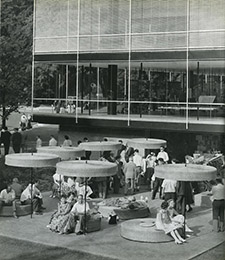
The transformations in West German architecture between 1949 and 1959 were fast-paced and comprehensive, its idiom moving away from the light, filigree style of the early post-war period towards the robust, material expression that characterized International High Modern Architecture from the mid-1950s onwards. Despite the pace and intensity of these changes, however, they cannot be ascribed to a singular rhetorical program or movement. Instead, they represent the interplay of architectural expression and building construction developments, both influenced strongly by contemporary American precedents exported to West Germany through official and popular channels. The work of Hans Schwippert and Sep Ruf, friends and professional affiliates throughout the period studied, offers important insights into the pathways these transformations took through rhetoric, construction, reception and architecture expression. The comparison of these two architects’ construction practices and architectural expression is underpinned by an analysis of three decisive documents, which describe the changing manner in which West Germany defined its self-image through architecture between 1949 and 1959.
Martino Stierli
Tuesday, November 14, 6:30pm
Room 832, Schermerhorn Hall
Columbia University
Marta Gutman
"How to Design a Junior High School": Examples from the 1960s in Berkeley and Harlem
Tuesday, Sept. 13, 6:30pm
Room 832, Schermerhorn Hall
Columbia University
Kathleen James-Chakraborty
Title TBA
Wednesday, October 26, 6:30pm
 Sarah Schlachetzki
Affordable Housing During the Weimar Republic. Modernism in Breslau
Thursday, March 3, 6:30pm
930 Schermerhorn Hall
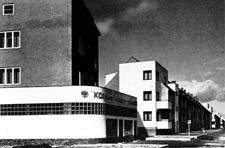
During the Weimar Republic, Breslau was Germany's seventh biggest city. The conflicts following World War I caused an exceptionally severe housing crisis in the region. Located at Germany's eastern periphery a few miles from the Polish border, Breslau protagonists had to negotiate their visions for the modern city against the backdrop of shifting boundaries, social unrest, and an increasingly nationalist discourse of self-justification. The talk will address both architectural propositions in a climate of extreme political tension as well as historiographical questions regarding a dual marginality.
Dirk van den Heuvel
Contested Spaces of the Open Society - Growth and Change in the Work of Jaap Bakema (1914–1981)
Tuesday, April 5, 6:30pm
832 Schermerhorn Hall
Tuesday, October 20, 6pm
832 Schermerhorn Hall
Eleonora Pistis
"Architecture, Antiquarian Studies and Learned Credulity: Scipione Maffei, Filippo Juvarra and the Ancient Licentia"
Tuesday, November 24, 6pm
832 Schermerhorn Hall
Nicholas Adams
"The Architecture of Gunnar Asplund and the Uses of Humor"
Tuesday 10 March, 6pm
Stronach Center, Schermerhorn Hall
Joan Ockman
Loos and Loss
Monday 6 April, 6pm
Stronach Center, Schermerhorn Hall
Itohan Osayimwese
"Tropical Architecture in the Service of Tropical Agriculture: Systems-Building and Foreign Aid in Post-Independence Nigeria"
Monday, April 13, 6pm
Stronach Center, Schermerhorn Hall
Lukasz Stanek
Architects from Socialist Countries in Ghana (1957-1967). Modern Architecture and Mondialization
Thursday, April 23, 6pm
Schermerhorn 934, Schermerhorn Hall
Ulrich Müller
Exhibiting Contemporary Architecture
Thursday, November 6, 6PM
Stronach Center, Schermerhorn Hall
Anthony Vidler
Reframing the Enlightenment:
Archive Fever from Latour to Ledoux
Thursday, December 4, 6PM
Stronach Center, Schermerhorn Hall
Sonja Dümpelmann
Up in the Air and Down to Earth:
On the Dialectics of Aerial Vision in Landscape and Urban Design
Concentrating on the period between 1920 and 1940, the talk will present ideas and practices central to the design professions that were either supported by or that emerged from aerial vision. It will show how viewing the earth from above redirected attention to bodily experience on the ground, and illustrates how design professionals understood the aerial view as simultaneously abstract and experiential, detailed and contextual, harmful and essential.
Sonja Dümpelmann is Associate Professor of Landscape Architecture at the Harvard Graduate School of Design. She holds a Ph.D. in Landscape Architecture from the University of the Arts, Berlin, and has held research fellowships at the German Historical Institute, and at Dumbarton Oaks, Washington DC. Her publications include a book on the Italian landscape architect Maria Teresa Parpagliolo Shephard (VDG Weimar, 2004), and most recently Flights of Imagination: Aviation, Landscape, Design (University of Virginia Press, 2014) as well as the edited Cultural History of Gardens in the Age of Empire (Bloomsbury Publishers, 2013), and the co-edited Greening the City: Urban Landscapes in the Twentieth Century (University of Virginia Press, 2011).
Thursday, March 27, 5:30 p.m.
612 Schermerhorn Hall
Vladimir Kulić
The Scope of Socialist Modernism
The lecture will discuss the aesthetic and discursive limits of socialist modernism by focusing on architecture in Yugoslavia between 1950 and 1980. It will present Vjenceslav Richter's neo-avant-garde work and Bogdan Bogdanović's Surrealist-inspired war memorials as different manifestations of the surviving leftist culture from the prewar period.
Vladimir Kulić holds a Ph.D. from the University of Texas in Austin and teaches architectural history and theory at Florida Atlantic University. His publications include Modernism In-Between: The Mediatory Architectures of Socialist Yugoslavia (with Wolfgang Thaler and Maroje Mrduljaš, 2012), Unfinished Modernisations (edited with Maroje Mrduljaš, 2012), and Sanctioning Modernism: Architecture and the Making of Postwar Identities (edited with Monica Penick and Timothy Parker, forthcoming 2014). He is the current ACLS-NEH International and Area Studies Fellow and a Visiting Scholar at the Heyman Center for the Humanities.
Tuesday, March 4, 6:15 p.m.
612 Schermerhorn Hall
Mario Carpo, Yale University & the École d'Architecture de Paris-La Villette
The Second Digital Turn: The Style of Big Data
Mario Carpo's research and publications focus on the relationship among architectural theory, cultural history, and the history of media and information technology. His Architecture in the Age of Printing (2001) has been translated into several languages. His most recent books are The Alphabet and the Algorithm, a history of digital design theory (2011), and The Digital Turn in Architecture, 1992-2012, an AD Reader.
Tuesday, February 25, 6:15 p.m.
612 Schermerhorn Hall
Wolf-Dietrich Löhr, Kunsthistorisches Institut in Florenz & Freie Universität Berlin
Dare la Regola: The Architect as Painter in the Lives of Alberti and Brunelleschi
An event organized with the Howard Hibbard Forum for Renaissance/Baroque Art and Architecture.
Monday, October 14, 6:30 p.m.
612 Schermerhorn Hall
Reto Geiser, Gus Wortham Assistant Professor at the Rice University School of Architecture
Toward an Education of Vision
Reto Geiser will discuss art historian and architecture critic Sigfried Giedion's persistent advances to improve visual literacy by offering students from all fields deeper insight into the history of art and architecture. From early proposals for an "education of vision," to his involvement with the "Explorations Group" in Toronto, to attempts exerting influence on the formation of the Visual Arts Center at Harvard, Geiser will trace how visual sensibilities that originated in the early twentieth century not only provided Giedion with a methodological framework to overcome disciplinary specialization, but also formed the basis for a broader dissemination of the principles of modern architecture.
Tuesday, March 26
Esra Akcan, University of Illinois at Chicago
"News from the Living Room: Storytelling and Participatory Architectural Writing"
Wednesday, April 17
Alex Bremner, University of Edinburgh
"Architecture, Religion, and British Global Expansion in the Nineteenth Century: Rethinking Empire and the Built Environment"
Wednesday, September 19
Juliet Koss, Scripps College
"Filming the Future Perfect, Moscow 1938"
Juliet Koss is Associate Professor and Chair of the Department of Art History at Scripps College in Claremont, California, and the author of Modernism after Wagner (University of Minnesota Press, 2010), a finalist for the College Art Association's Charles Rufus Morey Book Award. Her essays on modern European art, architecture, and related fields have appeared in journals and edited volumes in Europe and the United States and she has received fellowships from the Getty Research Institute, the Humboldt Foundation, the National Endowment for the Humanities, and the Mellon Foundation. In 2008 she was a Visiting Scholar at the Canadian Centre for Architecture in Montreal and, in 2009, a Fellow at the American Academy in Berlin; in 2011 she was the Rudolf Arnheim Visiting Professor at the Humboldt University, Berlin, where she taught seminars on the Bauhaus and on the Russian and Soviet Avant-Gardes. Her current book project, "Model Soviets," addresses the visual culture of the Soviet obsession with construction in the 1920s and 1930s and explores how documentary images of architecture—of models, of buildings covered in scaffolding, and of completed edifices—emblematized the role of construction more generally within the Soviet state.
"Filming the Future Perfect, Moscow 1938" explores the utopian grammar of architectural models in the Soviet 1920s and 1930s, focusing especially on Alexander Medvedkin's film The New Moscow, released in 1938 and removed from circulation by the censors. Showing architects looming over models for the Soviet capital, scenes filmed in Moscow's newly built metro and on its newly constructed streets, and Muscovites experiencing the built environment in a state of constant flux, The New Moscow tells the story of the design of a "living model of Moscow," a combination of large-scale architectural model and film projection that is presented to the Soviet public in the film's final scene. Possible reasons for the film's censorship abound; contravening Soviet cultural mandates to celebrate construction achievements through visual documentation, it includes documentary footage of large-scale destruction, reveals characters' confusion and nostalgia for the disappearing urban fabric, and overtly mocks construction propaganda. By poking fun at both Soviet technology and the utopian vision of the "living model," The New Moscow ridicules Soviet construction ideals and, by extension, the model Soviet future.
Wednesday, December 5
Jeremy Aynsley, Royal College of Art
"A Tale of Two Germanys: Design in the 1950s and 60s in the GDR and FRG"
THIS EVENT HAS BEEN CANCELLED
Wednesday, February 15
Juan José Lahuerta,
Barcelona School of Architecture (ETSAB)
"Ornament, Crime and Architecture: Loos the Architect Faces Loos the Writer"
Juan José Lahuerta is Professor of the History of Art and Architecture at the Barcelona School of Architecture (ETSAB). His primary interests include Gaudí, Dalí, Le Corbusier, Adolf Loos and Mies van der Rohe. His most recent publications are Le Corbusier (Milan, 2011), Estudios Antiguos (Madrid, 2010), and Humaredas. Arquitectura, ornamentación, medios impresos (Madrid, 2010). He is an editorial member of Casabella Milano, director of Mudito & Co. publications (Barcelona), and curator of the Picasso Museum in Barcelona.
Wednesday, March 7
Eeva-Liisa Pelkonen,
Yale School of Architecture
"Towards Cognitive Architecture: Louis Kahn meets Josef and Anni Albers"
Eeva-Liisa Pelkonen is Associate Professor at the Yale School of Architecture, where she is also Director of the Master of Environmental Design Program. Her most recent works include Alvar Aalto: Architecture, Modernity and Geopolitics (Yale University Press, 2009) and Achtung Architektur! Image and Phantasm in Contemporary Austrian Architecture (MIT Press, 1996). She is the editor of Kevin Roche: Architecture as Environment (Yale, 2011), and coeditor of Eero Saarinen: Shaping the Future (Yale, 2006).
Wednesday, April 11
Guido Montanari, Polytechnic University of Turin (POLITO)
"Architecture and Fascism: An 'Other' Modernity in Italy Between the Wars"
Guido Montanari is Associate Professor of Architecture at the Polytechnic University of Turin. His primary interest is in the fields of modern and contemporary architecture and city planning in Italy and Europe. His most recent publication is Architettura e cittá nel Novecento (with Andrea Bruno, Rome 2009), and his recent publications have focused on the neglected work of Amedeo Albertini (Skira, 2007) and Guiuseppe Momo (Celid, 2000).
José Lira, University of São Paulo
"Avant-garde, the City and Real Estate: Gregori Warchavchik, Odessa-São Paulo"
Monday, October 24, 5.30 p.m.
Judith Lee Stronach Center
José Lira is Associate Professor at the School of Architecture and Planing in the University of São Paulo (FAU-USP), where he presented both his PhD and PD Dissertations (1997 and 2008). He has served as a visiting scholar at GSAPP, Columbia University (2009), and as a Research Affiliate at the National Council of Research, Brazil (CNPq-BR). He is the author of Warchavchik: Fraturas da Vanguarda (Cosac & Naify, 2011), and edited Caminhos da Arquitetura, de Vilanova Artigas (Cosac & Naify, 2004), Tempo, Cidade e Arquitetura (FAU-USP/ Annablume, 2007) and Cidade: impasses e perspectivas (FAU-USP/ Annablume, 2007). He has also published chapters in books such as L'Aventure dês Mots de La Ville, Arquitetura + Arte + Cidade, Les Mots de la Stigmatisation Urbaine, and Rediscutindo o Modernismo, as well as articles in several journals in Brazil and elsewhere. He is currently the director of the University of São Paulo Center for Cultural Preservation (CPC-USP).
Claire Zimmerman, University of Michigan
"Activist History: Architectural Surfaces, ca. 1914"
Wednesday, November 2, 6 p.m.
Judith Lee Stronach Center
Claire Zimmerman is Assistant Professor of art history and architecture at the University of Michigan. She teaches courses on 19th and 20th century European and America architecture with emphases in Weimar Germany and the United Kingdom. Research interests include architecture culture as it interacts with commerce and industry, and the infrastructures of globalization that underpinned the spread of modern architecture throughout the 20th century. Her co-edited essay collection, Neo-avant-garde and Postmodern: Postwar Architecture in Britain and Beyond (with Mark Crinson) appeared as Volume 21 in the Yale Studies in British Art (Yale University Press) in fall 2010; an earlier monograph, Ludwig Mies van der Rohe was published by Taschen in 2006. Zimmerman's recent work has appeared in OASE, AA Files, Perspecta, the Journal of Architecture, and Harvard Design Magazine. She is completing a manuscript on photography in modern architecture in 2011. She was the 2009-2010 Helmut F. Stern Professor at the University of Michigan Institute for the Humanities.
John Harwood, PhD Columbia '06, Oberlin College
"Danger Zones: Aerial Bombardment and the Politics of Risk Analysis in 1930s-40s Britain"
Wednesday, November 16, 6 p.m.
Judith Lee Stronach Center
John Harwood is Associate Professor in Modern and Contemporary Architectural History at Oberlin. His research centers on the architectural articulation of science, technology, and corporate organization. His articles have appeared in Grey Room, AA Files, and do.co.mo.mo. He is co-author, with Janet Parks, of The Troubled Search: The Work of Max Abramovitz (2004), and co-author with Jesse LeCavalier and Guillaume Mojon of This - Will This (2009). His essays have also appeared in catalogues for the Venice Biennale for Architecture 2008, the V&A's exhibition Cold War Modern: Design 1945-1970 (2008), and several forthcoming edited volumes. His book, The Interface: IBM and the Transformation of Corporate Design, 1945-1976, will be published in November 2011 by The University of Minnesota Press. He has been a visiting scholar or fellow at the National Gallery of Art, the University of Minnesota Institute for Advanced Studies, and the University of Queensland, and received Oberlin's B. Wade and Jane B. White Fellowship and the Class of 1957 Distinguished Professor Award.
Kurt W. Foster
"Architecture in Print: How Karl Friedrich Schinkel Invented the Oeuvre Complète"
Thursday, March 24, 6.30 p.m.
Schermerhorn Hall, room 612
Among Schinkel's numerous professional credentials, an architectural treatise is missing. But he must be recognized as the inventor of a new and singularly successful format of promotion, the oeuvre complète. A gifted designer of public displays, panoramas, and stage sets, Schinkel fed the visual avidity of his contemporaries (and continues to do so today) with ingenious images of his projects and buildings. A biographical thread replaces the categorical order among architectural projects and suggests a conspectus of works across time and place.
Kurt W. Forster is director of doctoral studies at the Yale School of Architecture. He has held professorships at Stanford, M.I.T., the Federal Institute of Technology, ETH, Zurich, and the Gropius Chair at the Bauhaus University, Weimar. He has organized major exhibitions, including the Venice Architecture Biennale in 2004, and is now collaborating on exhibitions of Carlo Mollino (Munich) and Karl Friedrich Schinkel (Berlin). He also writes on historiography and contemporary photography.
Alice Friedman
"American Glamour: Mid-century Modern Installation"
Thursday, April 28, 6.30 p.m.
Schermerhorn Hall, room 612
Professor Friedman will discuss collaborations between architects, sculptors and lighting designers in mid-20th century American design. Specifically, she will elaborate projects between Richard Kelly, Richard Lippold and Harry Bertoia on the one side and Philip Johnson, Eero Saarinen and Skidmore, Owings and Merrill (SOM) on the other. This talk represents a work-in-progress, drawing on her recent book American Glamour and the Evolution of Modern Architecture (Yale 2010).
Friedman is the Grace Slack McNeil Professor of the History of American Art and Director of the McNeil Program for Studies in American Art at Wellesley College. She is the author of numerous books and articles including House and Household in Elizabethan England: Wollaton Hall and the Willoughby Family (U. Chicago, 1989), Women and the Making of the Modern House: A Social and Architectural History (Abrams, 1998), and most recently, American Glamour and the Evolution of Modern Architecture (Yale, 2010).
The Frankfurt Kitchen
Wednesday, December 1, 6:30 p.m.
MoMA
Join MoMA's Design Curator Juliet Kinchin for a private tour of the new show "Counter Space: Design and the Modern Kitchen," and its centerpiece, an unusually complete example of the Frankfurt Kitchen (1926), designed by Austrian Architect Grete Schütte-Lihotzky. Columbia GSAPP Professor Mary McLeod, who has written on Lihotzky for MoMA's recent publication Modern Women: Women Artists at the Museum of Modern Art, will comment.
Colin Rowe's "Space Talk"
Tuesday, December 7, 6:30 p.m.
832
Schermerhorn Hall
Columbia Professor Christoph Schnoor will discuss seminal architectural historian Colin Rowe's notion of "space talk," or his unique interpretation of urban and architectural space, and its vital legacy for architectural history. Schnoor is lecturer in architectural history, theory and design at Unitec New Zealand, and has written extensively on 20th architectural history, German colonial architecture, and Le Corbusier (most recently "La Construction des villes," gta, Zürich 2010).
 Home
Home Media Center