Upcoming Events
Monday, October 19, 2009

"In The Best Possible Light": The Classic Jazz Photography of Herman Leonard
A discussion of "In The Best Possible Light: Herman Leonard's Jazz," an exhibition of Leonard's work at Jazz at Lincoln Center.
With Herman Leonard, photographer; Kellie Jones, Professor of Art History, Columbia University; and Leonard exhibition co-curators C. Daniel Dawson, Diedra Harris-Kelley and Garnette Cadogan.
Introduced and Moderated by Robert G. O'Meally, Zora Neale Hurston Professor of English and Comparative Literature, and Founder, The Center for Jazz Studies at Columbia University
The jazz photographs of Herman Leonard comprise an indispensible historical record—particularly of the late Forties moment when the new music called bebop was crystallizing. How, without Leonard’s photographs, could we know how rehearsals at a 52nd Street club looked? How else to get a view from the stage of mid-career Ella Fitzgerald in full performance flow? To see Thelonious Monk, hatless, revising a score between sets at Minton’s in Harlem? Or Louis Armstrong, not mugging for the crowd, but in a reflective moment behind the scenes?
But Leonard was more than a faithful recorder of deeds: he was an artist. Whether illuminating a dark club’s smoke to suggest mystery and possibility; setting lights behind musicians to create a sense of sculptural depth; or making a gentle still-life of a musician’s shoes or hat—Leonard was revealing beauty in the moment. Consider his portraits of Miles Davis, whom Leonard calls his best subject: how light traces the angular facial structure and catches in the fiery eyes. “Photography is painting with light,” said Leonard, and in its glow, Davis’s skin looks, as Leonard saw it, “like black satin.”
As New Orleans trumpeter Kermit Ruffins enthused, Leonard’s photographs of these central figures in jazz history “makes me feel I can walk over and shake their hands.” For Leonard himself, “I want to show jazz artists in the best possible light--to tell their truth, but to tell it in terms of beauty.”
More about Herman Leonard
Monday, October 19, 2009, 7:30 pm
301 Philosophy Hall, Columbia University Morningside Campus
Free and open to the publicThursday, September 17, 2009
Creative Life: Music, Politics, People, and Machines
Bob Ostertag, University of California, Davis

Bob Ostertag will read and discuss issues from his new book, Creative Life: Music, Politics, People, and Machines (University of Illnois Press, 2009). In this dazzling set of writings from a musical artist who has worked on the cutting edge of new music for thirty years, Professor Ostertag explores the common ground and points of friction among music, creativity, politics, culture, and technology. In terrain ranging from the guerrilla underground in El Salvador's civil war to the drag queen underground in San Francisco and New York, these essays combine journalism and autobiography to explore fundamental questions of what art is and what role it can occupy in a violent and fragmented world, a world in which daily events compromise the universality toward which art strives. Drawing on his intimate engagement with political conflict in Latin America and the Balkans, Ostertag identifies an art of "insurgent politics" that struggles to expand the parameters of the physical and social world.
Composer, performer, historian, instrument builder, journalist, activist, kayak instructor--Bob Ostertag's work cannot easily be summarized or pigeon-holed. He has published 21 CDs of music, two movies, two DVDs, and two books. His writings on contemporary politics have been published on every continent and in many languages. Electronic instruments of his design are at the cutting edge of both music and video performance technology. He has performed at music, film, and multi-media festivals around the globe, and his radically diverse collaborators include the Kronos Quartet, John Zorn, Mike Patton, Anthony Braxton, Lynn Breedlove, Justin Bond, and Pierre Hébert. He is currently Professor of Technocultural Studies and Music at the University of California at Davis (more).
Professor Ostertag will sign copies of his new book following the lecture and discussion.
"Ostertag tells stories from his own experience as an artist and political activist. He searches for the connections and differences in the illumination sought by the artist and the insight sought by the activist, and he explores the quest for transcendence and universality that unites art and politics and also helps explain their divergence. There are no answers here, but rather a brilliant contemplation of the discontent and yearning that motivates our better natures." -- Frances Fox Piven, author of Challenging Authority: How Ordinary People Change America
Thursday, September 17, 2009, 7:30 pm
620 Dodge Hall, Columbia University Morningside Campus
Free and open to the publicWednesday, April 22, 2009
Burnt Sugar, The Arkestra Chamber:
A Workshop in Conducted Improvisation

In this unprecedented performance workshop, open to any student performers from any and all traditions--musicians, poets, actors, dancers, musicians, writers--Greg Tate, Louis Armstrong Visiting Professor at the Center for Jazz Studies for Fall 2009, will demonstrate how new musical material may be generated and existing musical material may be restructured and renewed in real-time performance, using Conduction, the versatile lexicon of hand and baton gestures developed over the past twenty years by improvisor and conductor Lawrence "Butch" Morris.
As leader of the innovative musical ensemble Burnt Sugar, The Arkestra Chamber, Tate uses Conduction in live performance and in the studio to compose and select material from a wide range of composers and genres--Thelonious Monk, Chaka Khan, Jimi Hendrix, Charles Mingus, Iggy Pop, and others. In this workshop, joined by members of the Arkestra and the workshop participants, Tate will demonstrate these techniques and create new music.
Wednesday, April 22, 2009, 7-9:30 pm
301 Philosophy Hall
Columbia University Morningside Campus
Sponsored by the Louis Armstrong Educational Foundation, and presented in collaboration with the Louis Armstrong Jazz Performance Program and the Music Performance Program, Columbia University. Photo of Burnt Sugar by Laura Williams.
BURNT SUGAR, THE ARKESTRA CHAMBER is the creation of writer/guitarist/producer Greg Tate. Formed in 1999, Burnt Sugar was conceived as a contemporary version of Miles Davis’ Bitches Brew band, exploring the connective tissue binding jazz, rock, funk, 20th century composition, and African music in a lyrical, seductive, exploratory, improvisational manner.
Employing Conduction, an interpretative system for improvisors developed by Lawrence“ Butch” Morris, Tate guides the band through improvisations on each of its song forms. As a result, each performance is an original mutation in tune with the collective personality of the audience as well as the individual character and talents of the players.
Burnt Sugar performs regularly at the usual hotbed venues in New York, including; Joe’s Pub, Tonic, Symphony Space, The Blue Note, Makor, The Knitting Factory, Galapagos, CBGBs, BAM Café, Aaron Davis Hall, Lotus and The Cutting Room.
About Greg Tate
Greg Tate will be the Louis Armstrong Visiting Professor at the Center for Jazz Studies in Fall 2009. Tate's writings on culture and politics have been published in the New York Times, the Village Voice, the Washington Post, Artforum, Rolling Stone, VIBE, Premiere, Essence, Suede, The Wire, One World, Downbeat, and JazzTimes. Tate was recently acknowledged by The Source magazine as one of the "Godfathers of Hiphop Journalism" for his groundbreaking work on the genre's social, political, economic and cultural implications.
His books include Everything But The Burden, What White People Are Taking From Black Culture (Harlem Moon/Random House, 2003), Midnight Lightning: Jimi Hendrix and The Black Experience (Acapella/Lawrence Hill, 2003); and Flyboy In The Buttermilk: Essays on American Culture (Simon and Schuster, 1993). Tate is now working on a book for Riverhead Press on the Godfather of Soul, James Brown.
Friday, April 17, 2009
Sweet Willie Rollbar's Orientation:
A Film Screening and Discussion
With Baikida Carroll, Oliver Lake, and K. Curtis LyleModerated by Brent Hayes Edwards

As part of the 2009 LeBoff Seminar in the Department of Media, Culture, and Communication at New York University, this special event will feature the world premiere screening of the short experimental film "Sweet Willie Rollbar's Orientation" (1970) made by poet K. Curtis Lyle in collaboration with theater artist Malinke Robert Elliott, composer Julius Hemphill, and other members of the Black Artists' Group (BAG) of St. Louis, the historically important collective of musicians, visual artists, actors, poets, and dancers that emerged as a vibrant cauldron for creative collaboration in the midst of the urban unrest of the late 1960s. Fragmented and surreal, "Sweet Willie Rollbar's Orientation" is one of the legendary productions of BAG,
The screening will be followed by a conversation about the film and about BAG more generally, featuring three of the artists who perform in the film: Lyle himself, and musicians and BAG co-founders Baikida Carroll and Oliver Lake. The discussion will be moderated by Brent Hayes Edwards, Professor of English and Comparative Literature at Columbia, and faculty of the Center for Jazz Studies.
Friday, April 17, 2009, 1:00-4:00 pm
Iris and B. Gerald Cantor Film Center, Theater 101
36 East 8th Street (between University Place and Greene Street)
New York University
Free and open to the publicMonday, April 6, 2009

Technotopia 1969: Miles Davis at the Crossroads
Professor Michael E. VealDepartment of Music, Yale University
Harald Kisiedu, Department of Music, Columbia University, respondent
This paper will examine Miles Davis's influential 1969 double album Bitches Brew not simply as a foundational piece of jazz-rock fusion, but rather as a piece of "electric jazz" which drew on aspects of popular practices and the jazz-avant-garde in equal measure.
Ethnomusicologist Michael Veal, Associate Professor of Music at Yale University, addresses topics of biography, history, analysis, and interpretation in various musics of Africa and the African diaspora. His most recent book, Dub: Soundscapes & Shattered Songs in Jamaican Reggae (Wesleyan University Press, 2007) examines the ways in which the studio-based innovations of Jamaican recording engineers during the 1970s created a sonic space for the emergence of a distinctly post-colonial Jamaican culture locally, while they worked to transform the structure and concept of the post-WWII popular song globally.
Monday, April 6, 2009, 8 pm
622 Dodge Hall, Columbia University Morningside Campus
Free and open to the publicRecent Events
Tuesday, March 10, 2009
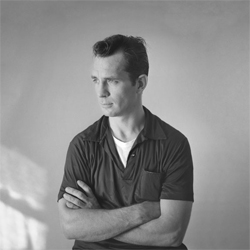
Jack Kerouac's Jazz: A Conversation
Sara Villa, Università degli Studi di Milano
David Amram, composer
John Szwed, Professor of Music and Jazz Studies, Columbia University
An interdisciplinary look at poet and novelist Jack Kerouac’s little-known writings on jazz, and his improvised voice-over and Amram’s soundtrack to Pull My Daisy, the 1959 landmark in new American cinema directed by Alfred Leslie and Robert Frank.
Tuesday, March 10, 2009, 7:30 pm
301 Philosophy Hall, Columbia University Morningside Campus
Free and open to the public
Wednesday, March 4, 2009

Writing From A Cave: Haruki Murakami and Jazz
Kiyofumi Tsubaki, Tsuda College, Tokyo; Visiting Scholar, Center for Jazz Studies, Columbia UniversityEmily Lordi, respondent
Japan’s acceptance of jazz was unique; most people became jazz fans through listening to jazz records, and in this process the “jazz café” played a very important role. A Japanese jazz café typically presented a very dark, cave-like (or, perhaps, womb-like) atmosphere, separated from the actual world, where jazz records were played at high volume. Customers were not permitted to talk to each other, and in any event it was usually impossible to do so. Consequently, the act of listening to jazz became intensely personal.
The writer Haruki Murakami's intense engagement with jazz is well known; with a collection of thousands of records, he even became an owner of a jazz café in Tokyo in the 1970s. With particular reference to Murakami’s best-selling novel Norwegian Wood, Professor Tsubaki and respondent Emily Lordi will consider the relationship between jazz and Murakami’s literature, connecting Japan’s acceptance of jazz with the peculiarly womb-like characteristics of Murakami’s fiction.
Wednesday, March 4, 2009, 8 pm
622 Dodge Hall, Columbia University Morningside Campus
Free and open to the public
Black Music, Ownership, and Value
Ronald Radano, University of Wisconsin, Madison
Respondent: Harald Kisiedu
Ronald Radano balances his teaching between the programs in
musicology and ethnomusicology and the Department of Afro-American
Studies at University of Wisconsin, Madison. His primary work is that
of an Americanist with special interests in cultural theory, race,
globalization, popular music and the history of North American black
music. He is author and editor of three books: New Musical Figurations: Anthony Braxton's Cultural
Critique (1993), Music and the Racial Imagination (2000;
co-edited with Philip V. Bohlman) and
Lying up a Nation: Race and Black Music (2003),
all published by the University of Chicago Press. Currently, he is
principally at work on a new book on black music, cultural ownership
and aesthetics, while also launching two secondary projects: the first,
a study of the global circulation of African-American musical rhythm;
the second, a critical meditation on private listening and the crisis
of taste.
Friday, January 30, 2009
4PM, 620 Dodge Hall
Columbia University Morningside Campus
Co-sponsored by the Center for Jazz Studies and the Department of Music, Columbia University. Columbia's Music Colloquia are free and open to the public. Refreshments will be served after the talk.
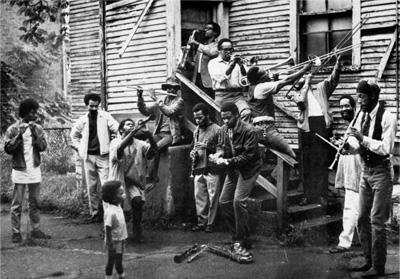 A Power Stronger Than Itself: A
Celebration of the AACM
A Power Stronger Than Itself: A
Celebration of the AACM
Curated by George E. Lewis and Christopher McIntyre
In conjunction with the recent publication of his book, A Power Stronger Than Itself: The AACM and American Experimental Music (University of Chicago Press, 2008), composer, musician, former Kitchen music curator, and long-time AACM member George Lewis hosts performances, a panel discussion, and a book signing. Founded in 1965 on the South Side of Chicago, the Association for the Advancement of Creative Musicians (AACM) is a dynamic collective that has reconfigured the trajectory of music-making in America through its devotion to the furthering of artistic experimentation and its forward-thinking approach to composition, performance, improvisation, and collectivity.
Co-sponsored by the Kitchen, the Edwin H. Case Chair in American Music, and the Center for Jazz Studies at Columbia University.
Performances by Muhal Richard Abrams, Amina
Claudine Myers, and Wet Ink
Thursday, October 9, 8pm
Performances by Nicole Mitchell, Matana Roberts,
and Wet Ink
Saturday, October 11, 2008, 8 pm
The Kitchen Center for Video, Music, Dance, Performance, Film, and Literature
Tickets: $10
A Power Stronger Than Itself:Book Signing and Panel Discussion

Moderated by Christopher McIntyre, with George E. Lewis, Brent Hayes Edwards, Amina Claudine Myers, Nicole Mitchell, Matana Roberts, and Ted Panken, followed by a book signing by Lewis.
Saturday, October 11, 2008, 5 pm
The Kitchen Center for Video, Music, Dance, Performance, Film, and Literature
Free
Associated Event: The Music of Oliver Lake and Reggie
Nicholson
Friday, October 10, 8 pm
Community Church of New York, 40 East 35th Street
Sponsored by the AACM New York
Chapter, Inc.
© 2008, Columbia University Center for Jazz
Studies.
Last Updated September 2, 2008.