

Sprague, Frank J. Engineering problems in electric elevated and suburban railroading
([S.l. : s.n., 1899])
|
||

 Click here and hold to drag menu around
|





|
|
|
|

|
Page [5] | 
|
HISTORY  AND  DEVELOPMENT  OF  ELECTRIC  TRAIN  OPERATION


                                        Cfc_3a!_53^*e_S-BíS=S.


         1887


    In  May,  ■ *)(.■.. a  contract was signed  for  install-

ing  in  the City  of  Richmond,  Virginia,  an  electric

railway which niarked thc active beginning of thc niodern

dcvclopiuent, for it proved to bc the pionecr in niost all the

csseutials of the present trolley systcm.  It was not a long

contract, but its terms wcrc somcwhat  rcniarkable,  beĩng

dictatcd  by enthusiasm and self-confidenec  ralhcr than

by ordinary conimerci.il rules.

    It provided that a systcm, existing thcn only on a blue-

print, except that the gcncral motor itlcas had been expcri-

mentally devclopcd on thc 34H1 Street hrauch  of the Man-


haltan Elevated Railroad, on an unbuilt road cleven miles

in length, wĩth twenty-nine curves, straight gradcs as Iiigh

as 8 pcr cent., aud grades on curves equĩvalent to 12 per

cent., embracĩng a central station of 300 II. T., and equip-

ments for forty cars, shotild be installed in  niuety days, and

íorthis $120.000 ĩn cash was to be paĩd if  the system "was

satisfactory to the Raĩhvay Company."

    The net loss to llic Spraguc l'.leelrîc Kailway & Motor

Company  011 this contract was fully $100,000.  The rest

is history—llie Iiistory o( ;m uuprccedcuted industrial de-

velopmcnt of such a character that every individual con-

nectctl witli tlic Richmond Road through all its vicissitudcs

may well lake a personal pride in it.

    According to stattstícs ptibiishcd in thc  Strcet Raihvay

Journal in  February, 1899, hy the closc  of 1898 there was

in operalĩon in tlie  United States alonc, otit of a  total of


17,291 miles oí clectric cable and horse car tracks.  15,672

niiles with elcctrical equipment, comprising 30,429 motor

cars  and 7,914 trail cars.

    The capitalized Habilities of these elcctric roads were

close on to $1,500,000,000.

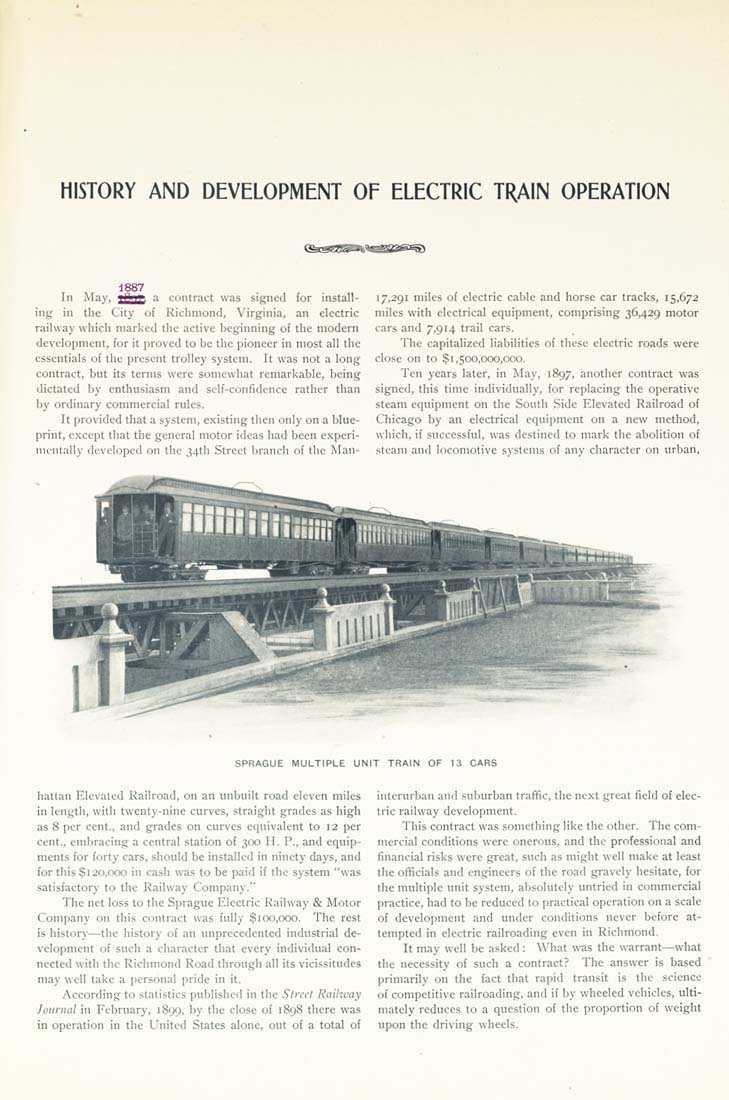
    Ten ycars later, in May, 189", another contract vvas

signed, this tinic individually, for replaeing the opcrative

steam cquipmcnt 011 thc Souih Sidc Elevatcd Railroad  of

Chicago by an electricai  equîpment  on a new method,

which, if succcsslul, was destincd to mark the abolition  of

stcain antl Itx'omotive svsloms oí any  charactcr  on  urban,


iuterurban antl suburban trnffic, the next great field of elec-

iric railway dcvelopment.

    This contract was something Hke tlie other.  The com-

nicreial conditions were onerous, and thc profcssional and

finaneial risks werc great, such as might well  make at least

theofliciaĩs and engineers of the road gravely hesitate, for

themultiplc unit system, absolutely untried in commercial

practice, had to be rcduced t<> praclical operation on a scale

of development  and  under eoiĸlitions  ncver  before  at-

tempted in  elcctric railroading evcu  in l.icluuond.

    It may well  be askcd:  What was the warrant—what

the necessity of  such a contract?   The answer is based

primarily on the fact that rapid transit is thc  scĩence

of compctitive railroading. and if  by whcelcd  vchicles, ulti-

matcly reduces to a qucstion of the proportion of weight

upon  thc driving wheels.


SPRAGUE MULTIPLE  UNIT TRAIN  OF 13  CARS
|
|
|
Page [5] |
|