

Sprague, Frank J. Engineering problems in electric elevated and suburban railroading
([S.l. : s.n., 1899])
|
||

 Click here and hold to drag menu around
|





|
|
|
|

|
Page [11] | 
|
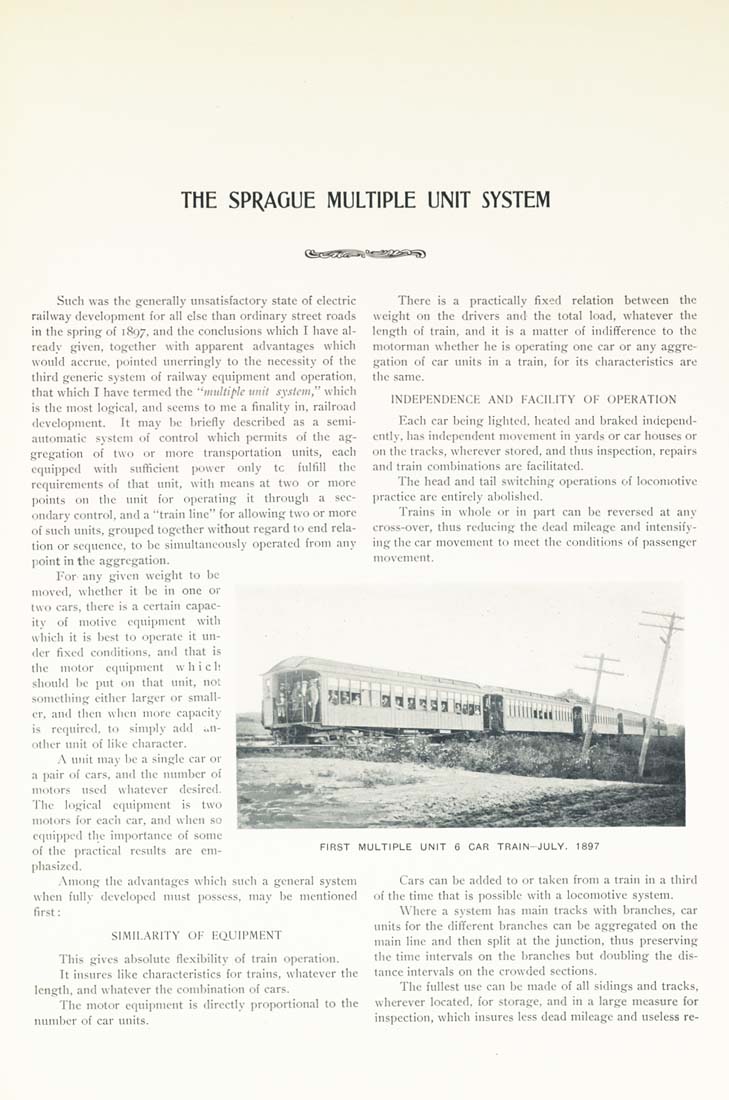
THE  SPRAGUE  MULTIPLE  UNIT  SYSTEM


    Such was thc gcnerally unsatisfactory state of electric

railway development for all elsc than ordinary street roa<ls

in the spring of 1897. and thc conclusions which I liavc al-

reariy  given, togcther with apparent  advantagcs  which

would  accruc. pointed iinerringly  to tlic necessity  ol thc

third geiieric system of railway cquipment and opcration.

tliat whieh I have termed the "multiple unit system," which

is ĩhc most logical.  aiĸl secms to me a  finality in, railroad

tlevelopnient.   It may bo  brîefly  describcd  as  a  semi-

automatic  system of  control which pcrmits  "E the  ag-

gregation of  two  or niorc  transportation  units,  each

equipped  with  sufncicnt   power  only  tc  fulfill  the

requirements of  tliat unĩt,  with means at  two  or  morc

points  ou tlio  imit  for   operating ii  through a sec-

ondary control, and a "train linc" for allowing two or moro

oí such units, groupod togcthor without rcgard t<> end rela-

lion or sequence, to be simultaneously  operated  from any

point in thc aggregation.

    For  any given  wcight to bc

moved, whether it  be in  onc or

Iwo cars, there is a  certain  capac-

ity  oí  motive  equipment  witli

which  il  is bcsl  lo  operate it un-

der fixed conditions, and  that is

ilif  motor   eqnipment  w h i ch

shoulil 1>c put "n  that nnit,  110:

something either largor or small-

cr.  aml tlion  when  more capacity

is  requrred,  to  simply :ĸl<l  ..n-

othcr utrit "f likc character.

    A unĩt may  be  a single car <>r

a pair  <>f cars, aiĸl  thc inunbcr of

motors  uscd whatever  desired.

The logical   equipment  is  two

motors lor each  car, anti when so

eqnîpped  the importance oí some

oĩ thc  practical  results  are eni-                 first h

phasized.

     Among  the advantages which  such a general system

when  fullv developed must  possess, may be mentioned

first:


              SIMILARITY  OF EOJJIPMENT


     Tlris gîves  absolute flcxibility of  train  operation.

     Tt itisurcs like  characteristĩcs  for trains, whatever  the

lengih, aud whatever thc combination of cars.

     'l'hi' inottir  cquĩpnicut is <lircctly proportional  to  the

nimibcr  of car nnits.


    Thcre  is a  practically  fixed  relation  between  the

wcight on  the  drivers aiĸl  the  total load,  whatever the

length oí train. aiĸl  it is a  nialicr of iiĸliffercnce to the

motorman whether he is opcrating onc car or any aggre-

gation of car units in a train, for its cliaracteristics are

ihc same.


   INDEI*KN_.KN(;K ANI)  FACfLfTY  OF  OI'KRATION

    Each car being lighted, heated and braketl iiĸicpcntl-

ently. has indcpeiĸlent niovcmcnt iu yards or car hotises or

011 the tracks, whorever stored. and thus iuspcction, repairs

and train combinations arc facilitated.

    Thc head antl lail switching operatíons of locomotivc

practice arc entirely abolĩshed.

    Trains in wfiole or in  part can be  reverse<l at any

cross-over,  thus reducing the <lea<l mileage aml intensify-

ing thc car movciucnt to nicct thc conditions nf passenger

movement.


    Cars can bc arideri to or takcn froni a train in a third

<>[ thc tiuie that ĩs possible with a locomotive systcm.

    Whcrc a syslcm  has main tracks with branches, car

units for the diffcrent branches can be aggregated on the

uiaiu iiiu'  and thcn split at the junction, thus prcserving

thc timc intervals 011  thc branchcs  but doubling the clis-

lancc intervals 011 the crowtled soctious.

    The fullest uso can be inade of all sidings and tracks,

wherever located, for storagc. and în a large measure for

inspectĩon, which instircs less dcad mileage and useless re-
|
|
|
Page [11] |
|