

Sprague, Frank J. Engineering problems in electric elevated and suburban railroading
([S.l. : s.n., 1899])
|
||

 Click here and hold to drag menu around
|





|
|
|
|

|
Page [15] | 
|
THE  MULTIPLE  UNIT  SYSTEM  ON  THE  SOUTH  SIDE  ELEVATED

                               RAILWAY  OF  CHICAGO


    Like niauy other innovations. thc opportunity to pnt

the system wlrieh has just boeu descrîbed, an<l which prom-

iseri s<>  iinich, into operation  was a long  time  coming.

.Matiy attempts liatl been madc, with ofîcrs as already itĸli-

cated  to conduct cxperimcnts on a wholesalc scale at my

own cxpensc, but with  no  satisíactory response, until in

April, 1897, I was  suddonlv callctl in consultatiou on thc

Soulh Sitlc Elevated Road in Chicago.

    This roatl had passed into thc hands of a rcceivcr, ha<l

been rc-organizcd,  and in thc spring of 1897, had, uiĸler

its new and energetic rresitlcnt, Mr. Lcslie  Carter, antl a


    During thc bricf pcriod of my transnrission from the

status of consulting engineer 10 th.it of contractor, a meet-

ing in Chieago provc<ĩ partĩcularly iiilcrcsting, for in the

early part of April, 1897, scarcely more tliim two months

after Mr. Wallacc's papcr bcfore the Socicty of Cĩvil Engi-

neers, I had thc pleasurc of being present ai a iable wriien

he made a stalcnicnt about  as follows:

    "What  í  wish io  tlo on way suburban traffic is to

abolish the timc table except at the dispatching ternrinus,

and to scnd ont frcquent trains in succossion wliose lcngth

shall bc onc or a dozcn  cars according to the traffic re-


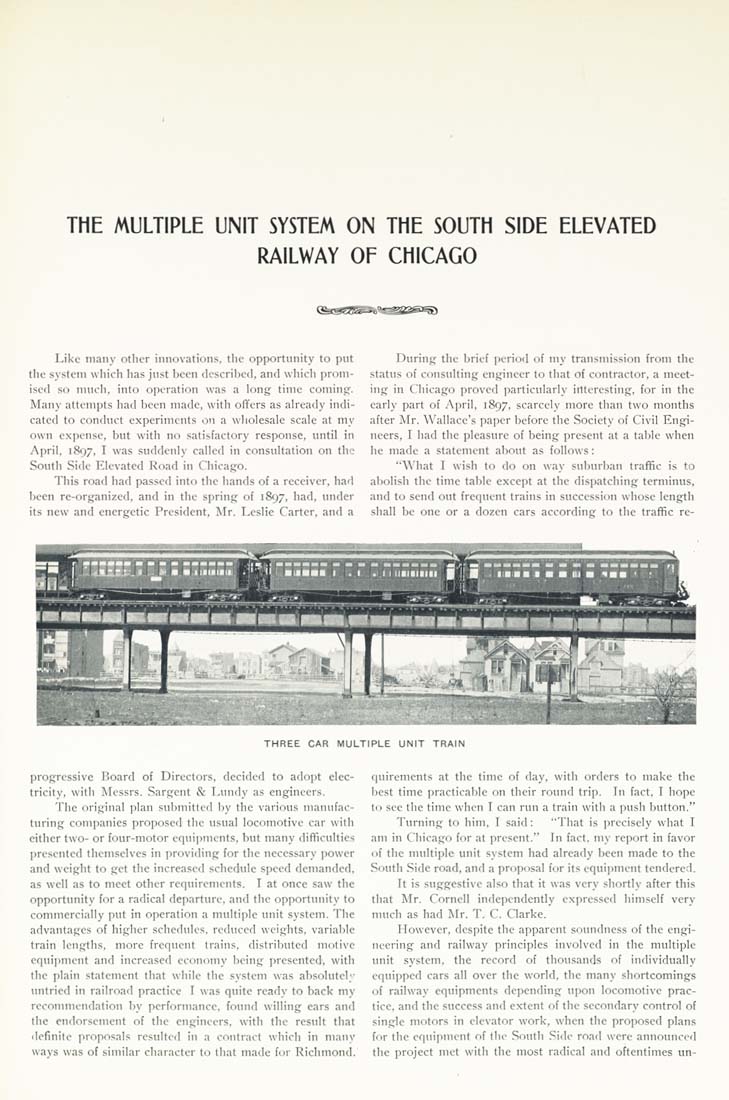
THREE CAR  MULTIPLE  UNIT TRAIN


progressivc  Board of Diroctors,  dccirieri to adopt  elec-

trĩcilv, with  Mcssrs. Sargent &  l.iuĸly as engincers.

    Tlic orĩginal plan submitted by thc various manufac-

turing conipanies proposetl the usual locomotîvc car with

eithcr two- or four-motor equipiuents, but many difficulties

prosenled  themselves in provitling for ttic necessary powcr

and wcight to get thc incrcasetl schedule speed dcmaiĸled,

as wcll as to meet othcr requircmcnts.  I  at once saw the

opportunity  for a radical tleparture, and thc opportnnity to

connncrcĩally put in opcration a multiplc unit system. The

advantagcs <>f higher schcriuics. reduced weights, variable

train  lengths,  morc fi-eqticnl trains, distrĩbuted  niotĩvc

equipment anri incroased economy boing prcscntcd, with

thc plain statcment  that wlrilo tiic syslem was absolutely

untried in railroad practice I was qnite ready to back my

recoiniiĸ'iĸlation by perfornĸince. founri willing cars and

the eiidorscinent of thc cngiuoers. with the result that

tlefinĩte proposaĩs resulted iu a  contract  whĩch in niany

ways  was  of similar character to that made for Riehmonri.


quirements at thc  tiinc of riay, with onlers to make the

bcst time practicablc on thcîr ronntl irip,   In fact, î  hope

to sce tlie timc whcn ĩ can run a train with a push button."

    Turning to him. I sairi:    "That  is prccisely  what I

am in Chicago for at present."  în fact, niy rcport in  favor

"f tlie niultiple unit systcm had already been made to the

South Side road, and a proposal for its equipmenl lenriereri.

    It is suggcstĩvc also that it was vcry shortly after this

that Mr.  Cornell  indepcndently cxpresse<l Irimself  very

much as had Mr. T. C. Clarke.

    Ilowevcr, despite tlie apparent soundness of tho  engi-

neering anri  railway prineiples involved  in the multiple

unit system, tlic  record  of thousantls  of  individually

cqnippcd cars all ovcr thc world, the tiiany shortcomings

of railway equĩpmcnls depending upon locomolive  prac-

licc. and thc succcss anri extent <>f the secondary control of

single motors in clcvator work, when thc proposed  plans

for tlie eqnĩpmont of the South Siric  roatl wcrc announced

thc project inct with the most rariical and oftentĩmes un-
|
|
|
Page [15] |
|