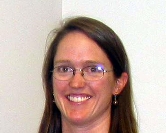
 Speaker: Prof. Andrea Lommen, Franklin and Marshall College
Speaker: Prof. Andrea Lommen, Franklin and Marshall College
Title: "Gravitational Wave Burst Detection Using Pulsars"
Abstract:
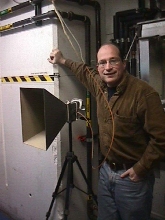 Speaker: Prof. David Saltzberg, UCLA
Title: "The ANITA telescope: A one million square kilometer objective lens for high energy neutrinos"
Abstract:
The Antarctic Impulsive Transient Antenna (ANITA) is a long-duration
balloon payload built to detect >3 EeV cosmic neutrinos. Such
neutrinos may reveal the true nature of the most powerful astrophysical
accelerators, and would allow us to probe the weak interaction at 150
TeV, an order of magnitude higher C.M. energy than at terrestrial
machines.
A near-certain source of these neutrinos is provided by the GZK effect,
in which the highest energy cosmic rays produce pions by scattering on
the 3K cosmic microwave background. The ANITA instrument uses the
Askaryan effect to detect neutrinos interacting in the Antarctic ice,
which produce radio-cherenkov radiation. Data from our first full
flight on a NASA long-duration balloon at 120,000 feet will be shown.
I will also describe the improved instrument we built to fly this
upcoming December. Ideas for achieving the next order of magnitude in
senstivity will be discussed.
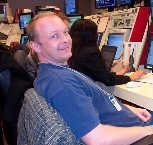
Speaker: Brendan Casey, FNAL
Title: "Quark flavor physics highlights of 2008"
Abstract:
I will give an overview of some interesting results that have recently come out of the B-factory and Tevatron programs. I will briefly cover spectroscopy where Belle, BaBar, and DØ have all claimed discovery of new states in summer 2008. Next, I will discuss searches for new sources of CP violation needed to explain the matter dominance of our universe. Here, I will focus on anomalous direct CP violation seen in charmless two-body B decay at B-factories and anomalous indirect CP violation seen in Bs mixing at the Tevatron. Finally, I will discuss searches for new charged current interactions that violate lepton universality such as a charged Higgs where information is now available from top, bottom, charm, and strange quark decay.

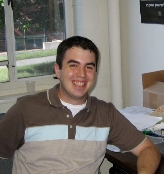 Speakers: Bence Kocsis, Princeton University and Ryan O'Leary, CFA - Harvard University
Title: "Gravitational waves from scattering of stellar-mass black holes in galactic nuclei"
Abstract:
We will discuss a new and interesting source of gravitational waves for ground-based observatories such as LIGO. In the nuclei of most galaxies, stellar mass black holes segregate from the stars and form a steep density cusp around the supermassive black hole in the center.
During two-body encounters between the BHs, occasionally enough gravitational waves are emitted to form a binary, which rapidly coalesces in less than one year. The BH-BH mergers are predominately eccentric during their merger in the LIGO band. This distinguishes them from other binary inspiral events, which circularize before becoming detectable, and allows us to use future ground-based detectors to actually probe the astrophysics inside of galacticnuclei. We also show that eccentric mergers extend the observable range of LIGO to larger masses than thought possible before, even up to 700 M_sun.
 Speaker: David Khatidze, Columbia University
Title:"Measurement of the electron charge asymmetry in ppbar -> W+X -> enu + X events"
Abstract:
We present a measurement of the electron charge asymmetry in p¯p ? W + X ? e + X events at a center of mass energy of 1.96 TeV using 0.75 fb?1 of data collected with the D0 detector at the Fermilab Tevatron Collider. The asymmetry is measured as a function of the electron transverse momentum and pseudorapidity in the interval (?3.2, 3.2) and is compared with expectations from next-to-leading order calculations in perturbative quantum chromodynamics. These measurements will allow more accurate determinations of the proton parton distribution functions.
 Speaker: Prof. Omar Benhar, INFN and Department of Physics "Sapienza" Universita' di Roma, Italy
Title: "Modeling nuclear effects in neutrino scattering"
Abstract:
I will outline the theoretical description of nuclei based on nonrelativistic many-body theory and realistic hamiltonians, and discuss its application to the study of electron- and neutrino-nucleus scattering observables.
 Speaker: Lidija Zikovic, Columbia University
Title: "Closing in on the Higgs Boson"
Abstract:
The Standard Model describes the unification of electromagnetic and
weak interactions. It was thoroughly tested over past thirty years,
and represents one of the major successes of modern physics. This
theory predicted the existence and the masses of the weak bosons. The
last remaining piece of the puzzle is the Higgs boson whose existence
is crucial for our understanding of the origin of particle masses.
Direct searches at LEP put a lower limit on the Higgs boson mass, and
together with precision measurement constrained it to ~<200 GeV. The
D0 and CDF experiments at the Tevatron recently excluded a new
interval in the Higgs mass. In this time when we are entering LHC era,
we are coming closer to the discovery or exclusion of the SM Higgs
boson.\\ I will discuss current searches for the SM Higgs boson with
the D0 experiment at Tevatron, highlighting the most important
techniques. I will also draw a parallel with future searches at LHC,
showing what we can learn from Tevatron experience.
 Speaker: Prof. Karol Lang, University of Texas
Title: "A search for neutrinoless double beta decay with NEMO-3 and SuperNEMO detectors"
Abstract:
The observation of neutrino oscillations has proved that neutrinos have mass.This discovery has renewed and strengthened the interest in neutrinoless double beta decay experiments which provide the only practical way to determine whether neutrinos are Majorana or Dirac particles.NEMO-3, located in the Modane Underground Laboratory in the Frejus Tunnel under the French-Italian Alps, is an ongoing experiment looking for neutrinoless double beta decays using a powerful technique for detecting a two-electron final state by employing an apparatus combining tracking, calorimetry, and the time-of-flight measurements. We will present results from NEMO-3 and will discuss the status of SuperNEMO, the next generation experiment that will exploit the same experimental technique to extend the sensitivity of the current search.