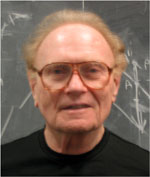
Leonard Matin
Professor
Ph.D., Columbia University, 1959
General Area of Research
Visual perception and cognitive neuroscience of space and sensorimotor behavior
Current Research
How do we know where objects are located relative to ourselves and how do we know where to reach for them? These two questions circumscribe a large segment of the area of Egocentric Space Perception and Visually-Guided Sensorimotor Behavior within the overlapping fields of cognitive neuroscience and perception. My research employs psychophysical experiments on the perception of space and manual behavior in conjunction with neuromathematical modeling, and is centered on both questions.
We are currently working on the mechanisms underlying several large-field visually-induced spatial illusions produced by pitched and roll-tilted visual fields which lead to large mislocalizations of both perception and manual behavior (e.g., eye level perceived at the hip; people perceived to have grown or shrunk, vertical appears tilted). Our experiments are carried out in the Pitchroom and other parts of the Visual Science laboratory; we also utilize fMRI measurements on the brains of human subjects at the uptown campus, and employ human centrifuges at other installations under high-g (up to 4g) to more readily vary the relative influence of visual signals and extraretinal signals from our own bodies (e.g., signals related to eye position, head position, and bodily motion) while measuring perception, manual behavior, and eye position.
Our work on several large-field illusions has led us to a neuromathematical model (Great Circle Model) that makes use of our analysis of spatial geometry and our solution of the loop equations for a neural network that relates processing in visual cortex to perception, accounts for results from a large number of experiments on space perception, and helps us interpret our discoveries of hand-to-body distance-dependence of sensorimotor behavior.
Relevant Publications
Li, W. and Matin, L. (2005). Two wrongs make a right: Linear increase of accuracy of visually-guided manual pointing, reaching, and height-matching with increase in hand-to-body distance. Vision Research, 45, 535-550.
Matin, L. and Li, W. (2001). Neural Model for processing the influence of visual orientation on visually perceived eye level. Vision Research, 41, 2845-2872.
Courses Frequently Taught
|
Columbia University
Psychology Dept.
306 Schermerhorn
1190 Amsterdam Avenue MC: 5501
New York, NY 10027
Phone:
212-854-4538
Fax:
212-854-4325
|