Figure 4.4.1
Introduction to Earth Sciences I
4.4 Earthquakes And The Interior Of The Earth
The analysis of the seismic waves sent out by earthquakes provides us with some of the greatest insights into the interior structure of the Earth. They provide perhaps the most direct way to view the Earthís interior since they can be used to create an image of the interior.
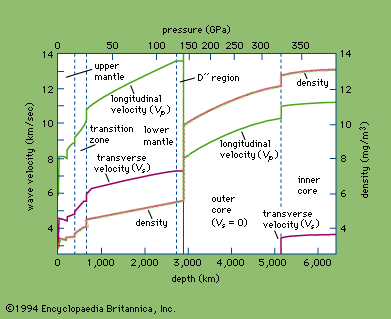
This is because the interior of the Earth is composed of layers and structures that propagate seismic energy at different speeds. We learned above that an earthquake gives rise to many types of seismic waves, the P-wave and S-wave being the first two to arrive at any site from an earthquake. The interior layers of the Earth propagate these waves at different speeds, generally increasing downward in the earth. At the top of the mantle the p-wave velocity is about 8 km/sec and this increases downward to about ____ km/sec. The S-wave speeds vary from ___ to ___ km/sec.
Most important for deriving an understanding of interior properties, S-waves do not propagate in liquids. Remember that the S-wave is a shear wave that results from a motion in the earth that literally tries to shear the rock. Liquids cannot be sheared, of course, so S-waves cannot pass through them. So S-wave velocities increase in the mantle until the core is reached then they go abruptly to zero in the liquid outer core.
Figure 4.4.1 |
| Summary of the average seismic-wave velocity and density profiles through the Earth according to the PREM model. The velocities of compressional (VP) and shear (VS) waves are given on the left, density on the right, and pressure as a function of depth on the top scale (see Table 2). From :Encyclopedia Britannica view this link for more context. |
The seismic waves bend (refract) as they pass through different layers and bounce off the interfaces between layers of very different material just as sound echoes off the walls of a canyon. They refract around the liquid outer core giving rise to shadow zones on the opposite side of the earth from the location of the earthquake.
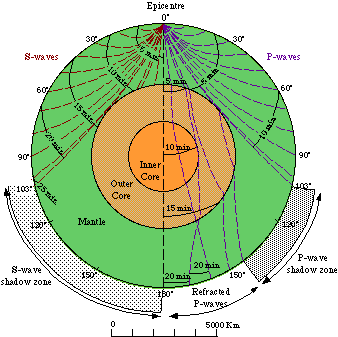
Figure 4.4.2: From
Geophysical Properties of the Earth
By recording and analyzing the many seismic waves that are
recorded at many locations throughout the Earth we can build up a picture of
the structures beneath in much the same way as is done in medical imaging. The
technique is called seismic tomography and is borrowed directly from the CAT
scan techniques of medicine.
A detailed description of Seismic Tomography: http://www.geof.ruu.nl/~bijwaard/abstracts/vakidioot/vak_uk.html
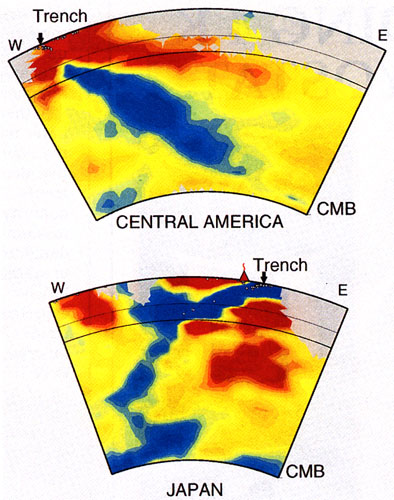
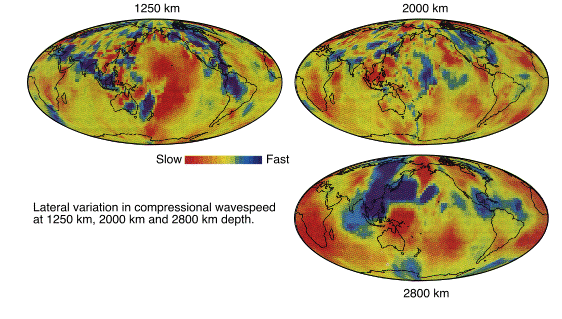
Tomography using S-waves or P-waves or a combination of the two has in recent years been used to create remarkable images of the interior structure. What is being images are changes in seismic velocity which are associated with temperature variations in the Earth. Particularly for S-waves propagation speed is very sensitive to temperature with faster regions being associated with colder material, warmer with slower velocities. Thus, we are able to image the decent of a slab at a subduction zone because that material is relatively cold compared to its surroundings. Similarly regions of hot upwelling mantle appear as distinct regions of slower velocity material. One thing we have learned most recently is that some slabs seem to penetrate much deeper into the mantle than most scientists had thought possible. In fact, they appear, in places, to penetrate to the core itself!
 Figure 4.4.3
 |
 Figure 4.4.4
 |
As well as these general pictures of mantle structure emerging from tomographic analysis, special properties of seismic waves can be used to reveal features of the deep structure in surprising detail. Here are some examples.