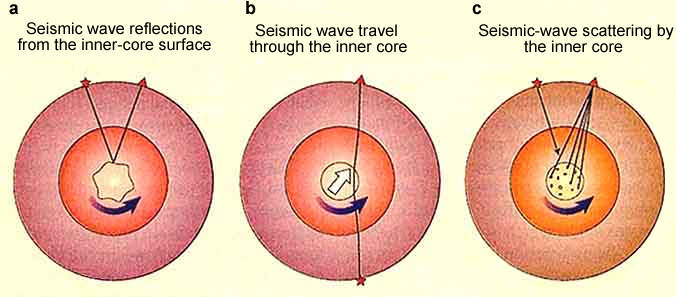
Figure 4.4.7
Introduction to Earth Sciences I
4.4.1 Inner Core Rotation
Lamont news site: http://www.ldeo.columbia.edu/press_releases/song/pr.html
This site describes an astonishing discovery published in 1996 about the Earth's inner core -- the Earth's inner core actually rotates inside the Earth. How can we possibly know such a thing? The first and essential piece of information is that it had been known for some time that the solid inner core of the Earth is anisotropic in the way it propagates seismic energy. What this means is that seismic body waves that pass through the inner core travel faster if they pass in one direction than in another. How do we know that in the first place? Imagine an earthquake that occurred in Chile (say) recorded by seismometers on exactly the other side of the Earth. The amount of time the seismic energy takes to make that long passage can be measured quite accurately. Imagine another earthquake that occurred further around the world in, maybe in Indonesia, and recorded also on exactly the opposite side of the Earth from Indonesia. Its time of passage through the Earth can also be measured. What is known is that the time of passage for seismic energy taking these trips from one side to the other varies quiet a bit depending on where the earthquake occurred. The surprising but clear cause of these time differences is that the energy travels faster through the inner core when traveling in certain directions. That's what is meant by anisotropy. Many Earth materials display this property and it is usually caused by internal layering - the energy will travel faster along a layer than it will across the layers. What was not known was that the inner core, made of solid iron, would display this property. Most scientists believe that it results from the preferred orientation of iron crystals in the core.
It is this property combined with other measurements that lead to the idea that
the inner core is rotating. The web site gives the details but in simple terms
we use measurements of seismic signals that travel all the way across the entire
Earth as described above but in this case two waves from the earthquake are used;
one that travels through the inner core and another that skirts the inner core and
travels only through the outer core. There will be a difference in time of travel
of these two signals because the one traveling through the inner core picks up
speed because the inner core propagates energy faster than the outer core so this
wave will arrive earlier than the other. Seismic signals of this type have been
recorded for many years and a seismologist at Lamont chanced to compare seismograms
recorded over the last several decades. To his surprise he saw that the time
difference between the wave that traveled through the inner core and the one that
traveled through the outer core appeared to systematically change. What could
make the travel time of seismic energy propagating across the Earth change over
the historic past? The answer is contained in the above Web site and is that
the anisotropic inner core must be rotating, and thereby changing the orientation
of "fast" direction for propagation.
Since the finding was first published in 1996, other seismic observations have been
used to examine the same effect. The figure below shows three independent approaches;
the middle one being the one discussed above. To the left we see a seismic wave reflected
off the inner core. The core-mantle boundary is known to be rough (see discussion below)
so the energy received from an earthquake (at the star location) to a receiver (at the
triangle) will vary in strength over time as the inner core rotates. On the left we
see a slightly different idea. The earthquake energy is scattered from many sources
within the inner core, and will also vary in strength and character as the inner core
rotates.
Figure 4.4.7
Since the original finding many approaches have been used, some have come up with negative results suggesting that there is no discernible rotation. Most have suggested that the rotation rate is slower than originally proposed. But the idea that the inner core might be rotating differentially with respect to the outer core and hence the Earth as a whole remains one of the most surprising findings of whole Earth seismology in the decade of the 1990's.