Figure 4.4.8
Introduction to Earth Sciences I
4.4.2 Structure of Mantle Discontinuities
So far in these lectures you have learned about some of the
major divisions within the Earth - the crust, the lithosphere (involved in plate
tectonics), the inner and outer core - but there are a number of other boundaries
that are much more subtle. The major boundaries involve significant changes in
the physical properties within the Earth and some are often associated with major
chemical changes also. Several "discontinuities" occur in the mantle that are most
likely to be associated with phase transitions. It is believed that the
bulk composition of the mantle is of the material peridotite that is composed of
an iron and magnesium silicate (Mg, Fe) SiO4. This is the material that lies
immediately beneath the crust and is sometimes exposed in oceanic fracture zones
and in other tectonically active parts of the Earth. Deep in the Earth the
increasing pressure squeezes the peridotite and cause the atoms to form a more
compact structure. No chemical reaction occurs, but the re-packing of the atomic
structure causes the same atoms to become a new material known as spinel or Ringwoodite.
It is still made of Mg, Fe, Si and O (magnesium, iron, silicon and oxygen) but it is
a different material because of the atomic packing. This may be a hard idea to
understand at first but remember that graphite (the material in your "lead" pencil),
coal, and diamonds are all made of carbon. They are just in different atomic
arrangements associated with pressure due to burial (diamonds come from very deep
within the Earth). A second phase transition occurs from spinel to different
material known as perovskite. The first phase transition causes a discontinuity
in the mantle about 410 km beneath the surface and the second at about 660 km
(they actually vary in depth depending on the tectonic setting.
The physical property changes across these boundaries that occur over quite short
distances (on the scale of the mantle) are not large enough to be detectable by
seismic tomography which gives a fairly low resolution, smooth picture of the structure
of the mantle. To resolve the discontinuities we need to study the very weak direct
reflections they cause or from refractions along their surface. Even trickier, there
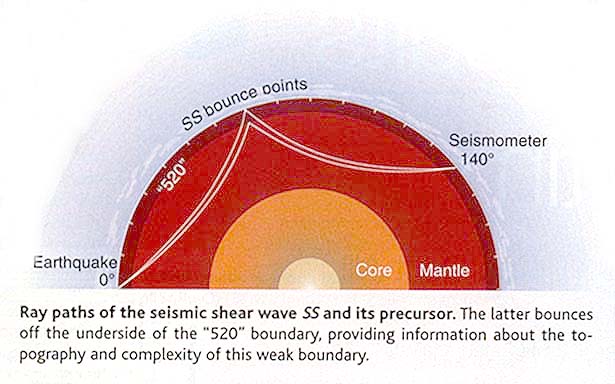
appears to be a very subtle boundary at about 520 km. It too is most likely caused
by a phase transition like the 410 and 660 discontinuities. In fact it may be a pair
of boundaries, one at 500 and the other at 560 km.
The difficulty with using waves to detect the physical world is
that the quality of your image is limited by the wavelength you
use. When using a particle as a probe, we need to use particles
with short wavelengths to get detailed information about small
things. To probe down to smaller scales, the probe's wavelength has
to be made smaller.
Things with long wavelengths are analogous to the 'throwing
basketballs in the cave to discover what is in growling in front of
you' story because neither can provide too much detail about what
they hit. Things with short wavelengths are like the 'throwing
marbles in the cave to discover what is in growling in front of
you' story in that they can provide you with fairly detailed
information about what they hit. The shorter the probe's wavelength
is, the more information you can get about the target.
The resolution of your measurement is the wavelength of light
divided by the diameter of the aperture. This means that you would
either need a small wavelength or a very large diameter to have
good resolution.
Check out this website for a more detailed explanation.
http://pdg.web.cern.ch/pdg/cpep/cave.html
In an innovative investigation shown below seismologists used shear waves that
bounced underneath the boundary as shown below.