 |
A signal corrupted by noise can be modeled in the time domain as follows:
where n[m] is the noise, x[m] is the original signal and y[m] is the resultant signal after noise corruption and m is the discrete time index. In the frequency domain, this can be represented as:
where Y(f), X(f) and N(f) are the Fourier transforms of y[m], x[m] and n[m] respectively.
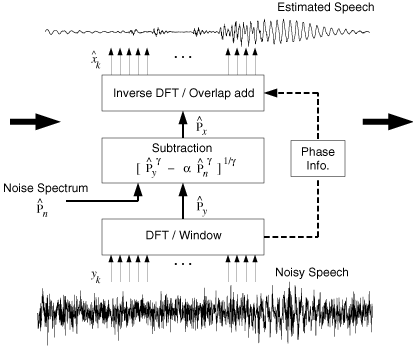
The basic idea behind spectral subtraction is first estimating the average noise spectrum N(f) and subtracting this from the noise corrupted spectrum Y(f) to obtain the spectrum of the original signal X(f). The phase for X(f) can be obtained by incorporating the phase of noise-corrupted signal y[m]. Finally, the inverse Fourier transform is applied to X(f) to obtain x[m].