El Nino & La Nina
ENSO indices, upper-ocean temperature, and their relationship to global surface temperature.
Recent ENSO and Global Temperature
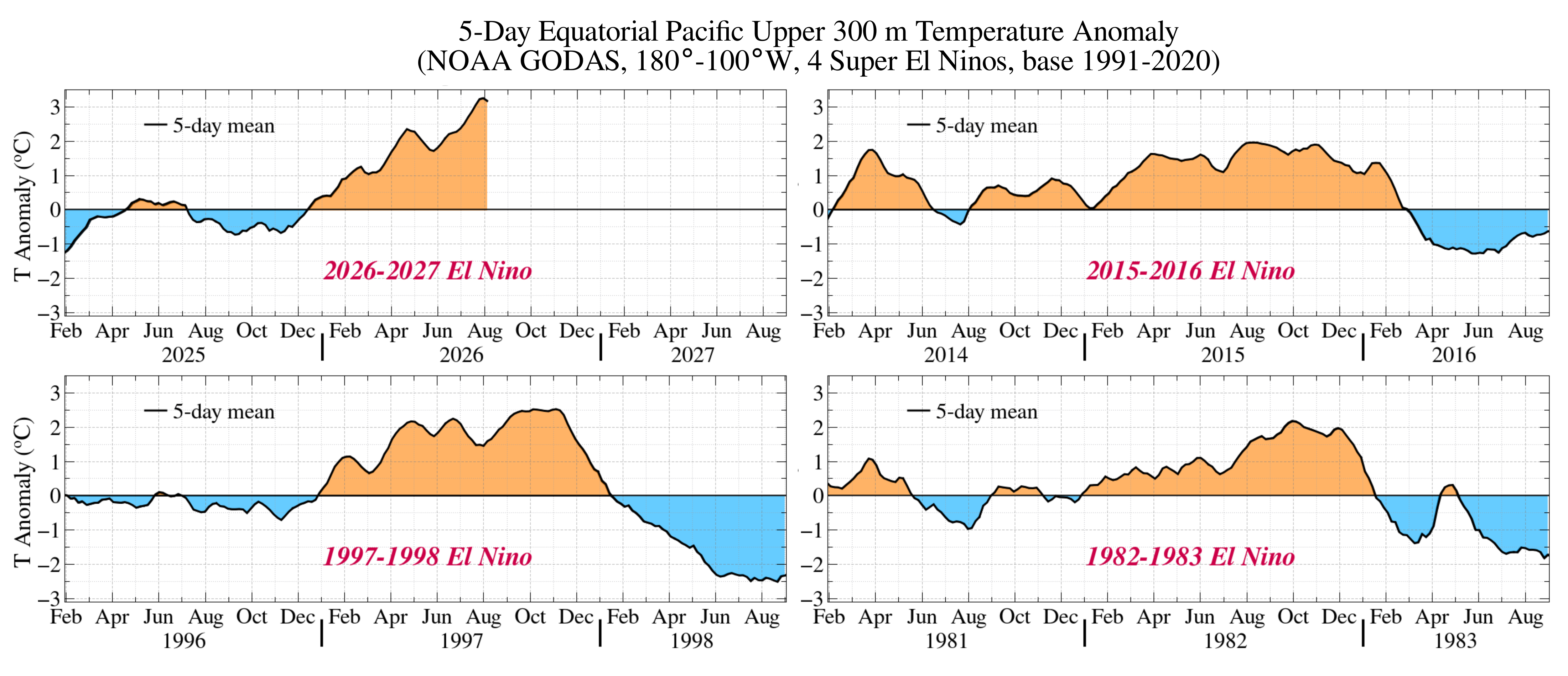
Equatorial Pacific upper 300 m temperature during four super El Nino events.
Five-day mean temperature anomalies relative to the 1991-2020 base period, spatially averaged over
180°-100°W, 0.33°N-0.33°S, comparing the current 2026-27 El Nino with the
1982-83, 1997-98, and 2015-16 events.
Figure available as
PDF
.
Data through 2 Sep 2026.
Data source: ref. [6].
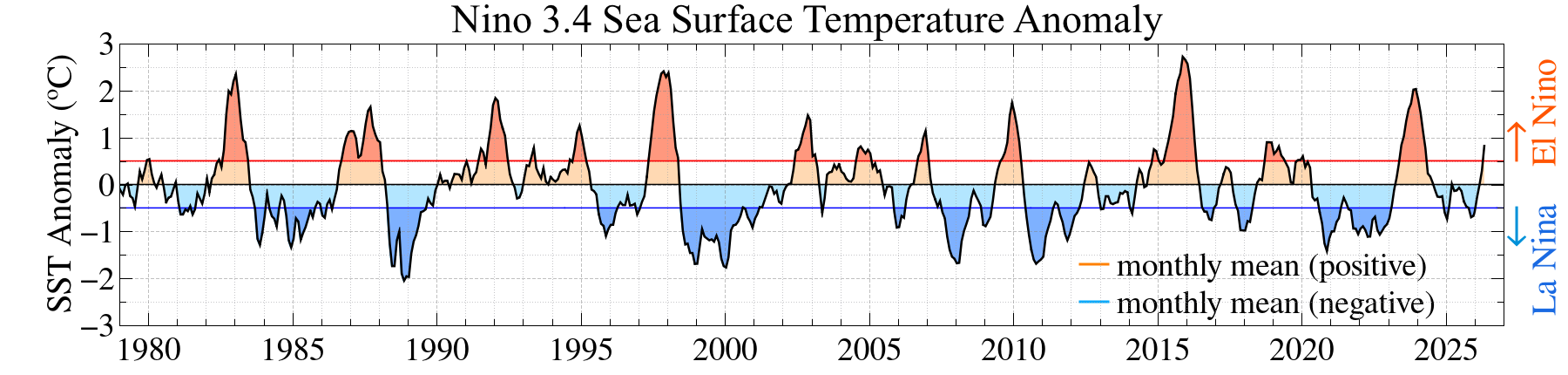
Nino 3.4 sea surface temperature (Jan 1979 – Sep 2026).
Monthly mean SST anomalies relative to the 1991–2020 base period, in the region 5ºN-5ºS, 170-120ºW.
Figure available as
PDF
.
Data through Sep 2026. Data source:
ref. [7].
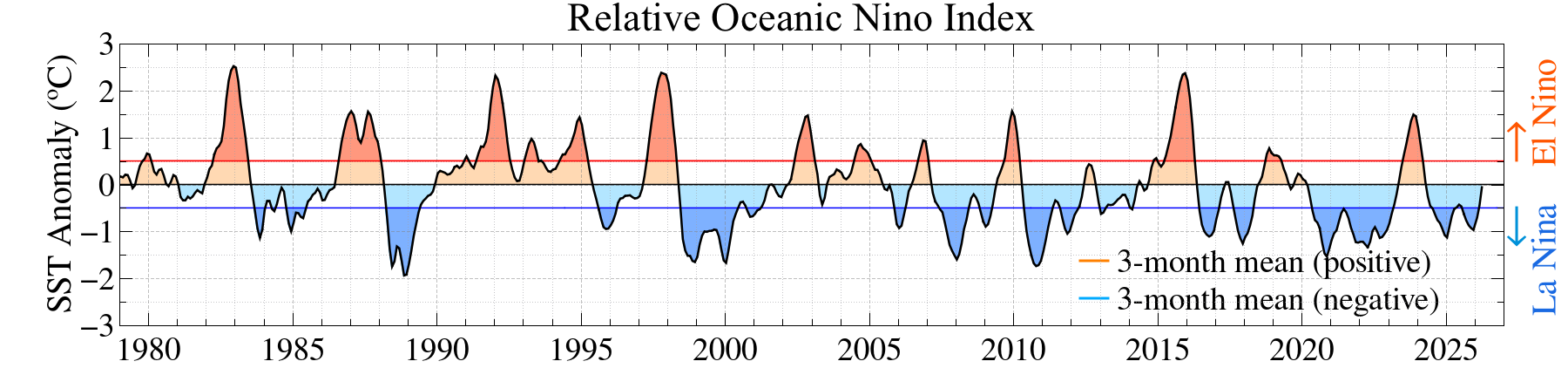
Relative Oceanic Nino Index (RONI, DJF 1979 – JAS 2026).
3-month running mean SST anomalies relative to the 1991–2020 base period, in the region 5ºN-5ºS, 170-120ºW.
Figure available as
PDF
.
Data through JAS 2026. Data source:
ref. [3].
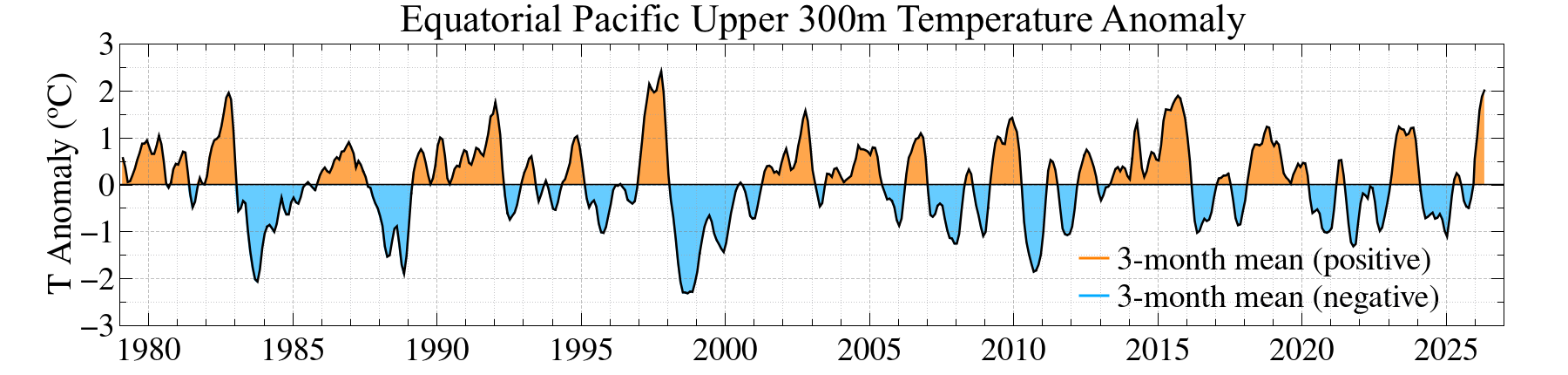
Equatorial Pacific upper 300 m temperature (180°E–100°W, Jan 1979 – Sep 2026).
3-month running mean temperature anomalies relative to the 1991–2020 base period.
Figure available as
PDF
.
Data through Sep 2026. Data source:
ref. [2].
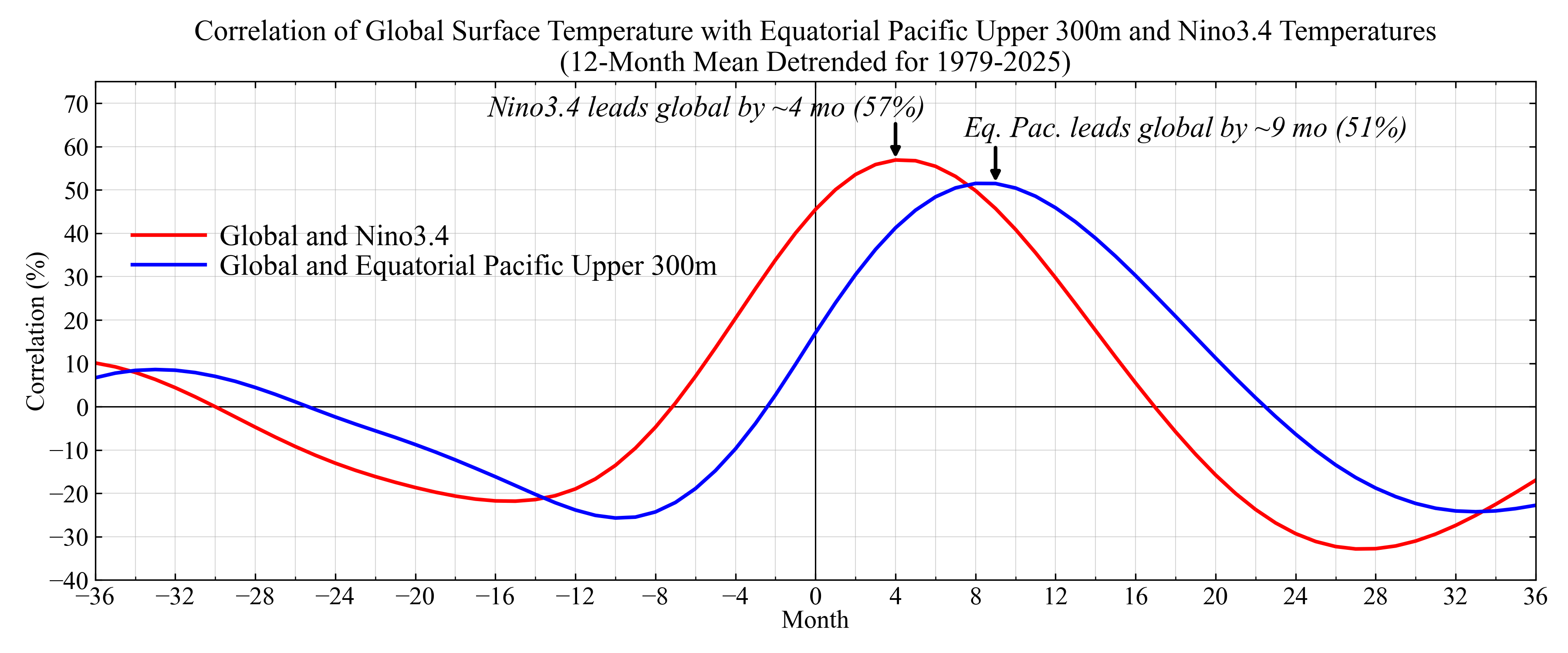
Correlation of global surface temperature with Nino 3.4 and upper 300 m temperature.
Lead–lag correlations based on detrended 12-month running means for 1979–2025.
Figure available as
PDF
.
Data through Sep 2026. Peak correlations occur at about 4 months for Nino3.4 and about 8.5 months for upper 300 m temperature. Underlying data sources:
ref. [4],
ref. [7],
ref. [2].
Extended ENSO Indices (1950–Present)
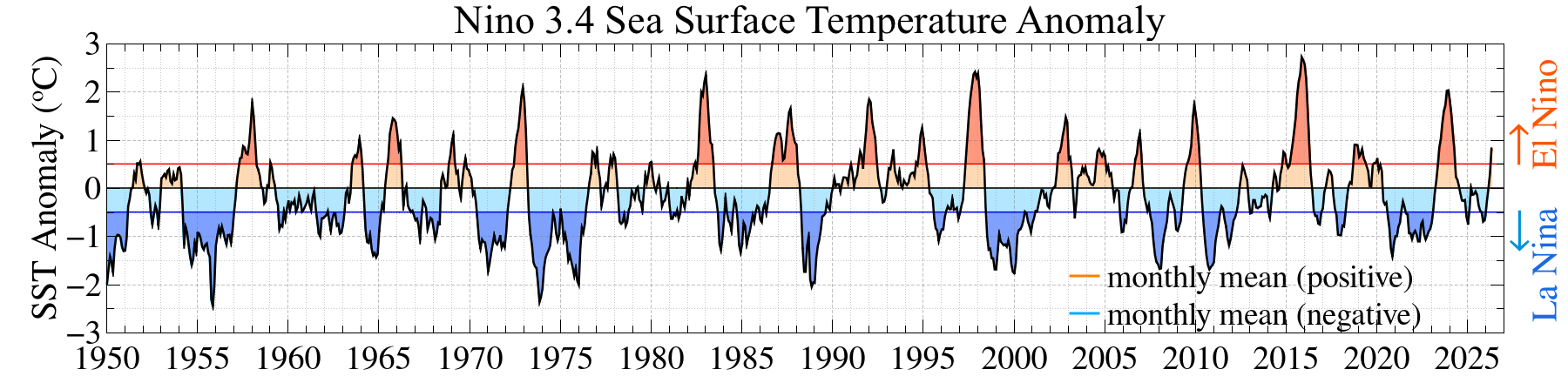
Nino 3.4 sea surface temperature (Jan 1950 – Sep 2026).
Monthly mean SST anomalies relative to the 1991–2020 base period, in the region 5ºN-5ºS, 170-120ºW.
Figure available as
PDF
.
Data through Sep 2026. Data source:
ref. [7].
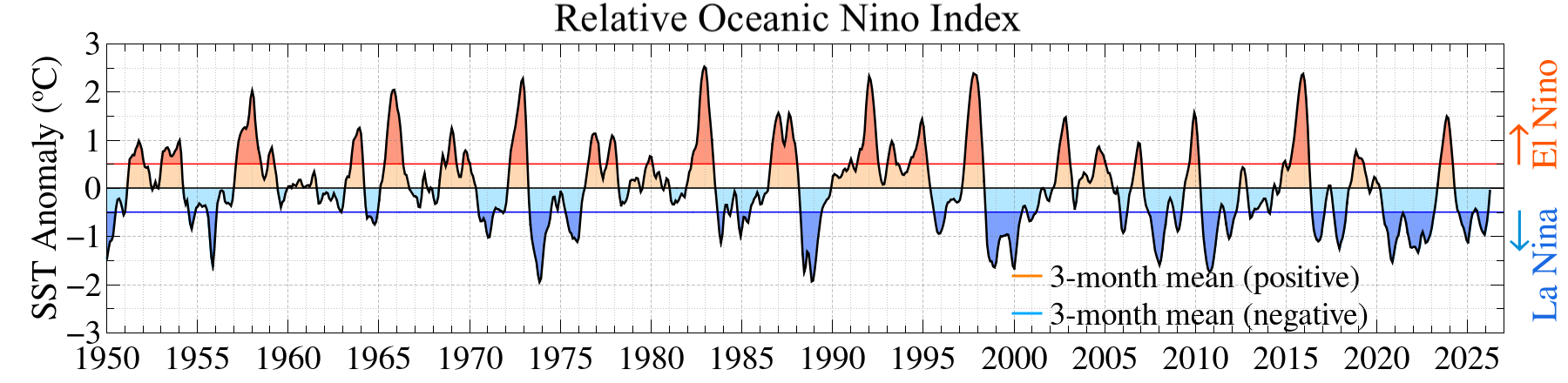
Relative Oceanic Nino Index (RONI, DJF 1950 – JAS 2026).
3-month running mean SST anomalies relative to the 1991–2020 base period, in the region 5ºN-5ºS, 170-120ºW.
Figure available as
PDF
.
Data through JAS 2026. Data source:
ref. [3].
ENSO and Global Temperature Relationships
Comparison of global surface temperature with Nino3.4 and equatorial Pacific upper-300 m temperature,
based on detrended 12-month running means for selected detrending periods.
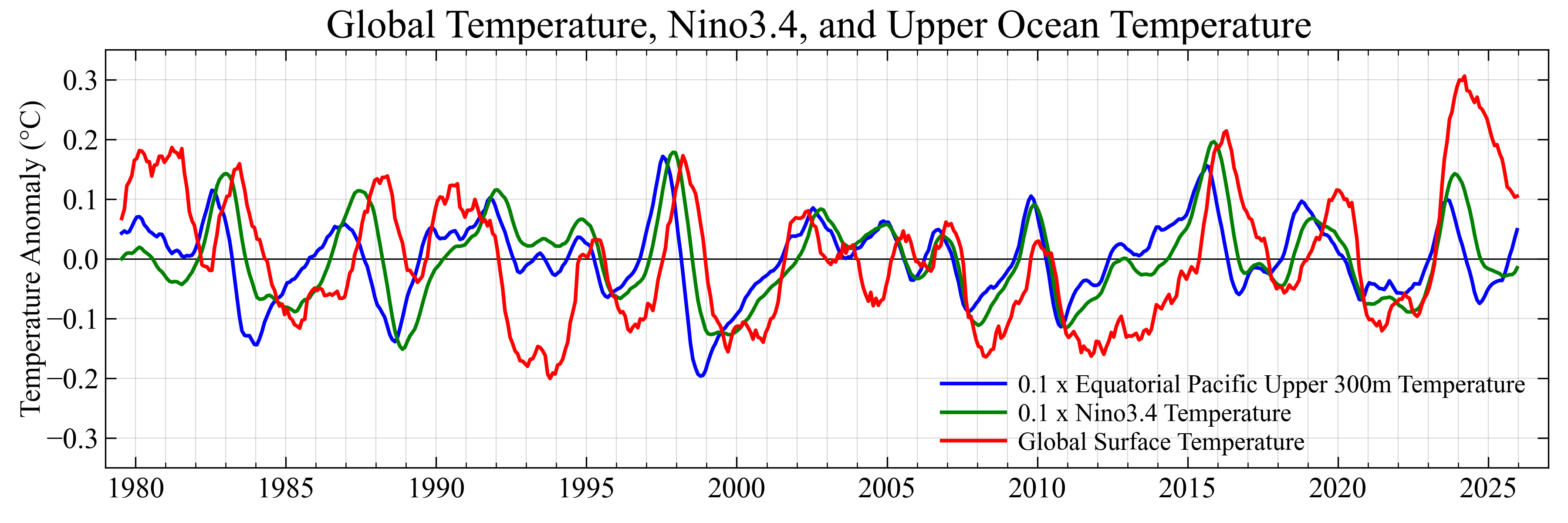
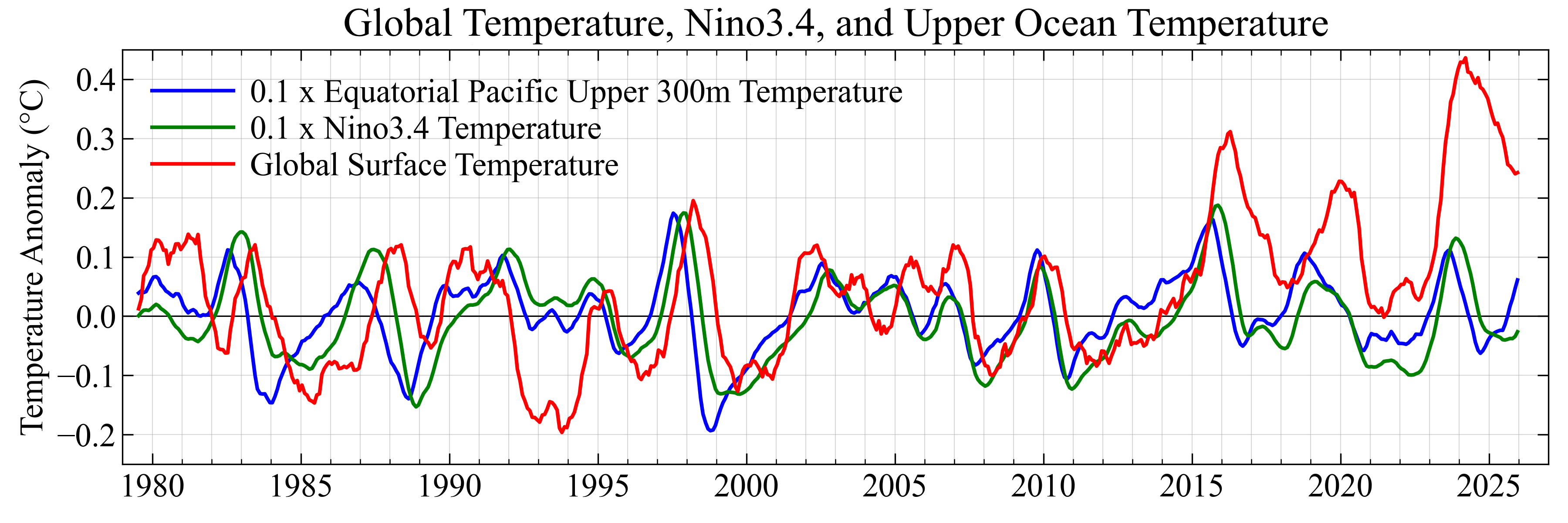
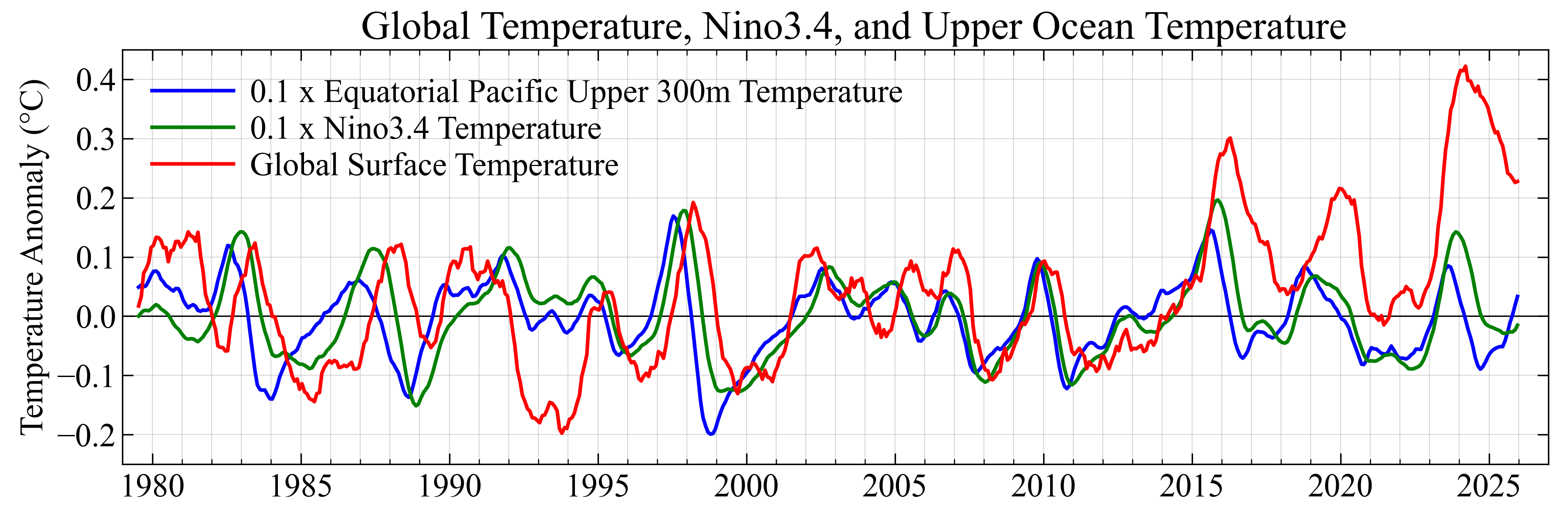
Global surface temperature, Nino3.4, and equatorial Pacific upper 300 m temperature (detrended for 1979–2025).
Detrended 12-month running means, with Nino3.4 and upper-300 m temperature scaled by 0.1.
Figure available as
PDF
.
Data through Sep 2026. Underlying data sources:
ref. [4],
ref. [7],
ref. [2].
Global surface temperature, Nino3.4, and equatorial Pacific upper 300 m temperature (detrended for 1979–2005).
Detrended 12-month running means, with Nino3.4 and upper-300 m temperature scaled by 0.1.
Figure available as
PDF
.
Data through Sep 2026. Underlying data sources:
ref. [4],
ref. [7],
ref. [2].
Global surface temperature, Nino3.4, and equatorial Pacific upper 300 m temperature (detrended for 1979–2015).
Detrended 12-month running means, with Nino3.4 and upper-300 m temperature scaled by 0.1.
Figure available as
PDF
.
Data through Sep 2026. Underlying data sources:
ref. [4],
ref. [7],
ref. [2].
Additional versions for other detrending periods are available on the
More Figures page.
ENSO Cycle Comparisons
Comparison of the present ENSO cycle with selected past El Nino periods
using Nino3.4 SST, Nino3.4 RONI, and equatorial Pacific upper-300 m temperature anomalies.
Nino3.4 SST and upper-300 m curves are based on three-month running means; for the
2025–present curves, the final point is the September 2026 monthly average. RONI curves
are three-month running averages; the final 2025–present point is extrapolated using
the average month-to-month change over the preceding three months. The plots compare
equivalent portions of each ENSO cycle.
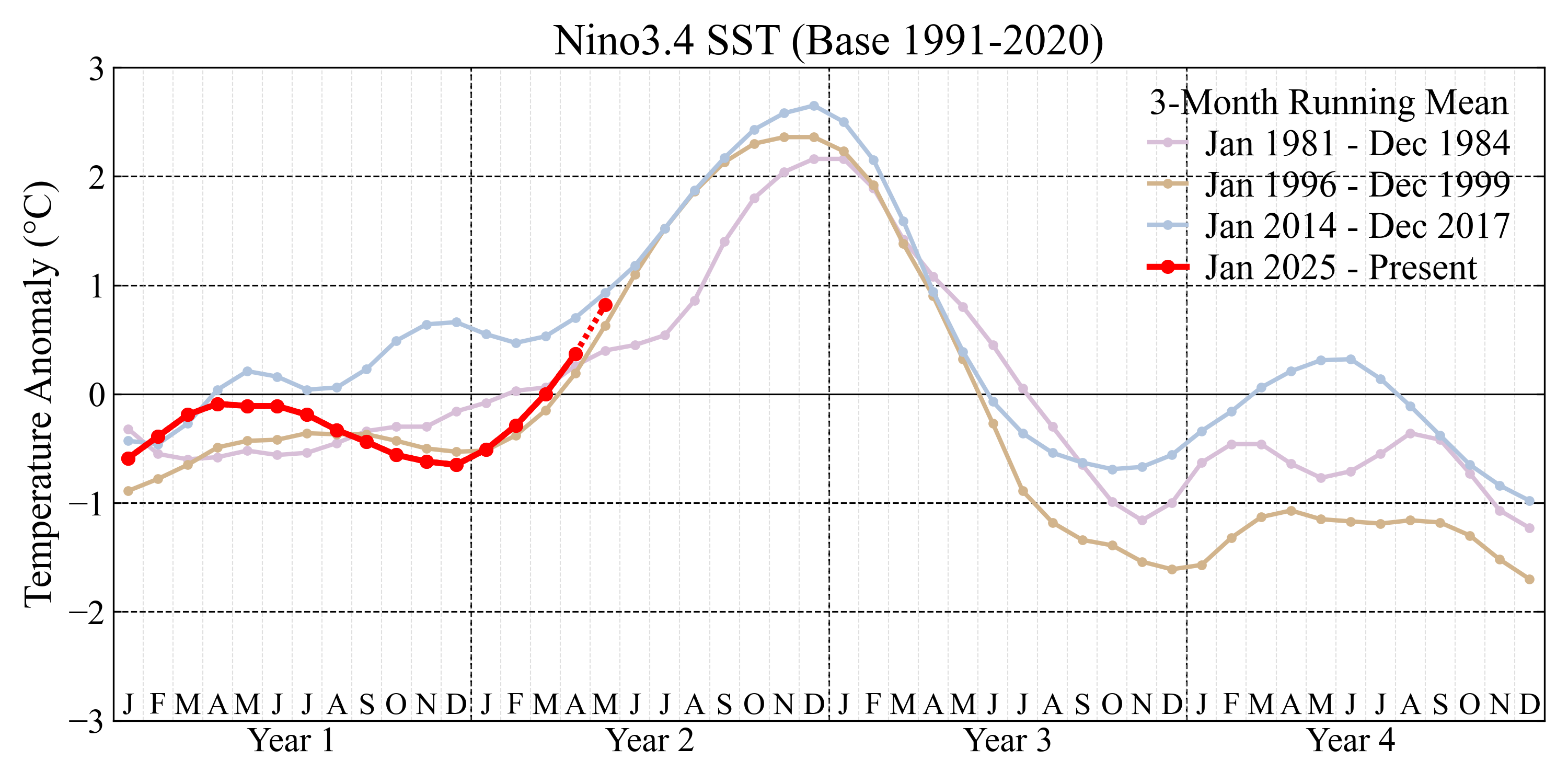
Nino3.4 SST, selected super El Nino periods (base 1991–2020).
Three-month running mean SST anomalies shown for 1981–1984, 1996–1999, 2014–2017,
and 2025–present.
Figure available as
PDF
.
For the 2025–present curve, three-month running means are shown through August 2026;
the final point is the September 2026 monthly average.
Data source:
ref. [7].
Nino3.4 SST, selected weaker El Nino periods (base 1991–2020).
Three-month running mean SST anomalies shown for 2008–2011, 2017–2020, 2022–2025,
and 2025–present.
Figure available as
PDF
.
For the 2025–present curve, three-month running means are shown through August 2026;
the final point is the September 2026 monthly average.
Data source:
ref. [7].
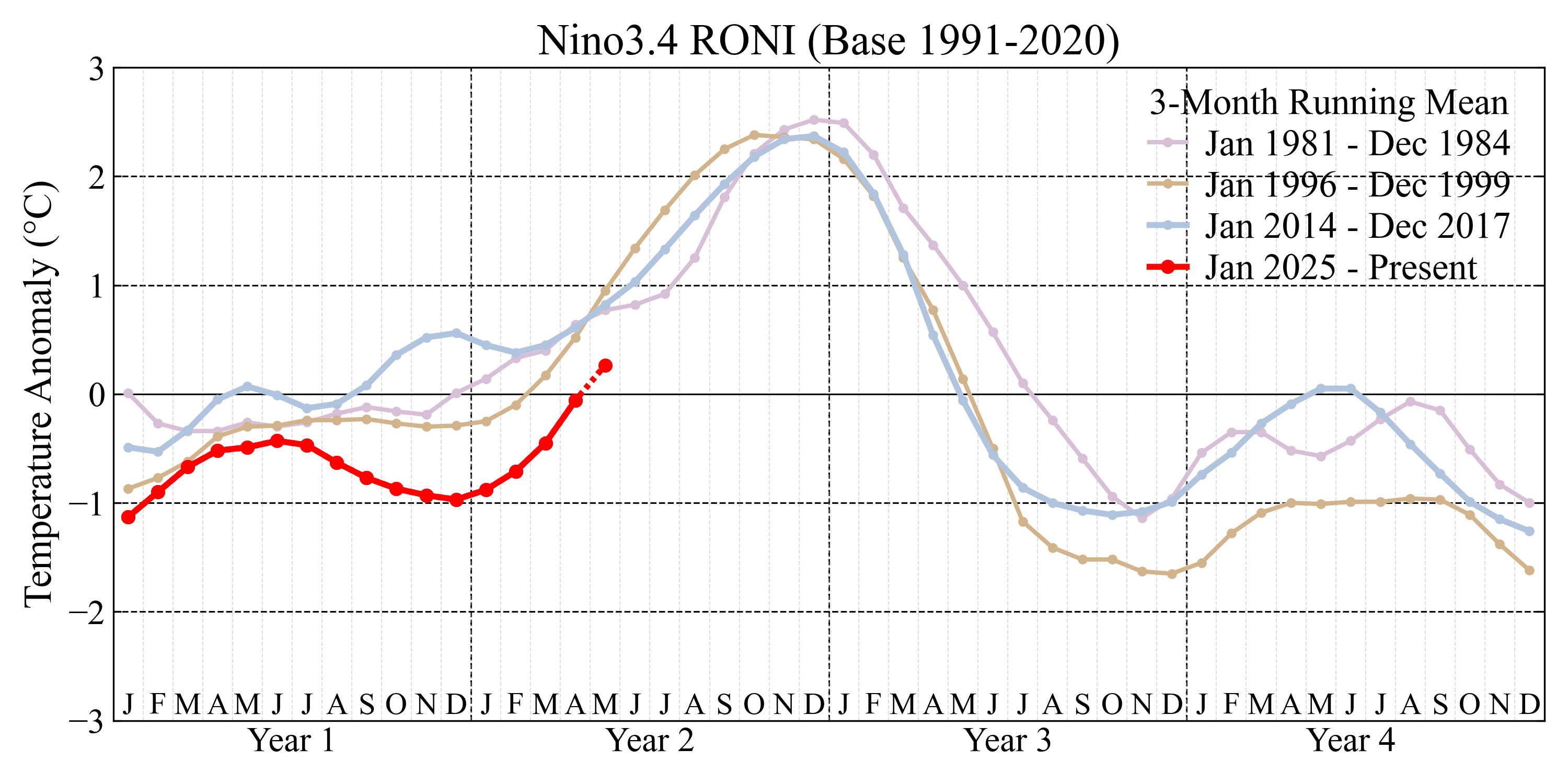
Nino3.4 RONI, selected super El Nino periods (base 1991–2020).
Three-month running mean anomalies shown for 1981–1984, 1996–1999, 2014–2017,
and 2025–present.
Figure available as
PDF
.
The final point of the 2025–present curve extends the latest three-month average
to September 2026 using the average month-to-month change over the preceding three months.
Data source:
ref. [3].
Nino3.4 RONI, selected weaker El Nino periods (base 1991–2020).
Three-month running mean anomalies shown for 2008–2011, 2017–2020, 2022–2025,
and 2025–present.
Figure available as
PDF
.
The final point of the 2025–present curve extends the latest three-month average
to September 2026 using the average month-to-month change over the preceding three months.
Data source:
ref. [3].
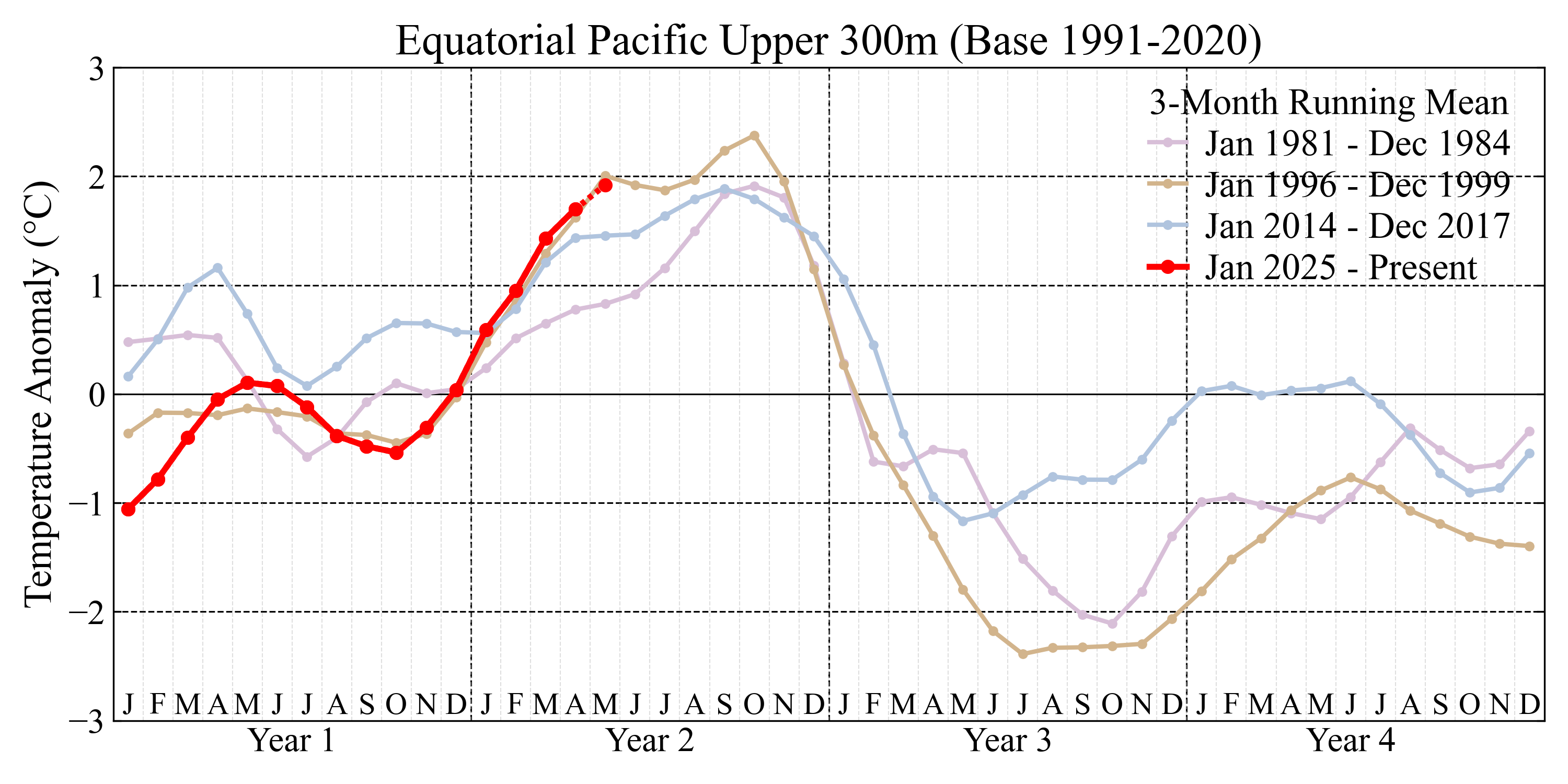
Equatorial Pacific upper 300 m temperature, selected super El Nino periods (base 1991–2020).
Three-month running mean temperature anomalies for the 180°W–100°W region,
shown for 1981–1984, 1996–1999, 2014–2017, and 2025–present.
Figure available as
PDF
.
For the 2025–present curve, three-month running means are shown through August 2026;
the final point is the September 2026 monthly average.
Data source:
ref. [2].
Equatorial Pacific upper 300 m temperature, selected weaker El Nino periods (base 1991–2020).
Three-month running mean temperature anomalies for the 180°W–100°W region,
shown for 2008–2011, 2017–2020, 2022–2025, and 2025–present.
Figure available as
PDF
.
For the 2025–present curve, three-month running means are shown through August 2026;
the final point is the September 2026 monthly average.
Data source:
ref. [2].
Equatorial Pacific Upper 300 m Diagnostics
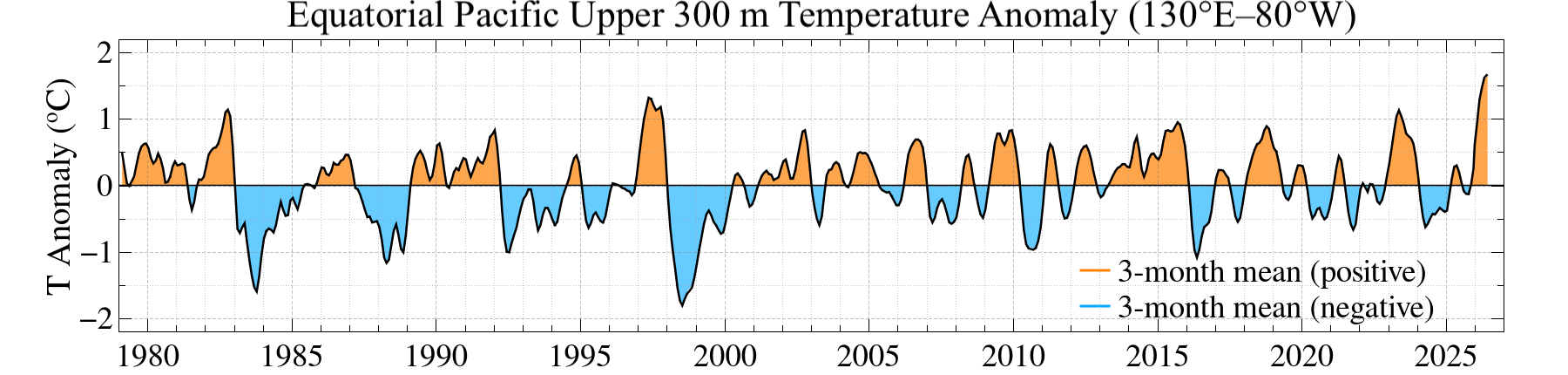
Equatorial Pacific upper 300 m temperature (130°E–80°W/280°E, 0.33°N–0.33°S, Jan 1979 – Sep 2026).
3-month running mean temperature anomalies relative to the 1991–2020 base period.
Figure available as
PDF
.
Data through Sep 2026. Data source:
ref. [6].
Figure available as
PDF
.
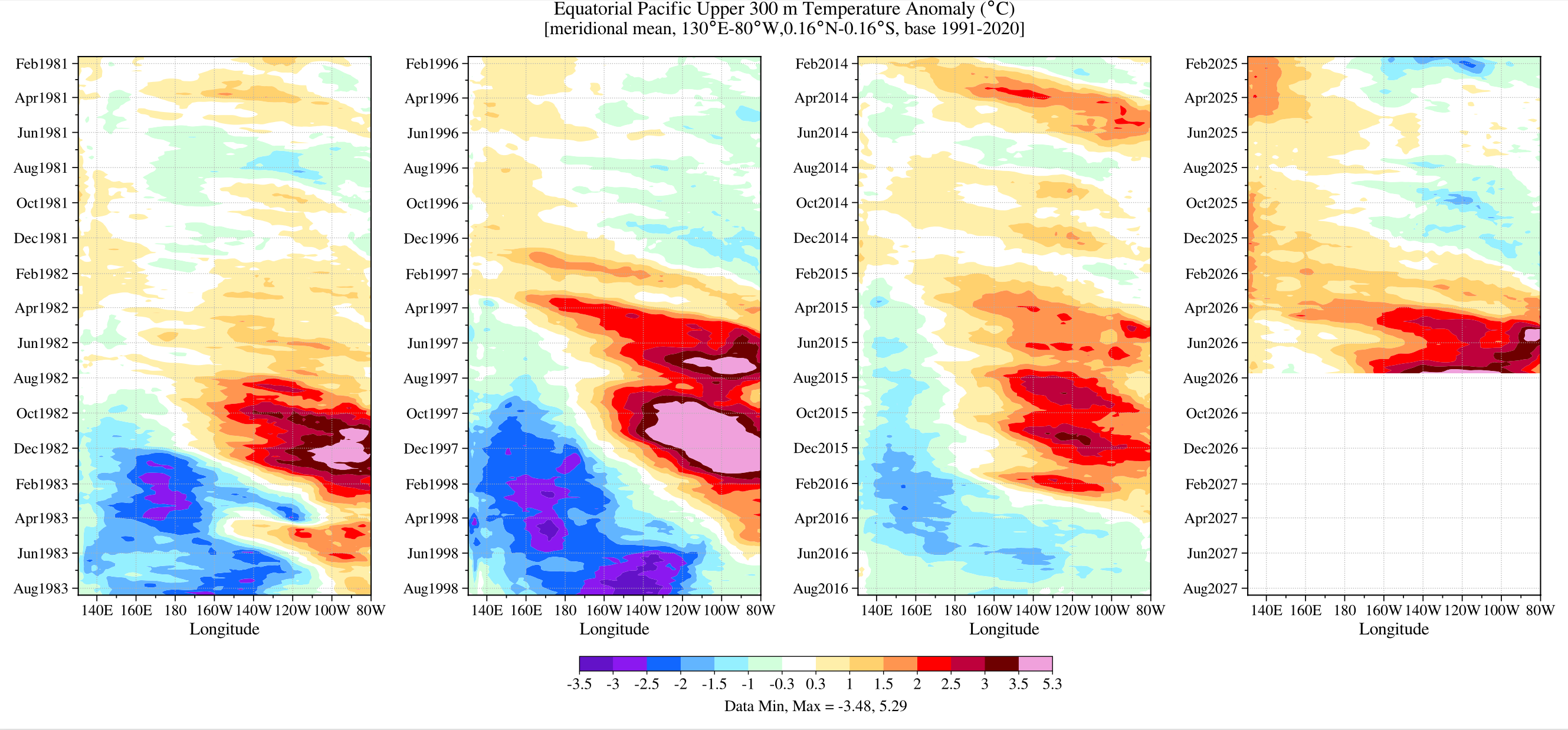
Equatorial Pacific upper 300 m temperature during four super El Nino events.
Time–longitude plots show meridional means over 0.33°N-0.33°S of 5-day equatorial Pacific upper 300 m ocean temperature anomalies relative to the 1991–2020 base period, highlighting Kelvin/thermal waves during three prior super El Nino events and the current 2026–27 event.
Data through 2 Sep 2026. Data source:
ref. [6].
Pacific Decadal Oscillation (PDO)
Note: Running-mean curves necessarily end earlier than the final monthly datum.
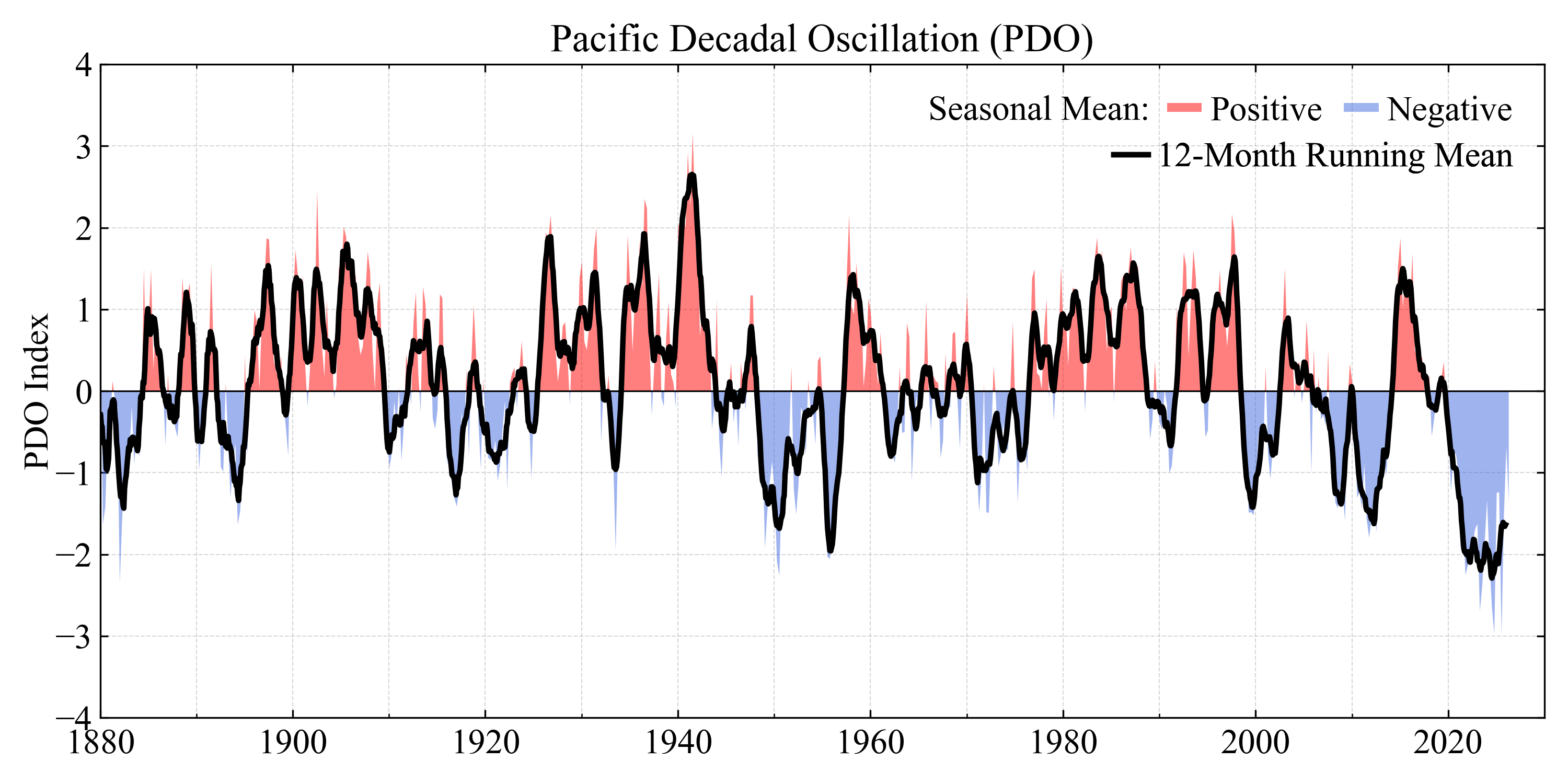
PDO index (Jan 1880 – Sep 2026).
Monthly PDO index with seasonal means and 12-month running mean.
Figure available as
PDF
.
Data through Sep 2026. Data source:
ref. [5].
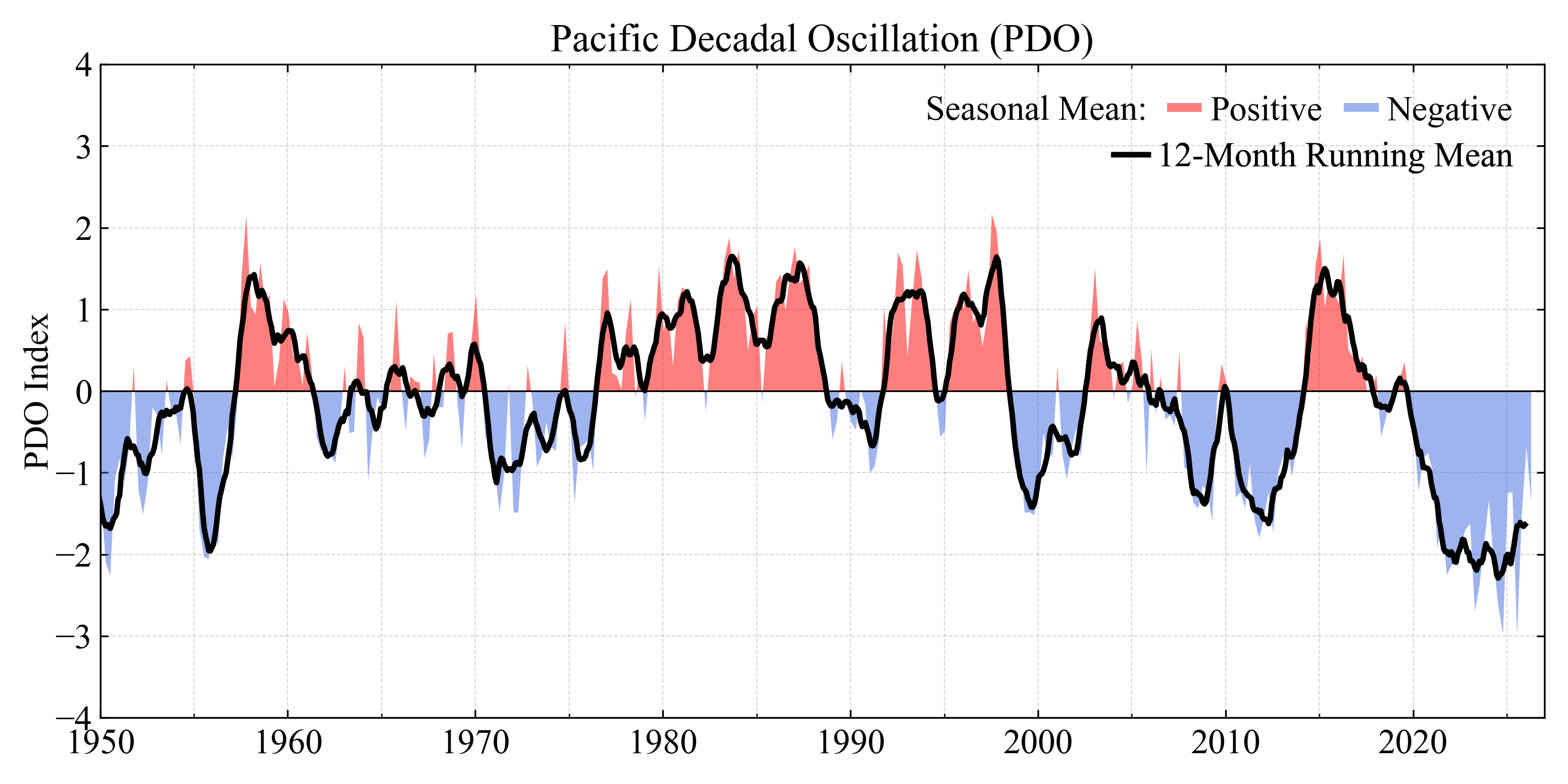
PDO index (Jan 1950 – Sep 2026).
Monthly PDO index with seasonal means and 12-month running mean.
Figure available as
PDF
.
Data through Sep 2026. Data source:
ref. [5].
-
NOAA Climate Prediction Center (CPC) indices
.
(a) Data table (Nino 3.4; Unadjusted weekly OISSTv2.1; 1991–2020 base):
wksst9120.for
.
(b) Data table (Nino 3.4; Monthly ERSSTv5; 1991–2020 base):
ersst5.nino.mth.91-20.ascii
.
-
NOAA PSL Central Pacific heat content (upper 300 m temperature anomaly)
.
Data table (CPC equatorial upper-300 m temperature anomaly index; 180°W–100°W):
heat_content_index.txt
.
-
NOAA CPC Relative Oceanic Nino Index (RONI)
.
Data table:
RONI.ascii.txt
.
-
NASA GISS Surface Temperature Analysis (GISTEMP v4)
.
-
NOAA NCEI Pacific Decadal Oscillation (PDO) Index
.
PDO plots use NOAA ERSSTv6 sea surface temperature data.
ERSSTv6 description:
NOAA PSL ERSSTv6
.
-
NOAA Climate Prediction Center Global Ocean Data Assimilation System (GODAS) pentadal data
.
Equatorial Pacific upper-ocean temperature fields are provided at 5-day resolution.
-
NOAA NCEI Extended Reconstructed Sea Surface Temperature, Version 6 (ERSSTv6)
.
Monthly sea surface temperature data from January 1850 to present,
with anomalies relative to the 1991–2020 base period.
Back to Data page