This mixture is blown over a small pool of water for a long time, after which it is assumed that the carbon dioxide dissolved in the water is in equilibrium with the carbon dioxide in the gas passing over it. Siggaard-Andersen reports that the equilibrium concentration of carbon dioxide in g-mol/l can be calculated from the equation:
[CO2] = (a /1000) PCO2
where a is the Bunsen coefficient, equal to 0.04392 for water at 25C, and PCO2 is the partial pressure of carbon dioxide in torr (1 torr = 1 mm Hg). Calculate the mass density of carbon dioxide in the equilibrated water volume. Considering the liquid to be a binary mixture of water and carbon dioxide, calculate the mole fraction of carbon dioxide. Please note that it would be unreasonable to assume that the density of water was significantly different from 1 g/cc or to assume that the dissolution of this much carbon dioxide would change its density. In this problem ignore any chemical reactions that might occur between water and carbon dioxide; later you will consider these reactions.
Something is not specified! If we write the equation for the diffusion of solute (say "A"), we find that the equation cannot be solved because the other variable, NB, appears in the equation. One way to deal with this uncertainty is to "declare" that the two N's are equal in magnitude and opposite in direction. This declaration is called "equimolar countercurrent diffusion". Solve the differential equation for NA according to this declaration in terms of c1, c2, T, and D. To obtain numerical values, use the quantities given above and take c1 to be 0.01 molar and c2 to be 0.005 molar. Calculate the mean velocity of the solute molecules in the middle of the sheet (z = T/2), in cm/sec.
Obtain the mass-average and molar-average velocities for this situation, under the assumptions given.
(See preceding problem.) Another assumption that can be made for the diffusion of B is that it is not moving at all, NB =0. We then say that the sheet or film through which A is diffusing is "stagnant". Under these circumstances, and taking c to be constant, you should be able to derive the differential equation
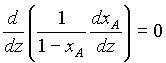
Show from this equation that when xA is small (in comparison to its maximum possible value, unity) the stagnant diffusion and equimolar counterdiffusion declarations produce equivalent results. This will not be true when xA is not small. Derive the following result:

The right-most equality defines the "permeability" of a thin sheet. It clearly depends on the sheet thickness, DAB, and a "log-mean" mole fraction. This quantity will be discussed further in class but is a value somewhere between the values xB1 and xB2. For dilute solutions it is nearly unity, which, again, makes these results comparable to those for equimolar counterdiffusion. The permeability may be defined similarly for equimolar counterdiffusion, i.e. as DAB/T.
v(r) =K(1 - [r/R]2)
Later on in this course you will find out how to relate K to such things a pressure drop and viscosity. The velocity, v, depends only on r, not on angular position, and not on how far down the tube the fluid has flowed. Before proceeding further, you should satisfy yourself that v is maximum (and equal to K) at the center of the tube and that the velocity decreases steadily to zero at the wall of the tube.
a. Calculate the flow rate, i.e. the total volume of fluid passing any cross-section of the tube per unit time.
b. If the fluid is blood, it can be considered to be a binary mixture: plasma and red blood cells (which make up 99.7% of the total cellular volume in blood). The concentration of red blood cells in blood is frequently reported as the hematocrit: the volume concentration (or volume fraction, the same thing) of red blood cells. For a healthy male the hematocrit is about 0.45 ml/ml, sometimes referred to as a 45% hematocrit. When blood flows in tubes, the red cells tend to concentrate toward the center of the tube. Since what is not cells is plasma, this means that plasma tends to concentrate near the wall. Consider a case where the hematocrit is assumed to vary with radius:
H= 0.6(1-r/R)
Calculate the hematocrit of the blood leaving such a tube.
Is the hematocrit equal to the radius-average (integral of Hdr divided by integral of dr) or the area-average (integral of H 2 pi r dr divided by integral of 2 pi r dr)? The answer is that it does not equal either. Understand this and come up with a good verbal explanation.
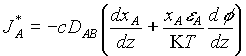
where e is the charge valency, and K is Boltzmann's constant and T is absolute temperature, not to be confused with T representing thickness above. This equation is the Nernst-Planck equation. Apply it to the following physical situation. (We will consider its application in biological situations later.)
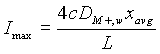
A stagnant water solution of salt MX lies between two flat parallel plates of metal M. A constant direct current is passed between the plates, resulting in the dissolution of one plate (the anode) and the deposit of M on the other plate (the cathode). Determine how concentration varies with distance between the plates and derive an expression for the maximum possible solute flux (which can be related to the current density by Faraday's constant). Assume both ions to be dilute and thus hardy ever to "see" each other. Note that xM+ must be equal to xX- everywhere. You should get the result that