Problem Set
|
Lecture Notes
|
| (PS1) |
1. Concept of control volume. Concepts of
concentration and conservation. Convection, diffusion, reaction. Fundamental conservation
equation. |
| (PS2) |
2. Free and forced diffusion. Chemical activity.
Thermal conduction. Diffusion of momentum. Equations for each. Reaction kinetics.
Equilibrium. Catalysis. Kinetic equations. |
| (PS3) |
3.
Compartmental analysis. Integration of fundamental conservation equation in uniform
concentration fields. Intracellular compartments. Inter and extracellular space. Organs as
compartments. |
| (PS4) |
4.
Intracompartmental kinetics, I. First order reactions, reversible, irreversible. Other
orders. Enzyme-catalyzed and reversible reactions. 4a.
Special notes on "automatic" derivation of equations describing
multiple-substrate, reversible, and inhibited enzyme reactions. |
|
5.
Intracompartmental kinetics, II. Systems of reactions. Sources and sinks. Infinite sources
and sinks. Steady and transient states. Metabolite inventory. Rate-limiting steps. |
20
|
6.
Transport among compartments. Membranes. Mechanisms of transport across membranes:
diffusion (mobility and solubility). Transporters. |
22 |
7. Combinations of
transport and reaction. Additive resistances. Controlling resistance and rate-limiting
step. Covered under lecture topic 5. |
25 |
8. Receptor-mediated
reactions. Signal transduction. Role of transport and rate processes. |
27
|
9. Macroscopic
applications: Convective-reactive balance in organs. Clearance. Homeostasis. |
29 |
10, Pharmacokinetics. |
October 1 |
11. Compartmental
analysis of artificial kidney operation. |
4 |
Reprise and review. |
6 |
Hour Test I (See note, below) |
8 |
12. Spatial gradients:
steady, one-dimensional diffusion in a non-reactive medium. Counter-diffusion.
Low-concentration limit. Oxygen diffusion across a lipid barrier. Diffusion to a reacting
surface. |
11 |
13. Extension to
cylindrical and spherical coordinates. Sources and sinks. Controlled release of drugs. |
13 |
14. Diffusion in a
reactive medium. Spacing of capillaries in metabolizing tissue. Tissue cylinder concept of
Krogh. |
15 |
15. Unsteady (transient)
diffusion in a non-reactive medium. Use of heat transfer analogy and charts. Application
to pharmacokinetics. |
18 |
16. Convection:
Comparison of convective and diffusive transport. Concept of blood as organ. Essential
role of blood. Morphological, chemical, physical characterization of blood. |
20 |
17. Hydrostatics. Balance
of internal and potential energy. Importance of pressure differences. Manometry. |
22 |
18. Stress and momentum
flux. Newton's law of viscosity. Non-Newtonian fluids. Viscoelasticity. Typical viscosity
values. |
25 |
19. "Real"
blood flow: distension, tapering, pulsatility in the arterial tree. Nature of flow in
precapillary and capillary vessels. Venous flow. Branching vs. fully developed flow.
Separated and secondary flows. |
27 |
20, Development of
Hagen-Poiseuille equation. Extension to arbitrary cross-sections. |
29 |
21. Analysis of
Hagen-Poiseuille equation: Entrance region, balance of axial pressure gradient and
momentum flux to wall, irrelevance of axial momentum. Mean velocity, shear rate. Stress
distribution. Reynolds' number. |
November 3 |
22. Development of
Stokes' law: concept of creeping flow. Viscometry: capillary, couette, cone-plate, and
falling-ball viscometers. |
5 |
23. Application of
Stokes' law to cells. Microrheology: Movement of cells in a shear field. |
8 |
24. Pulsatile flow in a
rigid tube. Wormersly's parameter. |
10 |
Reprise |
12 |
Hour Test II (See note, below) |
15 |
25. Convective diffusion:
the Leveque equation. |
17 |
26. Analysis of Leveque
result. Platelet deposition on a biomaterial surface. |
19 |
27. Graetz-Nusselt
equation. |
22 |
28. Dimensionless groups:
Sherwood, Nusselt, Prandtl, Schmidt, Peclet numbers. Theoretical results expressed as
"film coefficients". |
24 |
29. Device design:
log-mean driving force. Countercurrent, concurrent, and crosswise flows. Flow ratios. |
29 |
30. Convective diffusion:
the Lightfoot "zero order" approximation. |
December 1 |
31. Analysis of Lightfoot
result; application to oxygenation of hemoglobin. |
3 |
32. Coaxial convection
and diffusion: concentration polarization. Plasmapheresis. |
6 |
Catch-up or extra topics. |
8 |
Catch-up or extra topics. |
10 |
Catch-up or extra topics. |
13 |
Last class: Review and
reprise of course. |
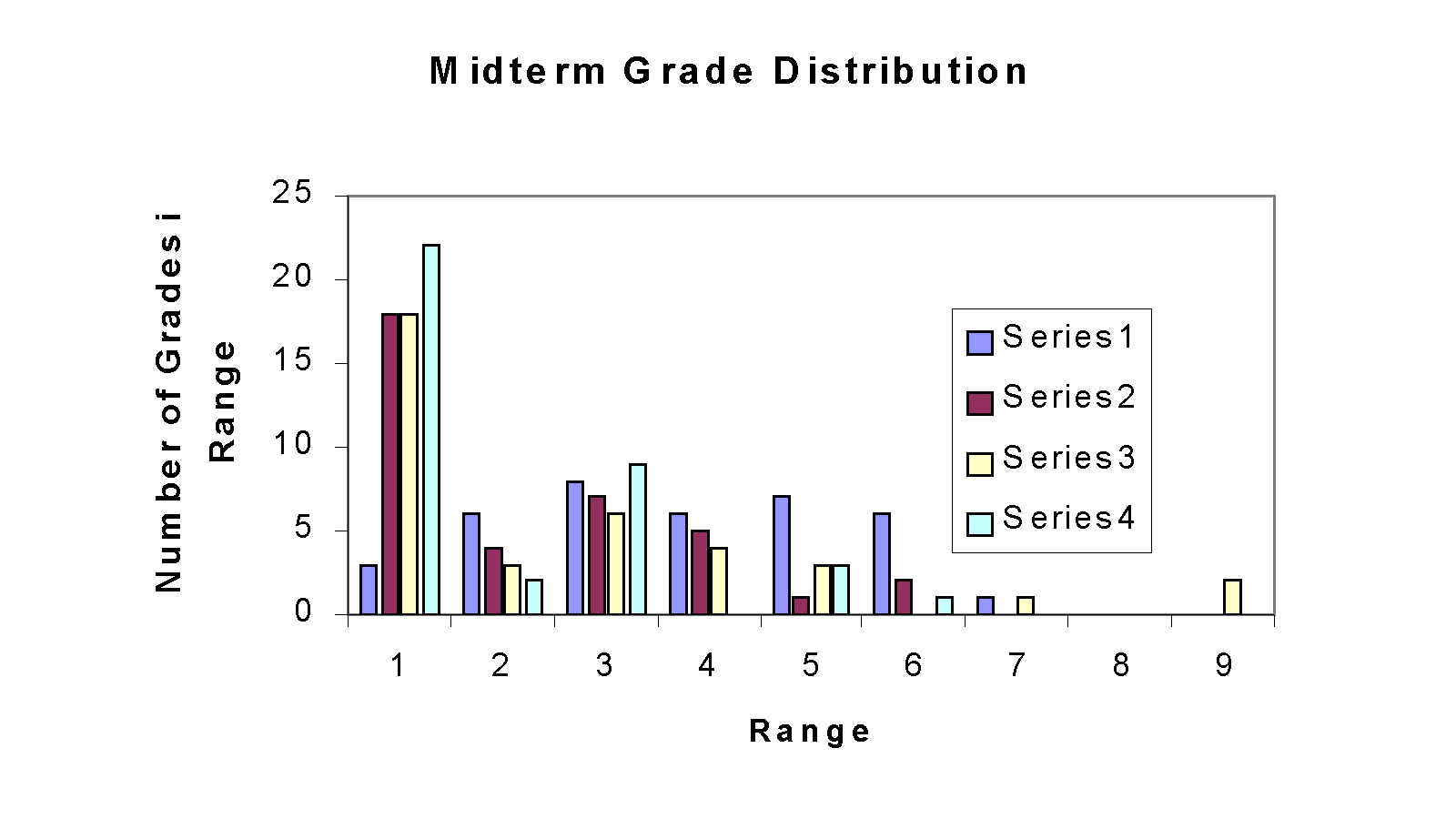
 Midterm Examination solution is posted as
a .pdf document. Click here. (What is
posted is the exam statement with the solutions inserted in red. Practice exam is
still available: Click here. Table below shows
distribution of normalized grades on the midterm examination (mean 27.8, standard
deviation 12.73) To normalize your grade, subtract the mean, divide the result by
the standard deviation, and add 2.5. The "worry line" is about 1.5.
Scores lower than that are seriously behind the class' performance.
Midterm Examination solution is posted as
a .pdf document. Click here. (What is
posted is the exam statement with the solutions inserted in red. Practice exam is
still available: Click here. Table below shows
distribution of normalized grades on the midterm examination (mean 27.8, standard
deviation 12.73) To normalize your grade, subtract the mean, divide the result by
the standard deviation, and add 2.5. The "worry line" is about 1.5.
Scores lower than that are seriously behind the class' performance.