BMEN E 3500, fall 1999
Problem Set 3. Note added 9/26/99. You are responsible for these problems. Problem 2 will be discussed in the week of 9/27/99
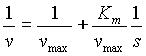
This expression suggests that one can obtain the parameters Km and vmax from a plot of 1/v versus 1/s. The following data for s (mol/L) and v mol/(L-min) x 106 are to be plotted and fitted by this method:
| s | v |
| 4.1 10-3 | 177 |
| 9.5 10-4 | 173 |
| 5.2 10-4 | 125 |
| 1.03 10-4 | 106 |
| 4.9 10-5 | 80 |
| 1.06 10-5 | 67 |
| 5.1 10-6 | 43 |
The type of plot that you are asked to make is called a Lineweaver-Burke plot.
Derive the formula given without proof in the lecture notes for the rate of a reversible enzyme reaction. This formula is not so important for enzyme reactions but is for the transporter model of transmembrane transport, to be discussed.
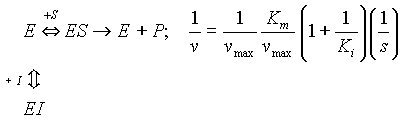
Stryer (Stryer, L., "Biochemistry", Freeman, San Francisco [1975], p. 132 - 133) discusses two forms of enzyme inhibition. Each is illustrated below.
Competitive inhibition:

Noncompetitive inhibition:
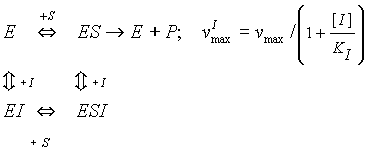
Derive these equations and show that they produce two different Lineweaver-Burke plots.
The following data are obtained with two different inhibitors acting on the same enzyme. Identify the type of inhibition for each. The v's are given in micromole/min.
| s, M | v, no inhibitor | v, inhibitor A | v, inhibitor B |
| 0.3 10-5 | 10.4 | 4.1 | 2.1 |
| 0.5 10-5 | 14.5 | 6.4 | 2.9 |
| 1.0 10-5 | 22.5 | 11.3 | 4.5 |
| 3.0 10-5 | 33.8 | 22.6 | 6.8 |
| 9.0 10-5 | 40.5 | 33.8 | 8.1 |
Return to course main page.