BMEN E 3500, fall 1999
Problem Set 4. Note added 9/26/99. You are responsible for this page and problem. The free-energy calculation will be discussed in class during the week of 9/27/99.
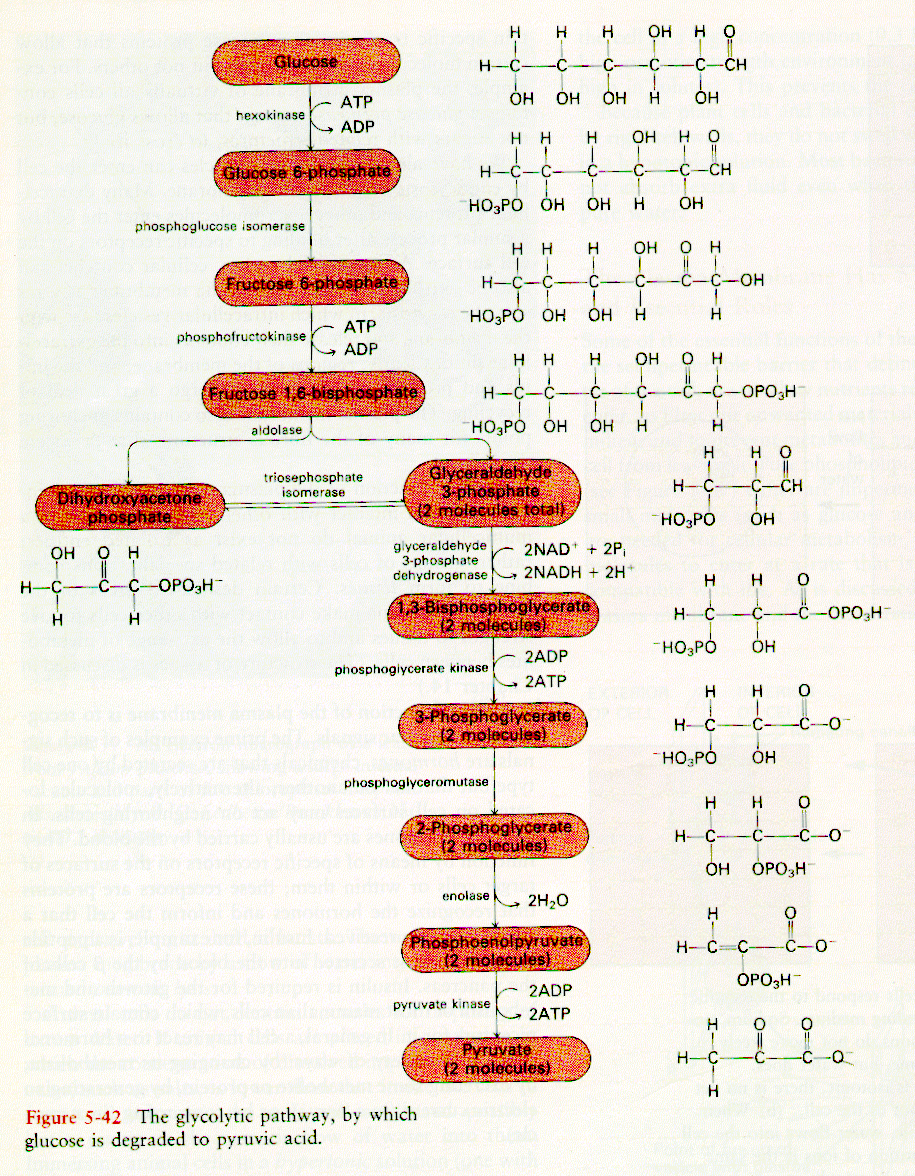
In this problem set applications of series reaction analysis are made to glycolysis. At the end of the set is a "map" of the glycolytic reactions, taken from Darnell et al., Molecular Cell Biology, (1st ed., Scientific American Books, New York, 1986, p. 170). Bailey and Ollis ("Biochemical Engineering Fundamentals, 2nd ed., McGraw-Hill, NY, 1986) give the following table, useful in rationalizing and quantifying glycolysis, adapted from the out-of-print Biochemistry text of Lehninger:
| Intermediate | Concentration, m M | Standard free energy change, DG0' (kcal/mol) |
| Glucose | 5,000 | -4.0 |
| Glucose 6-phosphate (G6P) | 83 | +0.4 |
| Fructose 6-phosphate (F6P) | 14 | -3.40 |
| Fructose 1,6-diphosphate (FDP) | 31 | +5.73 |
| Dihydroxyacetone phosphate (DHP) | 138 | +1.83 |
| Glyceraldehyde 3-phosphate (GAP) | 18.5 | -3.0 |
| 3-Phosphoglycerate (3PG) | 118 | +1.06 |
| 2-Phosphoglycerate (2PG) | 29.5 | +0.44 |
| Phosphoenolpyruvate (PEP) | 23 | -7.5 |
| Pyruvate (Pyr) | 51 | |
| Lactate (Lact) | 2900 | |
| ATP | 1850 | |
| ADP | 138 | |
| Phosphate | 1000 |
In addition it is known that the hydrolysis of ATP to ADP and Pi has a standard free energy change of -7.3 kcal/mol.
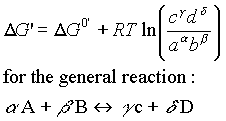
Determine if these reactions are at equilibrium, i.e. if the stated concentrations are compatible with the equilibrium constants using the relationship:
remembering, of course, that D G' equals zero at equilibrium, and that water and hydrogen ion concentrations, the latter corresponding to pH 7, do not need to be included in the expressions because their values have been presumed and incorporated into the equilibrium constant. (Good, quick question: what values have been presumed for these substances?)
Quoting Alberts, et al. (Molecular Biology of the Cell, 3rd ed., Garland, New York, 1994, p. 85):
"Step 3 of glycolysis is one of the reactions that must be bypassed during glucose formation. Normally, this step involves the addition of a second phosphate group to fructose 6-phosphate from ATP and is catalyzed by the enzyme phosphofructokinase. This enzyme is activated by AMP, ADP, and inorganic phosphate, whereas it is inhibited by ATP, citrate, and fatty acids. Therefore the enzyme is activated by the accumulation of the products of ATP hydrolysis which accumulate when energy supplies are low, and it is inactivated when energy (in the form of ATP) or food supplies such as fatty acids or citrate (derived from amino acids) are abundant. Fructose biphosphatase is the enzyme that catalyzes the reverse bypass reaction (the hydrolysis of fructose 1,6 biphosphate to fructose 6-phosphate, leading to the formation of glucose); this enzyme is regulated in the opposite way by the same feedback control molecules so that it is stimulated when the phosphofructokinase is inhibited."
In a later part of this course, attention will be called to the fact that enzymes can also be switched on and off by covalent modification, usually by adding a phosphate to a serine, threonine, or tyrosine residue, usually under the influence of another enzyme known as a protein kinase that may be activated by binding of a signaling molecule to the cell surface.
If a cell is to catabolize glucose at the rate of 5 10-12 micromoles/sec, and it can be assumed that: the regulating enzyme is phosphofructokinase; all other enzymes operate with sufficient speed to maintain equilibrium, and the need for the products of glycolysis means that they function as a sink for pyruvate, maintaining normal metabolic concentrations of metabolites antecedent to pyruvate,(see table above), what should the value of k for the forward component of this reaction be, in sec-1?
The value of KM for this enzyme with F6P as substrate is about 3 10-4M. Is this enzyme expected to be sensitive to F6P concentration under the conditions described here? What is the apparent order of reaction expected to be -- to be reported as a number between zero and unity?
What must be the order of magnitude of the permeability of the cytoplasmic membrane of a cell of 10 m m diameter consuming the stipulated amount of glucose and maintaing the concentrations given above, if permeation is not significantly to affect the rate of glucose uptake? Assume that the glucose concentration of the surrounding medium is 6500 m M and that there is no active transport of glucose.
Here is the scheme for glycolysis cited above:
Return to course main page.