 |
 |
|

|
|
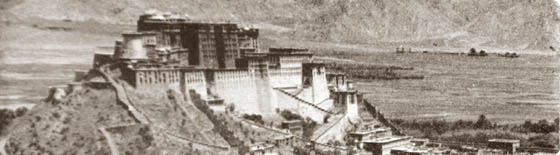
"Far reaching changes,
little short of cataclysmic, threaten the land of Tibet and
Lhasa its capital. Lhasa, the Forbidden, the Mysterious, is
in danger at no distant date of losing its unique place on this
planet."
Tibet in the late 1930s was a country struggling to maintain
its independence in the face of increasing pressure
from the surrounding empires of Great Britain, Russia, and
China. The object of much political intrigue, the
Tibetan government attempted to maintain a strict policy of
border control. Few Westerners, and fewer still
Americans, were able to breach the borders of Tibet. Theos
Bernard, with his knowledge of literary and spoken
Tibetan, coupled with papers of introduction from his Tibetan
teachers — and the friendship of the Tibetan
cabinet minister, Tsarong Shapé — was one of
the few ever to reach Lhasa.
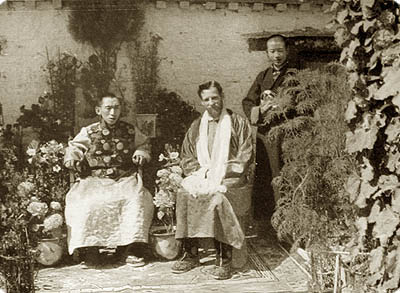
Although his journey from home lasted 16 months, only four
were spent in Tibet. During his stay in Lhasa,
Bernard was privy to unprecedented levels of access to Tibetan
ceremonies and resources. Documenting his
experiences in pictures, Bernard left a historical record
of an age-old civilization on the brink of political upheaval.
|
|
|
|
"No film could possibly convey
its majesty."
|
|
|
In traveling to Tibet’s "Forbidden City,"
Bernard followed the route established by his British predecessors
from
Sikkim, up through the Chumbi Valley, to Gyantse, from where
he petitioned for entry to Lhasa. When approval for
his visit finally came, Bernard set out with his party. Upon
entering the Lhasa valley, the first site he came upon
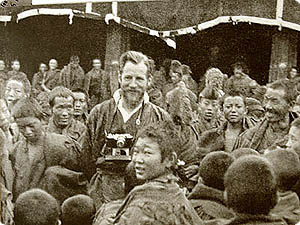
was Drepung Monastic University. "It was but a short
distance before we came around the bend which sheltered
the great monastery of Drepung, the largest in the world,
holding in the neighborhood of 10,000 monks. It was a
startling sight: white masonry studded over with the black
spots, which indicates the endless series of chambers,
gloomy cells of meditation. ... I had seen endless pictures
of this sanctuary, yet it was wholly unlike such
preliminary impressions. The truth is, no film could possibly
convey its majesty. There is a sense of
immaculateness about it which eludes the camera, so faithful
in capturing external forms."
|
|
|
|
Bernard at Drepung
Monastic University, c.1937
|
|
|
|
|
|
|
|
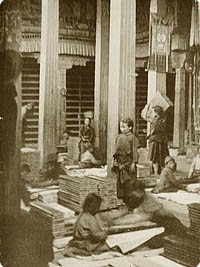
Zhol Publishing
House, Lhasa
|
|
|
A priority for Bernard in his journey to Tibet was the acquisition
of a complete set of the Tibetan Buddhist canon in
338 volumes. This he managed to acquire along with many more
volumes of the collected works of numerous
Tibetan authors provided him by the Regent, Reting Rinpoche.
These books were to serve as the focus of
Bernard’s efforts over the subsequent ten years as he
attempted to establish a research center for their
translation into the English language.
“Tsarong had finally decided to give me his Kangyur
and Tengyur, because he feared I would take the chance
of leaving Tibet by way of China. His attitude was that my
life was precious and that I should not take any chances.”
“Anyone coming to my room would have thought that I
had opened up a tailor shop to see yards upon yards of silks
strewn around the room, and the tailor and his assistant marking
it off. The custom for taking care of the precious sacred
volumes is to wrap them in large pieces of silk, after which
each book must be marked and indexed from the outside, so
that one might find the desired volume without having to unwrap
each one.”
|
|
|
"I found the Tibetans
the most gracious people on earth, and never before had I such
friendship extended me by foriegners."
Of the many volumes of books brought
back from Tibet by Theos Bernard, Yale University acquired
more than 200 volumes of his Tibetan texts including his copy
of the 63 volume “Treasury of Revealed Teachings”
for its library in 1963, while Harvard acquired his copies
of the Kangyur and Tengyur.
The remainder of materials brought back from Tibet serves
as the core of the “Theos Bernard Tibetan Collection”
at the University of California, Berkeley.
|
|
|
|
|
|
|
|